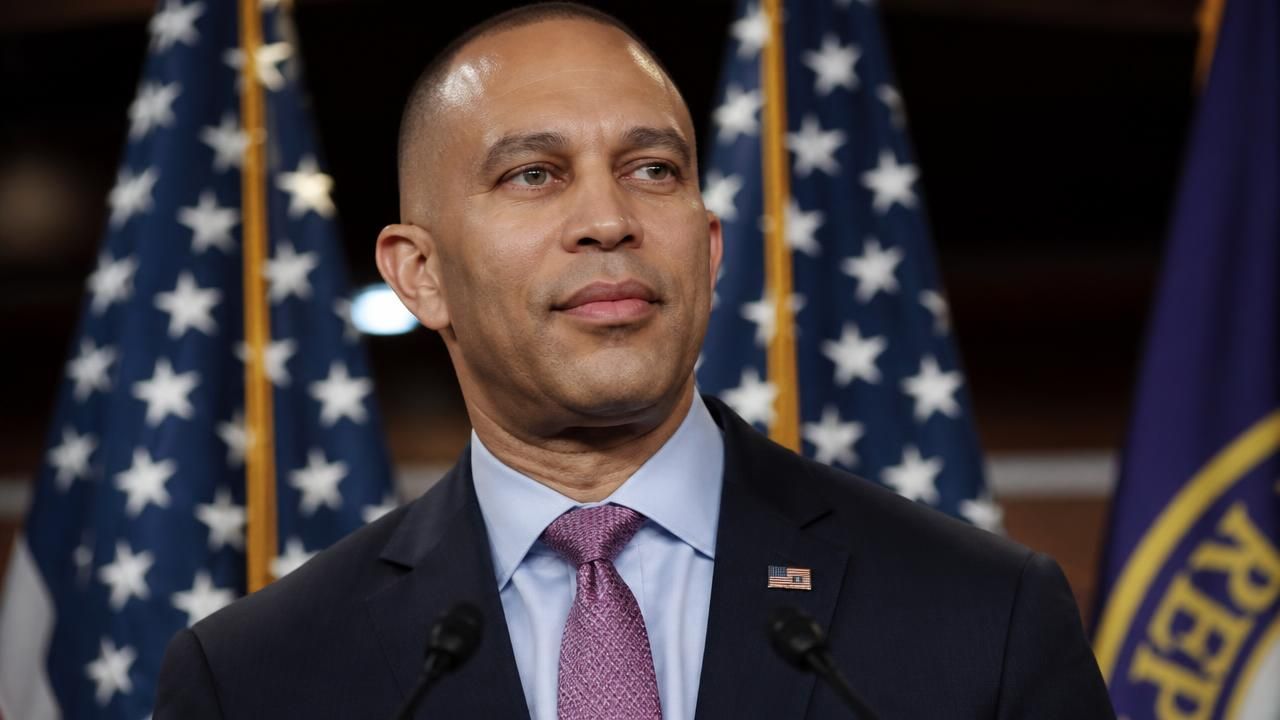
Hakeem Jeffries, the Brooklyn Democrat who has led his party's House caucus since 2023, is now in line to make history as the first Black speaker of the U.S. House of Representatives after Democrats secured a majority in the chamber. The development, reported across a wide range of outlets — from The New York Times to MSN and The Source — marks both a generational milestone for Congress and the opening of an unusually complicated chapter in Democratic politics.
The headline was near-identical across the outlets aggregating the story: Jeffries is "poised to become first Black House speaker." But the framing beneath those headlines diverged sharply, revealing the competing narratives already forming around his ascent.
A Reserved Moderate at the Center of the Storm
The New York Times cast Jeffries in the most nuanced light, describing him as "a reserved moderate seen by activists on the left as too timid to take on President Trump." That characterization captures the central tension of his career: a leader whose institutional instincts and disciplined messaging have made him a formidable inside player, but whose measured style has frustrated progressives who want a more confrontational posture toward the White House.
Jeffries, for his part, has rejected the notion that caution equals weakness. According to the Times, he insists he is "strongly positioned" to get things done — a phrase that doubles as both a promise to his caucus and a signal to the left that results, not volume, will be his measure.
"A reserved moderate seen by activists on the left as too timid to take on President Trump. He says he's 'strongly positioned' to get things done." — The New York Times
Who Is Hakeem Jeffries?
For readers encountering the story through aggregation — MSN's coverage and a Yahoo News explainer framed around the question "Who is Hakeem Jeffries?" — the biographical basics matter. Jeffries, born in Brooklyn in 1970, is a lawyer who spent years in private practice before winning a seat in the New York State Assembly in 2006. He was elected to Congress in 2012, representing a district spanning parts of Brooklyn and Queens.
His rise was steady and deliberate. He chaired the House Democratic Caucus from 2019 to 2023, served as a manager in both of Trump's Senate impeachment trials, and in 2023 succeeded Nancy Pelosi as the top House Democrat — becoming the first Black lawmaker to lead either party in Congress.
That lineage is significant. Jeffries inherits a caucus shaped by Pelosi's two decades of transactional, vote-counting leadership, and he will be judged on whether he can replicate her legislative discipline in an era of narrower margins and sharper internal divisions.
The Historic Weight
The Source and other outlets emphasized the symbolic dimension: a Black speaker would represent a landmark in a chamber that, for most of its history, excluded Black members entirely. The first Black lawmakers to serve in Congress during Reconstruction were followed by decades of disenfranchisement before the modern civil rights era reopened the door.
Jeffries would not be the first Black lawmaker to hold high congressional office — the House has had Black committee chairs, caucus leaders, and impeachment managers — but the speaker's gavel is a different order of magnitude. It is second in the line of presidential succession and the most visible legislative office in the country.
The Challenges Ahead
Every one of the aggregated reports paired the historic framing with a caveat about the difficulty of the road ahead. MSN's version was blunt: "major challenges lay ahead."
- A narrow majority. Even a slim margin gives individual members outsized leverage, and a handful of defections can sink a bill or stall a speaker's agenda.
- A hostile White House. With Trump in office, Jeffries must balance oversight and confrontation with the practicalities of funding the government and avoiding shutdowns.
- A restive left flank. Progressive activists who view him as too timid will press for aggressive investigations and refusal to compromise; moderates in swing districts will press the opposite.
- The Senate and the filibuster. House-passed legislation has little chance of becoming law without Senate cooperation, raising expectations-management problems for any new speaker.
Jeffries's allies argue his temperament is precisely suited to these conditions. His career has been defined by coalition management rather than confrontation — building relationships with the New Democrat Coalition and problem-solvers while keeping the Congressional Black Caucus and labor-aligned members inside the tent.
Why It Matters
The story's significance extends beyond one career. Jeffries's ascent would complete a leadership transition that began when Pelosi and her top deputies stepped aside, replacing a generation of leadership forged in the 1980s with a younger, more demographically representative bench. It also tests a broader theory of Democratic politics: whether a reserved, institutionally minded leader can hold together a coalition that increasingly rewards combativeness.
The coming months will provide the answer. If Jeffries can unify his caucus, extract concessions from a Republican Senate, and frame his party's case to voters, the "too timid" critique may fade. If he cannot, the question of whether the first Black speaker was given room to succeed will become a defining argument inside the Democratic Party for years to come.
For now, the headline is settled: Hakeem Jeffries is poised to make history. What remains unsettled is everything that comes after the gavel.