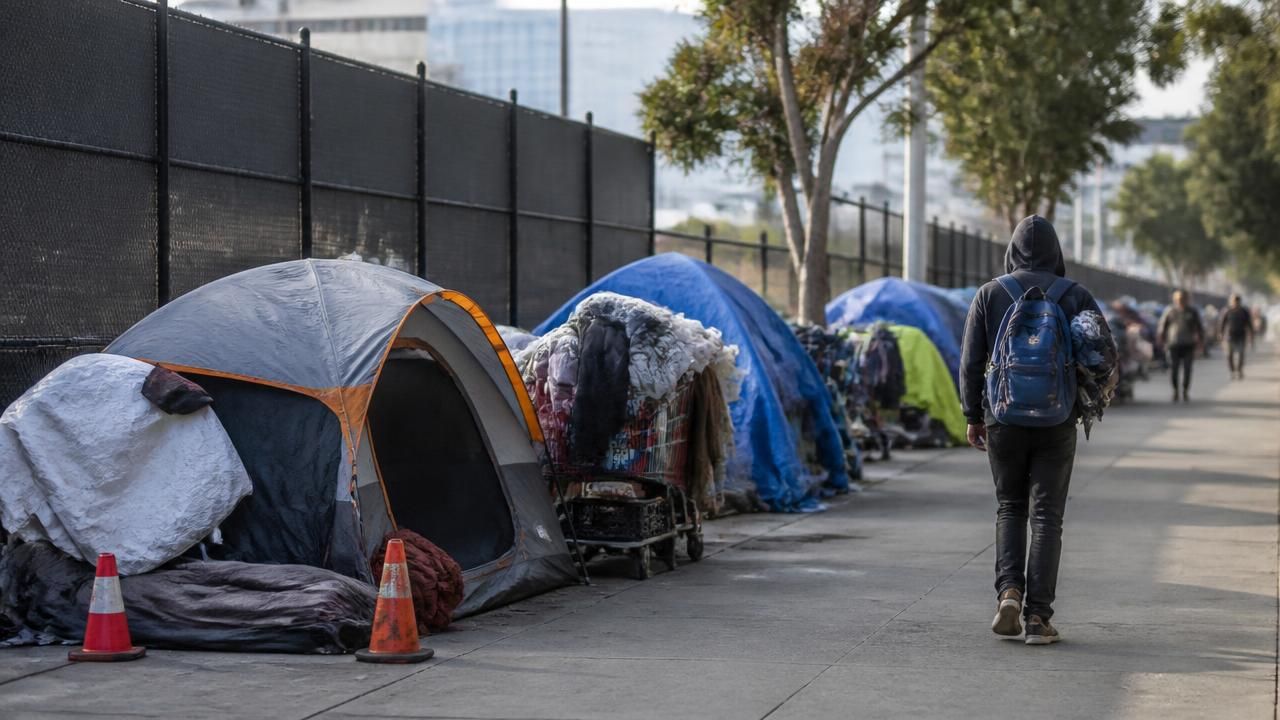
Homelessness in the United States fell by its largest margin in more than a decade in 2025, according to a new federal report, marking the first significant reversal after several years in which the nation's unhoused population climbed to record levels. The decline was confirmed by outlets across the political spectrum — NPR, The New York Times, MSN and Southern California's KPBS — all of which reported the same headline finding while framing its causes in markedly different ways.
Despite the drop, the total number of people experiencing homelessness still stands at nearly 700,000, a figure that underscores how deep the crisis has become and how far even a substantial one-year improvement leaves the country from resolving it.
What the Numbers Show
The federal count, released in the annual point-in-time estimate conducted by the Department of Housing and Urban Development, showed the steepest year-over-year decline in over ten years. The figures are based on a single-night tally of people in shelters, transitional housing and unsheltered locations such as streets, encampments and vehicles — a methodology that has long been criticized by researchers as an undercount but remains the most consistent national benchmark available.
The decline was national in scope but not uniform. California, which has long accounted for the largest single share of the country's homeless population, also recorded a decrease, according to KPBS's reporting on the federal findings. That is notable given that the state's large urban centers — Los Angeles, San Diego, San Francisco and Oakland — have been the focal point of public debate over encampments, housing costs and local policy responses.
A Fight Over Credit
Where the sources diverge most sharply is on the question of why the numbers fell. The Trump administration has moved quickly to claim credit, presenting the decline as evidence that tougher federal posture on homelessness — including pressure on cities to clear encampments and a push to tie funding to enforcement-oriented approaches — is producing results. That framing dominated coverage on MSN, which led with the government's own assertion of responsibility for the drop.
The decline is a direct result of federal leadership and a refusal to accept encampments as a permanent feature of American cities.
— The Trump administration's framing of the new federal data
Homelessness advocacy groups and many researchers dispute that account, arguing that the drop reflects forces that predate and operate independently of the current federal approach. NPR reported that the administration and advocacy organizations cite fundamentally different explanations for the decline. Advocates point instead to the expansion of housing vouchers and rapid-rehousing programs, eviction protections and rental assistance enacted during the pandemic, a surge in shelter capacity in several major metros, and — in some regions — cooling rents and rising apartment vacancies that have eased the pressure on the lowest-income renters.
Timing matters here. Many of the interventions advocates credit were funded through multi-year appropriations, meaning their effects are landing in exactly the window the new count captures. Administration officials counter that without federal enforcement pressure, cities would not have moved people off the streets and into available shelter beds at the pace the data suggest.
California as the Bellwether
California's decline carries outsized political weight. The state's homelessness crisis has been a persistent line of attack from national Republicans against Democratic governance, and Governor Gavin Newsom's administration has spent billions on interim housing, sober-living facilities and encampment clearances through programs like Homekey and the Community Assistance, Recovery and Empowerment Court. A measurable drop gives state officials evidence that those investments are working, even as local officials warn that shelter placements do not always translate into permanent housing.
Critics of the state's approach note that a single year's decline can mask churn: people cycling from encampments into shelters and back onto the street. Service providers in Los Angeles and San Diego have consistently argued that the binding constraint is the supply of permanent, deeply subsidized housing — not outreach capacity.
How Reliable Is the Count?
All of the reporting carries an important caveat. The point-in-time count is a snapshot, not a census, and it depends on thousands of volunteers and local agencies conducting surveys on a single night, often in winter. Cities that expand outreach teams tend to find more people; cities that clear encampments tend to push people out of sight. A year-over-year swing of this magnitude invites the question of whether the nation is seeing a genuine reduction in homelessness or a change in where and how it is counted.
Researchers generally accept the direction of large movements in the data while cautioning against over-reading single-year changes. The consensus among housing analysts is that the count is best used as a trend indicator over several years rather than a precise measure of need.
What Comes Next
- Funding fights: Continuum of Care grants, housing vouchers and eviction-prevention dollars are all subject to annual appropriations, and any contraction could reverse the gains.
- Rent trajectories: A meaningful share of the improvement appears tied to softening rents in Sun Belt and Western metros; a renewed spike would test whether policy alone can hold the line.
- Political stakes: Both the White House and state governments will cite this report as validation heading into the 2026 midterms, making the next count a heavily scrutinized data point.
- The 700,000 floor: Even at the improved level, the population remains roughly where it stood before the pandemic surge — a reminder that the crisis has been stabilized, not solved.
The immediate takeaway is that the country has bent the curve for the first time in years. Whether that bend becomes a durable trend or a one-year anomaly will depend less on rhetoric about credit and more on whether the housing that people are being moved into actually exists — and stays affordable.