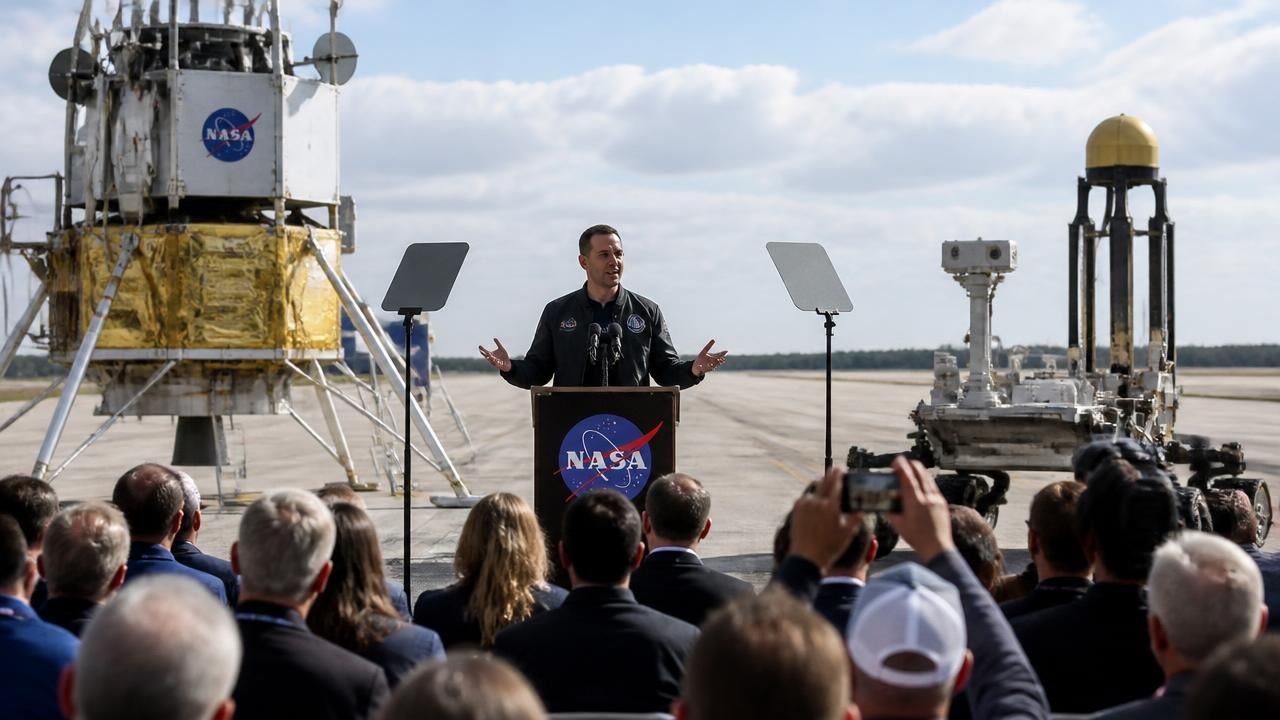
NASA used the runway at its own Florida spaceport as a backdrop Saturday to announce a broad suite of awards and mission updates aimed at turning the Moon's South Pole from a target on a PowerPoint slide into a working outpost. The agency said the investments will advance commercial robotic deliveries, a nuclear-powered rover named PROMISE, launch and orbital transfer services, and surface infrastructure — the building blocks of what it now calls the Moon Base program.
The news was delivered at the MAX POWER aerospace expo and air show at NASA's Kennedy Space Center, an event that mixed industry exhibition with the kind of procurement announcements that contractors scour for weeks. Within hours, the headline number circulating in financial media was $10 billion, with Fox Business framing the package as a Moon base contract that has drawn SpaceX and Blue Origin into what it described as a lunar gold rush.
“Building the Moon Base mission by mission”
NASA Administrator Jared Isaacman cast the announcements as an extension of the agency's traditional playbook rather than a single mega-program.
“We are building the Moon Base mission by mission,” Isaacman said. “Today's announcements expand nearly every part of that campaign, using the playbook that carried NASA through its greatest eras: fly often, learn, apply those lessons, and get more better and more capable with every mission. When our astronauts return to the Moon, they will arrive with the first elements of the Moon Base already waiting for them on the surface.”
Carlos García-Galán, manager of the Moon Base Program, said the agency had consolidated several formerly separate efforts into one streamlined campaign in the eight months since an internal milestone NASA calls Ignition.
“In the eight months since Ignition, we've made incredible strides in accomplishing the near impossible: establishing a permanent outpost on the lunar surface,” he said. “We've consolidated numerous efforts into a streamlined program, evolving our human exploration architecture into an iterative and sustained campaign for Moon Base technology development and implementation.”
What the money actually buys
Read together, the announcements describe a layered architecture in which robots and commercial rockets do the early work and humans arrive later to a partially built site. The components include:
- Commercial robotic deliveries: Privately built landers carrying science instruments and cargo to the lunar surface ahead of crewed missions.
- PROMISE: A nuclear-powered rover designed to operate through the two-week lunar night, when solar-powered hardware must shut down or rely on costly batteries.
- Launch and orbital transfer services: Contracted rides to lunar space, including the tug-like vehicles that move payloads from one orbit to another.
- Surface infrastructure: The power, communications and mobility systems that would let a base grow incrementally rather than arrive in one piece.
Trade press coverage filled in granular detail. Impulse Space said it had been awarded two task orders under the Moon Base umbrella, while Quantum Space confirmed it is part of a team that received a $185 million NASA contract for the Moon Base transportation program — evidence that the agency is spreading work across a wide supplier base rather than concentrating it in a handful of legacy primes. Several outlets also emphasized the rovers themselves, with USA Today previewing three lunar vehicles intended to scout terrain and set the stage for a permanent base.
Why the South Pole
The geography is the strategy. The lunar South Pole holds permanently shadowed craters where water ice is believed to be trapped — a resource that could be split into hydrogen and oxygen for propellant and life support. That possibility is what makes a sustained presence economically conceivable rather than purely symbolic, and it is why NASA's architecture keeps pointing at the same rugged, partially sunlit terrain.
The trade-offs are real. The South Pole's low sun angles create extreme cold and long shadows that challenge solar power — hence the interest in nuclear surface power and in PROMISE's reactor. Communications are harder, landing corridors are narrower, and the terrain is more punishing than the flat equatorial plains where the Apollo missions landed.
Differing frames, same story
The same announcement read very differently depending on the outlet. NASA's own release emphasized capability and cadence — flying often, learning, iterating. Financial media led with the money and the marquee names, casting the awards as a market-opening moment in which SpaceX and Blue Origin compete for a share of a lunar economy. Trade coverage focused on the winners of individual task orders and the mechanics of the transportation program. Consumer outlets stayed closest to the hardware, because a nuclear rover and a fleet of scouts are easier to picture than an orbital transfer award.
All of them, however, describe the same shift: NASA is no longer buying a single heroic landing but an assembly line of deliveries, each one adding a piece to a site that is supposed to keep operating after the astronauts go home.
Skeptics and what comes next
Veterans of past lunar programs are cautious. NASA's earlier efforts to build a sustained lunar architecture — from the Constellation program to the original Artemis landing timeline — slipped repeatedly on budgets, technical setbacks and changing political priorities. A $10 billion figure spread across multiple awards and multiple years is also not a single check; it is a ceiling that depends on annual appropriations that Congress controls.
Still, the structure of this campaign is deliberately different. By purchasing discrete services — delivery, transport, power, mobility — NASA can keep flying even if one element falls behind, and commercial partners absorb some of the development risk in exchange for the chance to sell the same capabilities to other customers.
The next milestones will be visible from the ground: the first commercial robotic landings under the expanded manifest, the delivery and testing of PROMISE, and the placement of early surface infrastructure at the South Pole. If those arrive on schedule, the first crewed missions of the Moon Base era would find hardware already waiting — exactly the scenario Isaacman described. If they slip, the announcement will join a long list of ambitious lunar plans that never quite reached the surface.