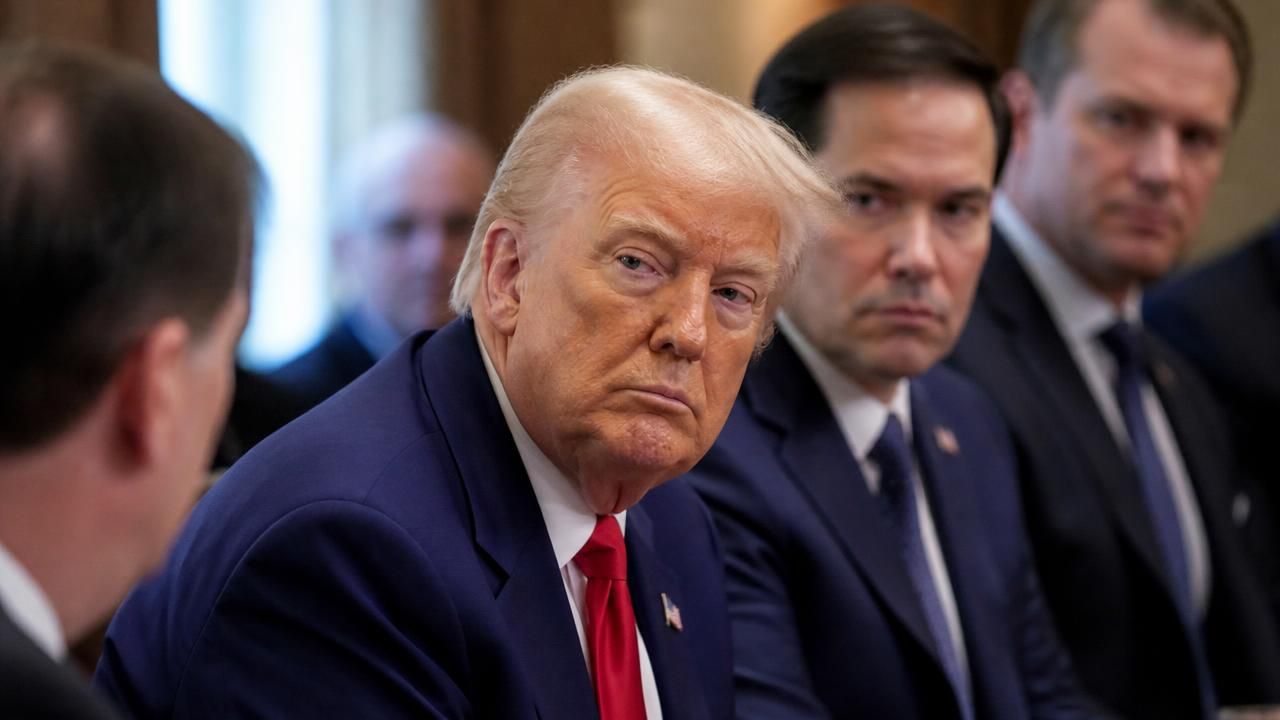
Republicans are confronting the wreckage of a midterm election drubbing that has left Donald Trump politically exposed, his personal brand recast from asset to liability, and his party locked in an open fight over who to blame and what comes next. The result, reported across outlets from CNN and MSN to Bloomberg and the Christian Science Monitor, is a rare moment of unified diagnosis from a normally fractured press corps: the president's coalition took a beating, and the explanations emerging from Mar-a-Lago are already being disputed by members of his own party.
Trump Points to Iran — and His Party Pushes Back
According to accounts carried by Express and echoed in conservative and international coverage, Trump has told allies that the war with Iran is “largely” to blame for the losses, an attempt to locate the cause of the defeat in foreign policy rather than in his own standing. The framing has not travelled well. The News, citing Republican officials, reported that lawmakers are demanding a pivot as “internal friction mounts” over the midterm losses, with 2028 hopefuls openly targeting the president's record rather than defending it.
“Complete Armageddon” was how one Republican operative described the party's internal state in the days after the result, in remarks carried by MSN — a characterization that captures the speed with which recrimination replaced message discipline.
The scale of the defeat has produced an unusual spectacle: a vice president, JD Vance, attempting to put visible distance between himself and the president he served, according to NDTV. That move, more than any single race, signals how quickly the party's center of gravity is shifting away from Trump as 2028 calculations begin in earnest.
Hegseth Emerges as the First Casualty-in-Waiting
Nowhere is the fallout more concentrated than at the Pentagon. Firstpost asked whether Pete Hegseth has become “the first victim of the Republican rout,” with speculation over his ouster growing, while The Australian reported that the defense secretary faces midterm backlash and impeachment pressure tied to the war in Iran. The mechanism is straightforward: a war that the president himself now cites as the cause of his party's defeat becomes, by definition, a political liability for the officials who prosecuted it. Whether Hegseth is sacrificed to satisfy the party's restive base or protected to avoid the appearance of a purge remains one of the most consequential open questions in Washington.
The MAGA Question, and a Changing Equation for Israel
The Christian Science Monitor posed the deepest question of the cycle: does MAGA have a future? After an anti-Trump backlash of this magnitude, the movement's claim to electoral dominance looks considerably weaker, and the coalition's generational-transition problem — long deferred — is now unavoidable. MSN reported separately that Trump's personal brand has turned into a political liability, a remarkable reversal for a figure whose endorsement was once the most valuable currency in Republican politics.
Abroad, the implications are already being priced in. MSN reported that Trump's midterm defeat “changes the equation” for Benjamin Netanyahu and Israel, whose government had built its strategic planning around a predictable American president. A weakened Trump, facing a party that wants a pivot and a base that wants answers, is a less reliable partner — and a leader with less room to absorb domestic criticism of foreign entanglements.
Markets and the AI Industry Recalibrate
The financial framing was equally stark. Bloomberg's The Pulse With Francine Lacqua convened Goldman Sachs chief European economist Jari Stehn, Veolia CEO Estelle Brachlianoff, CB Strategies founder Caroline Behringer and IE University professor Amanda Sloat to work through the political and economic aftershocks — a lineup that reflects how quickly a domestic electoral result becomes a global markets story. For investors, the question is not simply who won, but whether a wounded president can still deliver legislative certainty on trade, defence spending and regulation.
In the technology sector, VentureBeat framed the “Blue Wave” as a pivotal moment for the American AI industry, arguing that the shift in power will reshape the policy environment for artificial intelligence and business more broadly. A Congress less inclined to defer to the White House on AI governance, antitrust and export controls would alter the strategic calculus for every major technology firm.
Down-Ballot: Historic Firsts and Local Reckonings
- In Texas, MSN reported that James Talarico and Gina Hinojosa landed historic wins on election night, part of a broader Democratic advance in a state Republicans have long treated as safe.
- Trump nonetheless returned to the trail in Iowa to rally for Ashley Hinson and other GOP midterm candidates, per NBC News — a reminder that the president's pull with the base has not vanished, even as his broader brand has weakened.
- In Michigan, Representative Haley Stevens faced backlash over her endorsement of Mike Rogers, according to Yahoo, illustrating how the midterms have scrambled even local political alliances.
- And in the most surreal coda of the cycle, MSN reported that Trump's communications chief floated Nicki Minaj as a possible White House press secretary following talks aboard Air Force One — a staffing rumour that, fairly or not, reinforced the impression of a White House operating without a coherent post-election plan.
What Happens Next
The converging accounts point to three near-term tests. First, whether Trump concedes any measure of responsibility beyond the Iran war — a concession his base may not tolerate and his critics will not accept as sufficient. Second, whether the party's 2028 aspirants convert private grumbling into public breaks, with Vance's distancing already the leading indicator. Third, whether the administration can govern with a coalition that has just been repudiated at the ballot box.
For now, the most telling fact is the one all twenty sources agree on: a president who once defined his party's fortunes is now being defined by them, and the debate inside the GOP is no longer about whether to move past Trump, but about how quickly — and who will get there first.