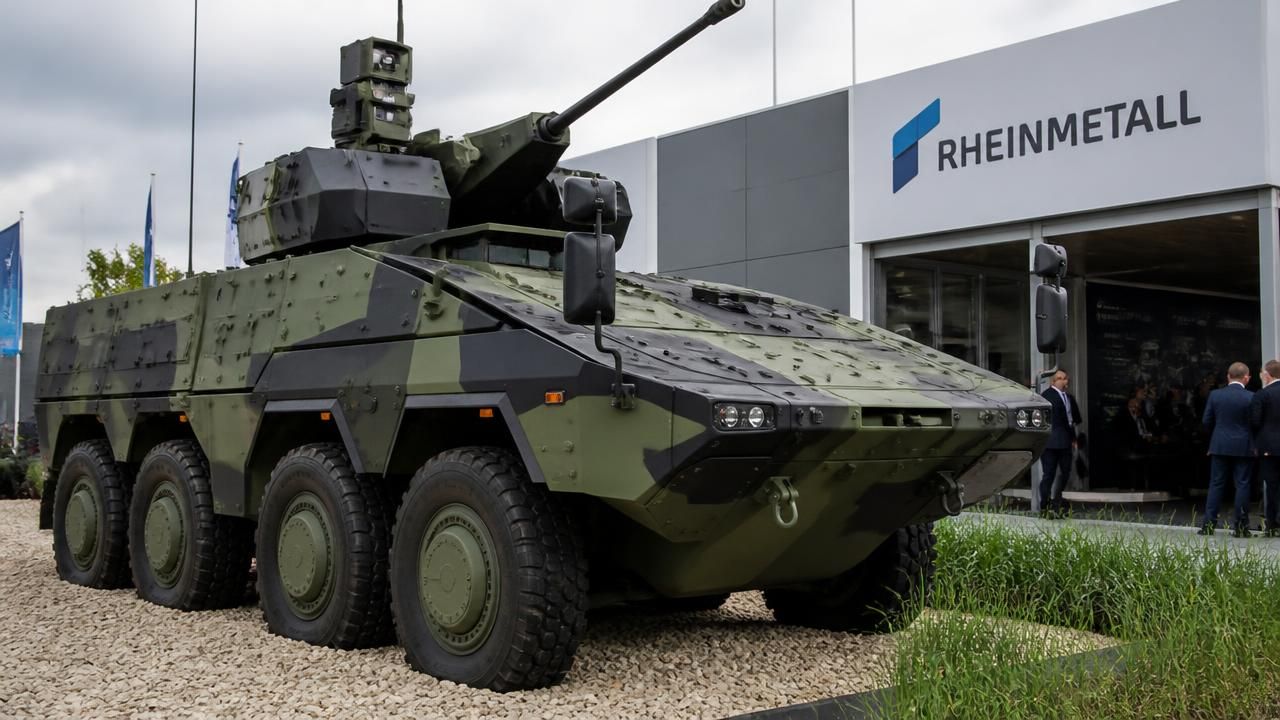
DÜSSELDORF, Germany — Thursday, November 5, 2026 — Rheinmetall AG, the Düsseldorf-based arms manufacturer that has become the single biggest equity expression of Europe's rearmament, cut its 2026 sales guidance for the second time this year and watched roughly a sixth of its market value evaporate in a single session.
The company attributed the downgrade to mounting delays in the Boxer armored vehicle program, which it said would push a substantial tranche of expected orders out of the current year and into the next. Shares fell as much as 17% before recovering slightly, according to CNBC, marking one of the sharpest one-day declines in the stock's four-year run as a market darling.
A Guidance Cut That Wasn't Supposed to Happen Again
The mechanics of the warning are deceptively simple. Rheinmetall's order book is enormous, but it is also lumpy: framework agreements convert into binding, revenue-generating contracts only when national budgets clear, export licenses are granted and procurement agencies sign. The Boxer — an eight-wheeled, modular armored fighting vehicle built by the ARTEC consortium that Rheinmetall operates alongside KNDS — sits squarely at that bottleneck.
Because the Boxer's order intake slipped, so did the revenue the company had penciled in for 2026. Bloomberg's Benedikt Kammel reported that the delays would push orders into next year, meaning the top-line target had to come down. Crucially, the underlying demand has not disappeared; it has been deferred. That distinction matters enormously for a company whose backlog is measured in tens of billions of euros.
What made the announcement damaging was its sequencing. This is the second trim to the same 2026 target, and markets rarely forgive a company for missing on the second attempt after presenting the first cut as a one-off. MarketScreener framed the release bluntly as a "profit warning" that "shocked investors" — language normally reserved for genuine earnings disappointments rather than timing slippage.
How Different Outlets Framed the Selloff
The coverage diverged in revealing ways. Bloomberg led with the program mechanics — the Boxer, the order slippage, the second cut — treating the story as an operational and procurement narrative. CNBC foregrounded the market reaction, headlining the 17% plunge and the "stalled military contracts" behind it. MarketScreener leaned into the shock factor of a profit warning.
The MSN-syndicated coverage captured the most consequential framing of all: that investors were beginning to question Rheinmetall's growth outlook, not merely its quarterly timing. And MarketScreener's separate report that JPMorgan expects the share price to plunge and has cut its target added institutional weight to that skepticism.
"Rheinmetall shares slide as investors question growth outlook after second guidance cut."
— The framing that circulated across syndicated financial coverage on Thursday
The shift in language is telling. For three years, Rheinmetall was treated by analysts as a structural growth story in which any dip was a buying opportunity. Now the questions are about guidance credibility: how hubristic are management's multi-year targets, and how much of the company's valuation rests on procurement schedules it does not control?
Why This Matters Beyond One Stock
Rheinmetall's rise was extraordinary. The stock joined Germany's DAX in March 2023, replacing Fresenius, and has since risen more than tenfold from its pre-war levels as Berlin reversed decades of defense austerity after Russia's full-scale invasion of Ukraine.
The tailwinds were real and remain so.
- European spending pledges: NATO members agreed at the 2025 Hague summit to move toward 5% of GDP on security by 2035, with 3.5% earmarked for core defense.
- German fiscal space: Berlin exempted defense outlays above 1% of GDP from its constitutional debt brake and created a €500 billion infrastructure fund.
- Capacity expansion: Rheinmetall has invested heavily in 155mm ammunition lines in Unterlüß, a plant in Hungary, the acquisition of Spain's Expal, a joint venture in Lithuania and the conversion of Volkswagen's Osnabrück site.
- Product breadth: The portfolio spans the Leopard 2, Lynx, Boxer, Puma turrets, ammunition, sensors and simulation.
But all of that is supply. The 2026 warning is a reminder that the demand side is mediated by governments whose budgeting is political, cyclical and slow. Rheinmetall does not sell off the shelf; it sells through parliaments.
The Valuation Question
That mismatch is what the market is now pricing. Rheinmetall trades at a multiple of forward earnings that implicitly assumes years of uninterrupted double-digit growth. Each guidance cut erodes the premium attached to that assumption — hence the outsized, 17% reaction to what is, arithmetically, a deferral rather than a loss.
Defense equities across Europe also carry a political risk now absent in 2022. The sector's ascent has been so steep that a growing list of investors worry it has run ahead of spending actually executed, while budget reallocations, coalition politics and export-license disputes can delay contracts indefinitely. For every analyst who sees the selloff as an entry point, there is one who sees it as the first repricing of a narrative that outran its orders.
What to Watch Next
Three things will determine whether Thursday's drop is a footnote or a turning point. First, whether ARTEC converts the delayed Boxer orders early in 2027, confirming the slippage was merely timing. Second, whether Rheinmetall reaffirms the remainder of its medium-term targets at its next capital markets update — a second erosion of confidence would be far harder to repair than the first. Third, whether JPMorgan's cut proves a lone call or the start of a broader round of target reductions across the European defense complex.
For now, the company's fundamental position is intact: Europe's armies need what it builds, and they need it faster than their procurement systems can deliver it. But Thursday's collapse showed that in defense investing, being right about the long-term threat does not protect you from being wrong about the quarter.