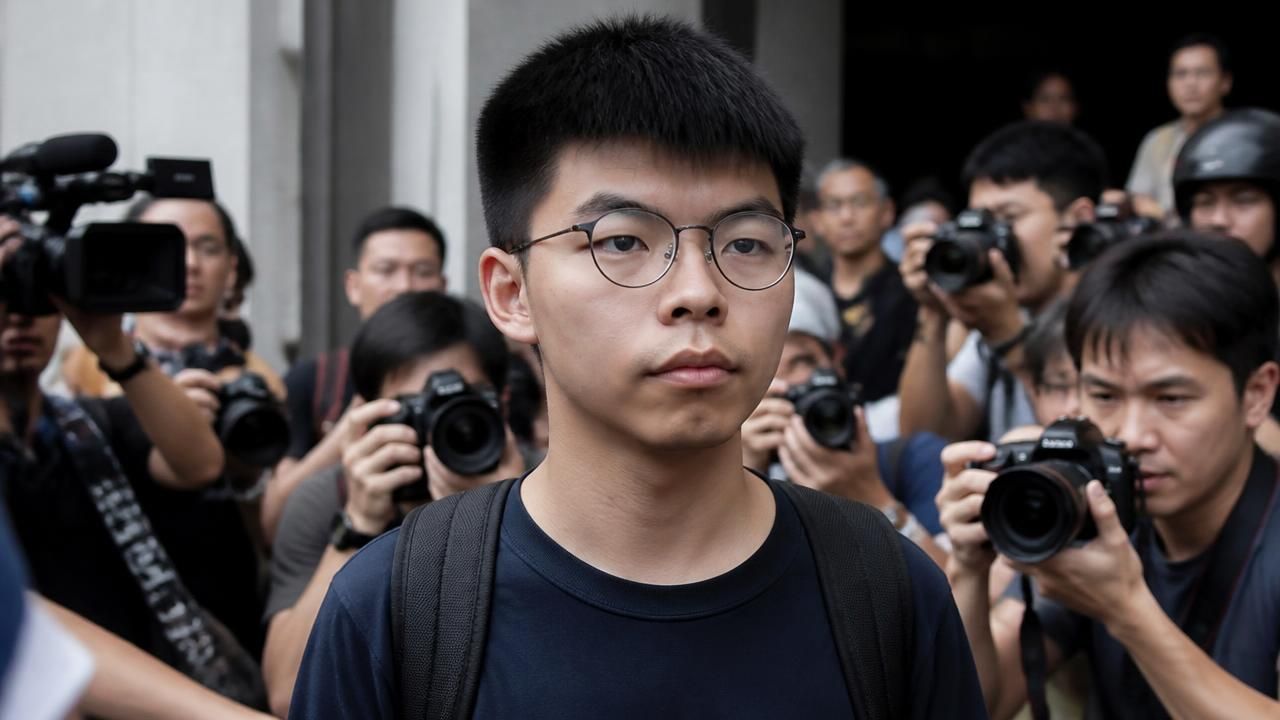
HONG KONG — Joshua Wong, for more than a decade the most recognisable face of Hong Kong's pro-democracy movement, was sentenced to 10 years in prison in his second conviction under the Beijing-imposed national security law, a ruling that rights organisations and Western governments described as the starkest illustration yet of how far the territory's political space has contracted.
Wong, 29, had pleaded guilty to a charge of collusion with foreign or external forces — among the most serious offences in the 2020 legislation, which carries a maximum penalty of life imprisonment. The sentence was handed down by a Hong Kong court and confirmed across a wave of international coverage, from The New York Times and The Guardian to Bloomberg, The Associated Press and NPR.
Who is Joshua Wong?
Wong was still a teenager when he became a household name. As a schoolboy he helped lead Scholarism, the student movement that in 2012 forced the government to shelve a planned national-education curriculum. He rose to global prominence as a leader of the 2014 Umbrella Movement, the 79-day occupation of Hong Kong's streets demanding free elections, and later returned to the front line during the huge, sometimes violent 2019 protests against an extradition bill.
That trajectory — as Newsday framed it in a profile, 'once a teen activist' now 'spending years of his adult life in prison' — is itself the story of Hong Kong's reversal. Wong has been in custody since 2021, serving sentences for earlier protest-related convictions, including for unauthorised assembly. The new term is not a replacement for those sentences but an addition to them, meaning that a man who first went to jail in his early twenties may not walk free until his late thirties.
The case against him
Prosecutors argued that Wong's campaigning abroad — lobbying foreign governments and urging sanctions on Hong Kong and mainland officials — amounted to collusion with external forces, and that his role in organising the unofficial 2020 primary election was part of a conspiracy to paralyse the government. The primary, in which more than 600,000 residents took part in unofficial polling, was designed to help the pro-democracy camp win a legislative majority and, its organisers said, to press demands for accountability and free elections.
Explainer coverage across aggregators such as MSN and outlets including primetimer.com sought to answer the question many readers asked: why ten years? The answer lies in the architecture of the security law, which grants judges wide discretion, allows certain cases to be heard without a jury, and sets exceptionally high maximum penalties. The 2024 local security ordinance, enacted under the same framework, added further offences and powers.
A widening crackdown
Wong's sentencing is the latest in a sequence of cases that have dismantled Hong Kong's opposition. In 2024, 45 of the 47 democracy campaigners convicted over the same unofficial primary — including figures such as Benny Tai — received prison terms ranging from about four to ten years. Independent media outlets have closed, civil-society groups have disbanded, and dozens of activists have left the city.
Beijing and Hong Kong authorities reject the characterisation of a crackdown. Officials argue the security law restored stability after the unrest of 2019, that prosecutions are based on law and evidence, and that national security is a legitimate concern of any sovereign government. State-aligned outlets have portrayed the defendants as having sought foreign interference in the city's affairs.
Rights groups respond
Amnesty International condemned the ruling in blunt terms, framing the sentence as evidence of the authorities' disregard for fundamental freedoms.
This cruel sentence is a grim reminder of how far Hong Kong's authorities have turned their back on human rights. Joshua Wong is a prisoner of conscience, jailed for peacefully exercising rights that Hong Kong promised to protect.
Other human-rights organisations and a number of Western governments echoed that assessment, with diplomats and legislators in London and Washington reiterating calls for Wong's release and for the revocation of the security law. Critics note that the law's collusion provisions are drawn so broadly that almost any meeting with a foreign politician or interview with overseas media can be characterised as an offence.
How the story was framed
Coverage varied markedly by outlet. International newsrooms — NPR, The Guardian, Bloomberg, The New York Times and the Associated Press — led with the political significance, describing the sentence as a measure of the crackdown on a movement that once filled Hong Kong's streets. Profile-driven and aggregation outlets concentrated on Wong's biography and the mechanics of the charge, while advocacy groups such as Amnesty supplied the moral verdict. Several outlets, including Bloomberg, AP and The Times, gated their reporting behind bot checks and paywalls, a reminder of how difficult it can be to verify details from inside a city whose press freedoms have shrunk.
What happens next
- Appeal: Wong's legal team is expected to challenge both the conviction and the severity of the sentence, though the security law's designated judges have rarely ruled against the government.
- Diplomacy: The case is likely to feature in US–China and UK–China discussions, and could complicate any thaw in relations.
- Hong Kong's reputation: Business groups are watching closely. The city has rebuilt its role as a financial hub, but critics argue that legal uncertainty and the absence of political pluralism carry a long-term cost.
- Symbolism: For a generation of Hong Kongers, Wong's name remains shorthand for the freedoms the city once enjoyed — and, increasingly, for what has been lost.
For now, the practical outcome is simple: a 29-year-old man already behind bars has been told he will spend another decade there. The wider question — whether Hong Kong can still be the open, pluralistic city its own Basic Law promised — is one the courtroom has effectively answered.