NASA has reported a successful demonstration of technology intended to let spacecraft guide themselves to safe landing sites on the Moon, Mars and beyond, after a drone carrying the agency's experimental navigation payload completed a series of simulated lunar descents over a dry lakebed in Southern California.
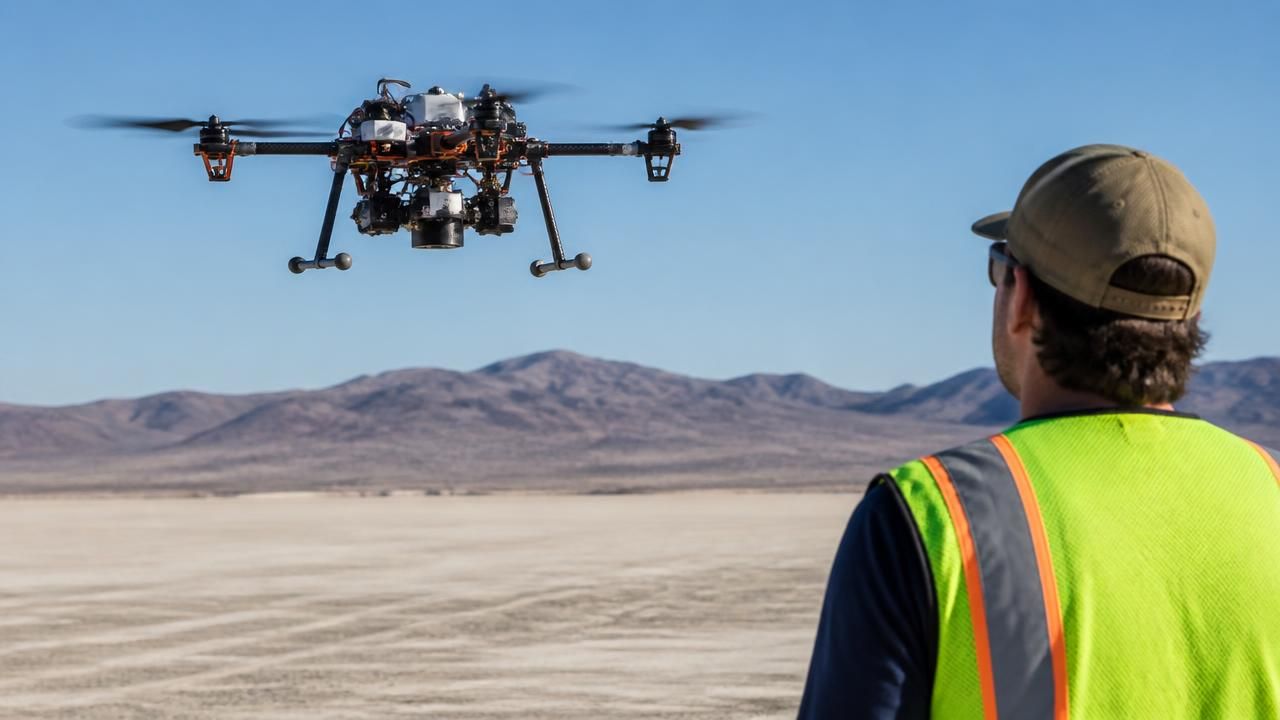
The flight, conducted Aug. 27 at Rogers Dry Lake near NASA's Armstrong Flight Research Center in Edwards, California, used an Alta-X remotely piloted aircraft carrying the Safe and Precise Landing – Integrated Capabilities Evolution (SPLICE) guidance, navigation and control payload. According to NASA, the aircraft executed simulated lunar descent and landing maneuvers while the onboard system mapped the terrain below and evaluated candidate touchdown zones in real time.
The agency said the payload successfully communicated with the remotely piloted aircraft during hover maneuvers in flight — an earlier milestone photographed on July 15, 2026, at the same Armstrong test range by NASA photographer Ryan Kline. Development of SPLICE is led by researchers at NASA's Johnson Space Center in Houston.
A drone standing in for a lunar lander
The test campaign reflects a pragmatic approach to maturing landing software: rather than waiting for a rocket-powered lander flight, engineers mounted the SPLICE hardware on a commercially available multirotor drone and flew it over desert terrain that, in sensor terms, can be treated as a plausible stand-in for a cratered surface.
During the August runs, the system used an advanced guidance algorithm to build a picture of the ground beneath the vehicle and assess potential landing areas. If the system judges the targeted site unsafe — because of rocks, slopes, craters or other hazards — it autonomously diverts the drone to a safer location. NASA says the payload generates high-resolution digital elevation maps from light-detection and sensor data, giving the guidance software a three-dimensional model of the approach path.
SPLICE will help spacecraft land precisely and detect and avoid potential hazards, which is critical for NASA missions to the Moon and to Mars.
That formulation, included in NASA's own image caption and release, is the agency's central claim: precision and hazard avoidance are not optional refinements but baseline requirements for the next generation of surface missions.
Why precision landing is an unsolved problem
Landing on another world remains one of the most unforgiving phases of any mission. Apollo 11's descent in 1969 famously required Neil Armstrong to take manual control and fly past a boulder field after the automatic system steered toward an unsafe site — a diversion that consumed propellant margins the mission could barely spare. Half a century later, uncrewed landers still fail: a swath of attempted lunar touchdowns by national programs and private companies over the past decade have ended in crashes or tipped-over spacecraft, frequently because of terrain or navigation errors discovered too late in the descent.
The technical challenge is that a spacecraft on final approach has seconds, not minutes, to act. It must know its position relative to the surface to within meters, image the ground through dust and varying illumination, classify hazards, replan a trajectory and execute it — all without a human in the loop, because light-time delays make joystick flying from Earth impossible.
NASA has chipped away at these problems before. The Perseverance rover's 2021 landing on Mars used terrain-relative navigation to steer away from rough ground, and China's Chang'e landers have carried optical hazard-avoidance cameras. SPLICE is designed to fold those capabilities — plus a Doppler lidar and a descent-and-landing computer — into a single, spacecraft-ready package suitable for both robotic and crewed vehicles. Earlier iterations of the hardware were exercised on suborbital rockets and vertical-takeoff test landers before this summer's drone flights.
How the story traveled — and how it was framed
Coverage of the milestone spread quickly and mostly verbatim. Aggregators including Mirage News and Phys.org republished the agency's release under near-identical headlines — "NASA Navigation Test Shows Promise for Planetary Landings" — while MSN's syndicated version leaned into the future-facing framing: "NASA tests new landing technology that could change future moon missions." (Several of those syndicated pages were inaccessible to readers at the time of writing, returning security blocks and HTTP errors.)
The uniformity is telling. Because SPLICE remains a technology demonstration rather than a mission, NASA's announcement contained no flight date for an operational use, no named program office taking delivery and no cost figures — the details that would normally anchor independent reporting. What spreads in that vacuum is the promise rather than the program.
- What it is: A guidance, navigation and control payload combining terrain mapping, hazard detection and autonomous diversion.
- Where it flew: Rogers Dry Lake, near NASA Armstrong Flight Research Center, Edwards, California.
- When: Simulated lunar descent and landing maneuvers on Aug. 27; hover communication tests documented July 15, 2026.
- Who built it: Researchers at NASA's Johnson Space Center, Houston.
- Why it matters: Precise, hazard-aware autonomous landing is a prerequisite for lunar surface operations and eventual human Mars missions.
What comes next
The strategic stakes are considerable. NASA's Artemis architecture envisions landers delivering cargo and crews to the lunar south polar region, where shadows, steep slopes and patchy illumination make site selection unusually difficult. The agency's Commercial Lunar Payload Services program has likewise shown how brittle uncrewed touchdowns can be. For Mars, the challenge compounds: a thicker atmosphere, entry-descent-landing uncertainties measured in kilometers, and no possibility of real-time ground intervention.
SPLICE's drone flights are, in that light, a modest but necessary step — a way to log flight hours and retire software risk on cheap, repeatable aircraft before the same code is trusted to a multi-billion-dollar spacecraft. The next validation milestones would logically involve higher-fidelity lander testbeds and, eventually, integration onto an actual mission's descent stage. NASA has not announced a specific flight opportunity.
For now, the takeaway is narrow but real: a NASA payload can look at the ground, decide it is unsafe, and fly itself somewhere better. Whether that translates into a generation of spacecraft that land where they are told — rather than where physics permits — will be decided well beyond Rogers Dry Lake.