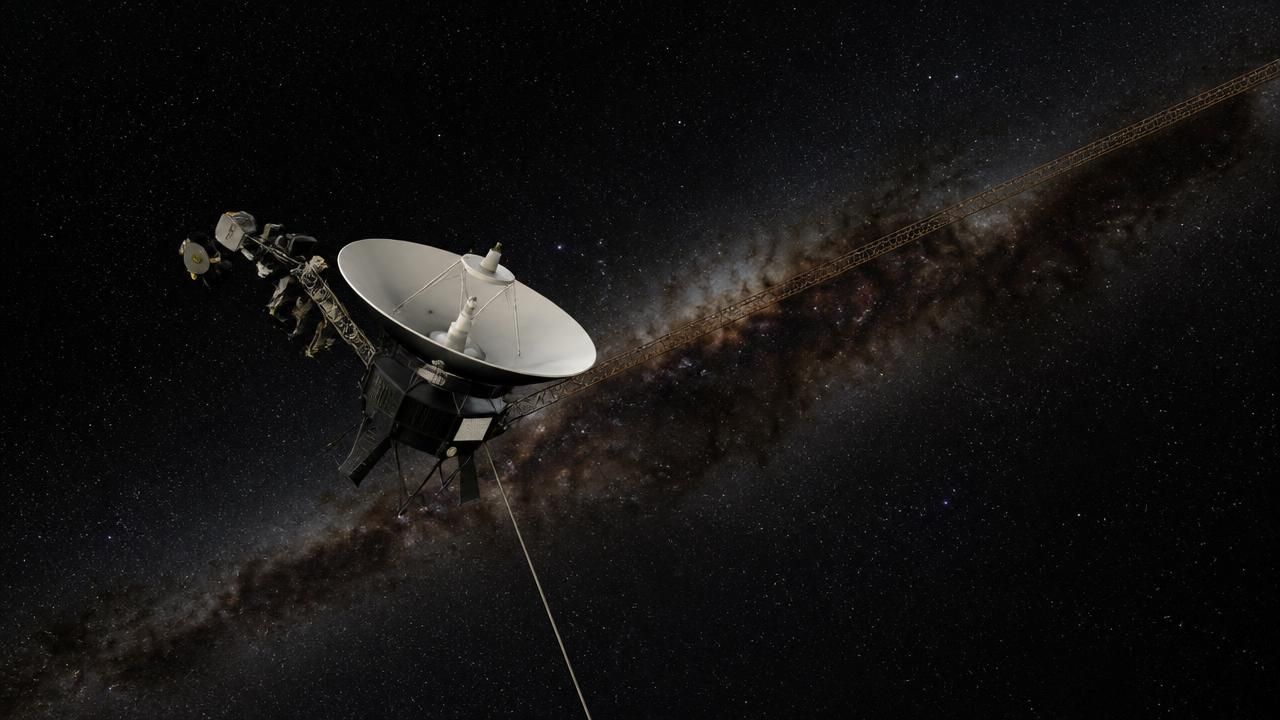
Nearly half a century after it left Earth atop a Titan IIIE-Centaur rocket, NASA's Voyager 1 is about to cross a boundary no human artifact has ever crossed. On November 18, 2026, the spacecraft will reach a distance of one light-day from Earth — roughly 25.9 billion kilometers — meaning that a radio signal traveling at the speed of light will take a full 24 hours to reach it, and another 24 hours for any reply to come home.
The milestone, first flagged by Science Daily and confirmed across a wave of coverage from IFLScience, MSN, Hindustan Times and others, is as much an engineering story as a cosmic one. Voyager 1 is not merely far away; it is old, cold, and running on fumes. The same week that celebrations are being prepared, mission controllers are managing an aging power supply, a shrinking instrument suite, and — most alarming — a recent 48-hour communications blackout that briefly left engineers unsure whether the probe was still alive.
The meaning of a light-day
A light-day is not a place so much as a statement about time and distance collapsing into one another. At one light-day, Voyager 1's round-trip communication time reaches 48 hours: any command sent by the Deep Space Network on Monday morning is answered, at best, on Wednesday. That latency transforms the practice of spacecraft operations. There is no real-time troubleshooting, no live diagnostics, no quick fix. Every anomaly must be modeled in advance, every command triple-checked, and every failure met with patience.
"It's official: Voyager 1 will cross the 1 light-day threshold on November 18, 2026" — as reported by IFLScience.
It is also a rare, intuitive yardstick for the scale of the solar system. Light crosses the roughly 150 million kilometers between Earth and the Sun in about eight minutes. It reaches Neptune in around four hours. Voyager 1 has been flying for 49 years to get one full day out. Coverage from aroundprague.cz framed the milestone slightly differently, describing the probe as a full light-day from the Sun — a reminder that the exact reference point depends on where Earth sits in its orbit, a nuance that occasionally gets lost as the story travels between outlets.
An aging machine in interstellar space
Voyager 1 crossed the heliopause — the boundary where the Sun's wind gives way to the interstellar medium — in August 2012, becoming the first spacecraft to enter interstellar space. Voyager 2 followed in 2018. Since then, both probes have returned the only direct measurements humanity has of the gas, dust, and magnetic fields of the space between the stars.
But the spacecraft are powered by radioisotope thermoelectric generators, which convert the heat of decaying plutonium-238 into electricity. That output declines by roughly four watts per year. To keep the science going, engineers have adopted a strategy of managed sacrifice: heaters have been switched off, and one science instrument after another has been retired. Discover Magazine's coverage emphasized this trade-off directly, noting that as Voyager 1 nears its historic distance, NASA continues shutting down instruments — an irony that is not lost on the team.
An energy-saving maneuver executed in recent months has bought additional mission time, according to Science Daily, extending the scientific return of a spacecraft that has already outlived its designers' wildest expectations. Each watt saved is a small reprieve.
A scare in deep space
The engineering triumph has been punctuated by genuine alarm. Mashable reported that Voyager 1 gave mission control "another moment of panic" when the probe mysteriously lost contact with Earth; the unexplained outage lasted roughly 48 hours before communications were restored. NASA's Jet Propulsion Laboratory subsequently described the incident as a brief communications pause that was resolved, with power-conservation measures continuing apace — though JPL's own pages were returning server errors at the time of reporting, leaving much of the public record to be assembled from secondary coverage.
The scare is not unprecedented. In 2023, a software fault left Voyager 1 transmitting garbled telemetry for months. In 2024, engineers traced a more serious problem to a failed memory chip and rebuilt the affected code from Earth, a repair executed across a signal path of more than 20 billion kilometers. As Voyager-1's coverage on MSN put it, the probe keeps "breathing" in interstellar space while NASA pulls off another life-saving miracle.
Why it matters
- It is a distance record with no rival. No other human-made object is remotely as far; Voyager 1 is more than twice as distant as Pluto at its farthest.
- It is a communications frontier. The 48-hour round trip foreshadows the operational realities of future interstellar probes.
- It is a test of institutional endurance. Voyager has survived budget cycles, workforce turnover, and five decades of technological change.
- It is a cultural artifact. Each craft carries a Golden Record — greetings in dozens of languages, music, and images — a message in a bottle addressed to no one in particular.
How the story is being told depends heavily on the outlet. Science-focused publications lead with the physics and the poignancy; general-interest outlets lead with the drama of the near-loss and the ingenuity of the recovery; aggregators reduce it to a date. All of them converge on the same underlying fact: this is a machine operating far beyond its warranty, held together by clever engineering and institutional stubbornness.
After November 18, Voyager 1 will keep going. Mission planners expect the probe to remain at least partially operational into the early 2030s, when the last instrument will likely fall silent. It will then coast onward — toward no particular destination, at roughly 17 kilometers per second — carrying its greetings, its gold-plated record, and the distinction of being the first thing our species ever sent a full day into the dark.