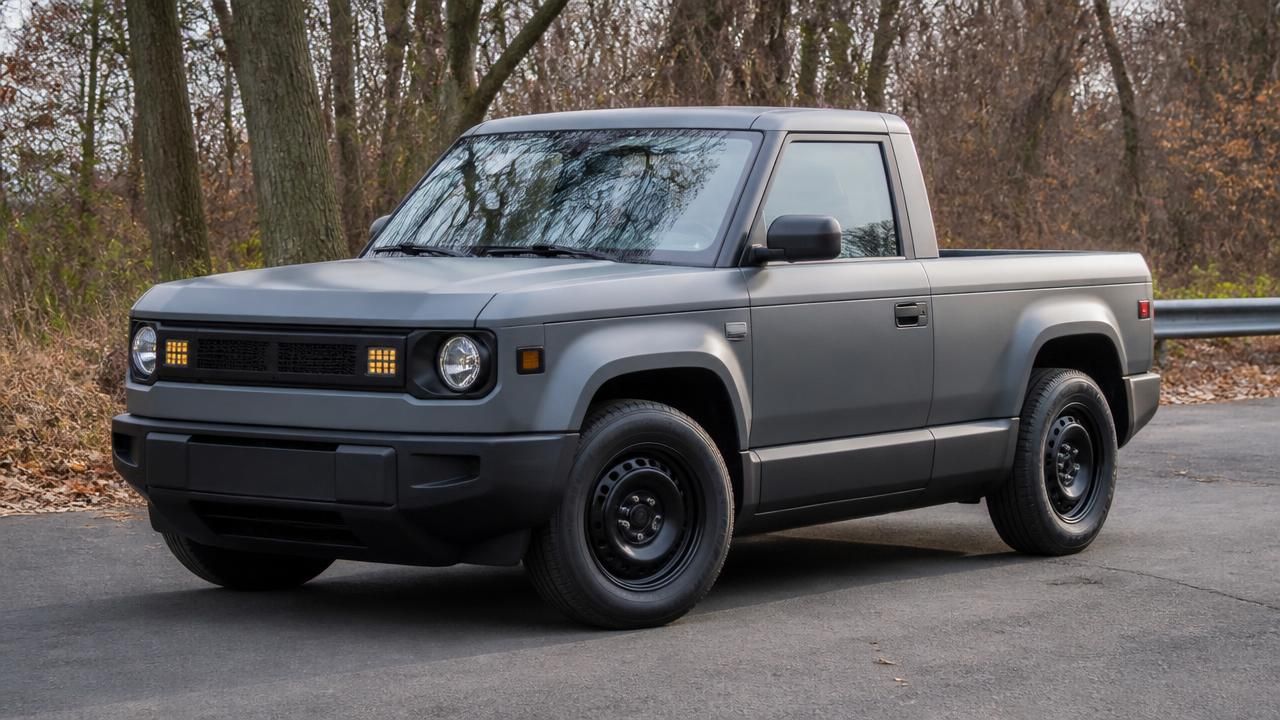
For years, the sub-$25,000 electric vehicle has been the industry's favorite promise and least-kept one. This week, startup Slate Auto put a steering wheel in reviewers' hands and made the case that the cheap EV is finally real—flaws, Velcro and all.
Slate's pickup, priced at $24,950, has now been driven by journalists from Ars Technica, InsideEVs, Car and Driver, Yahoo and a cluster of syndicated outlets, and the early verdict is strikingly consistent: the truck drives credibly, feels refreshingly simple, and may be the most consequential affordable EV since the segment's long drought began. It is not, however, finished.
A 45-minute drive and a well-worn mule
Ars Technica's reviewer caught the prototype locally—no cross-country flight, just a drive from southwest Washington, DC to Rockville, Maryland. The truck on hand was no show pony: its minimalist digital display showed almost 6,000 miles (9,656 km), and the cabin carried the scars of development life, including hard, shiny black plastic surfaces and strips of Velcro left behind from the camouflage that hid the interior during public testing.
What struck the reviewer was how little the truck asked of its driver. Door handles with a pleasing mechanical action—compared to the old Morris Marina—opened without drama, and the seat and steering column adjust manually but with generous range, a cost-saving omission that budget cars have long used to punish tall drivers.
“If my 45-minute drive yesterday morning is anything to go by, I think Slate Auto will have quite the hit on its hands,” Ars Technica's reviewer wrote.
InsideEVs went further with its headline verdict: “I Drove Slate's $25,000 Electric Truck. It Could Be A Real Game-Changer.” Yahoo's first drive framed the same experience as “a minimalist electric truck with old-school charm,” while MSN's syndicated coverage described a bare-bones truck that “surprised this early reviewer” and a ride that “shows the appeal of a simple truck.”
Cheaper without feeling cheap
The unifying theme across coverage is that Slate has largely dodged the trap that has sunk budget EVs before it: the perception of penury. USA Today's headline put it plainly—the Slate truck “proves cheaper doesn't have to feel cheap.” Car and Driver took a wider lens, calling the pickup “an EV for the New Austerity Era,” a nod to a market where average new-vehicle transaction prices have climbed past the reach of many households and where even modest electric offerings routinely start north of $35,000.
Slate's strategy is the inverse of the industry's playbook. Rather than loading a vehicle with content and then discounting it, the company has stripped the truck to essentials—manual adjustments, a small legible screen, mechanical controls—and priced it at $24,950 from the start. Ars Technica's framing of that approach was blunt: “Underpromise, overdeliver?”
The context matters. Ford's Maverick demonstrated that American buyers will embrace a small, cheap, honestly built truck; Rivian and Ford's electric trucks have demonstrated the opposite lesson at the top of the market, where prices have drifted upward with each model year. A genuinely sub-$25,000 electric pickup would occupy white space no established automaker currently fills, and several have publicly shelved plans to try.
Prototype problems aren't production promises
Reviewers were careful to separate the mule from the machine. MSN's coverage noted that prototype faults remain, and Ars Technica was explicit that the cabin's materials were not representative of the production version—the shiny black plastics and leftover camouflage tape are artifacts of development, not design intent. That caveat cuts both ways: it leaves Slate room to improve, but it also means the most important questions about the truck—durability, fit and finish, and how the cabin holds up after 50,000 miles rather than 6,000—remain unanswered.
Other open questions linger beyond the drive. Range, charging performance, crash-safety results and long-term service support are all unresolved for a company that has never shipped a vehicle at volume. Scaling manufacturing is the graveyard of EV startups, and a $24,950 price is only credible if the bill of materials and the factory behind it cooperate.
Showroom signals retail ambitions
Slate also opened its first showroom, where customers can test drive the $24,950 pickup—a signal that the company intends a direct-to-consumer retail model rather than leaning on franchised dealers. The move mirrors Tesla and Rivian's approach and solves a specific problem for an unknown brand: nobody buys a truck from a company they've never sat in. But physical retail is expensive, and each location adds fixed cost to a business model built on thin margins.
Access to the coverage itself was patchy—several syndicated versions of the first drives surfaced on MSN, Yahoo and USA Today behind error pages or paywalls—but the headlines alone told a consistent story: praise for value and simplicity, tempered by acknowledgment that this is an unfinished vehicle from an unproven company.
The bottom line
Slate has accomplished something rare in the EV business: it has generated enthusiasm without generating hype about features. The pitch is not a faster screen or a longer range figure—it is a truck that costs $24,950 and doesn't insult its buyer. If the production version closes the gap on the prototype's rough edges, the reviewers who spent 45 minutes behind the wheel believe Slate may have a genuine hit. If it doesn't, the affordable EV will remain what it has been for a decade: a promise with a press release attached.