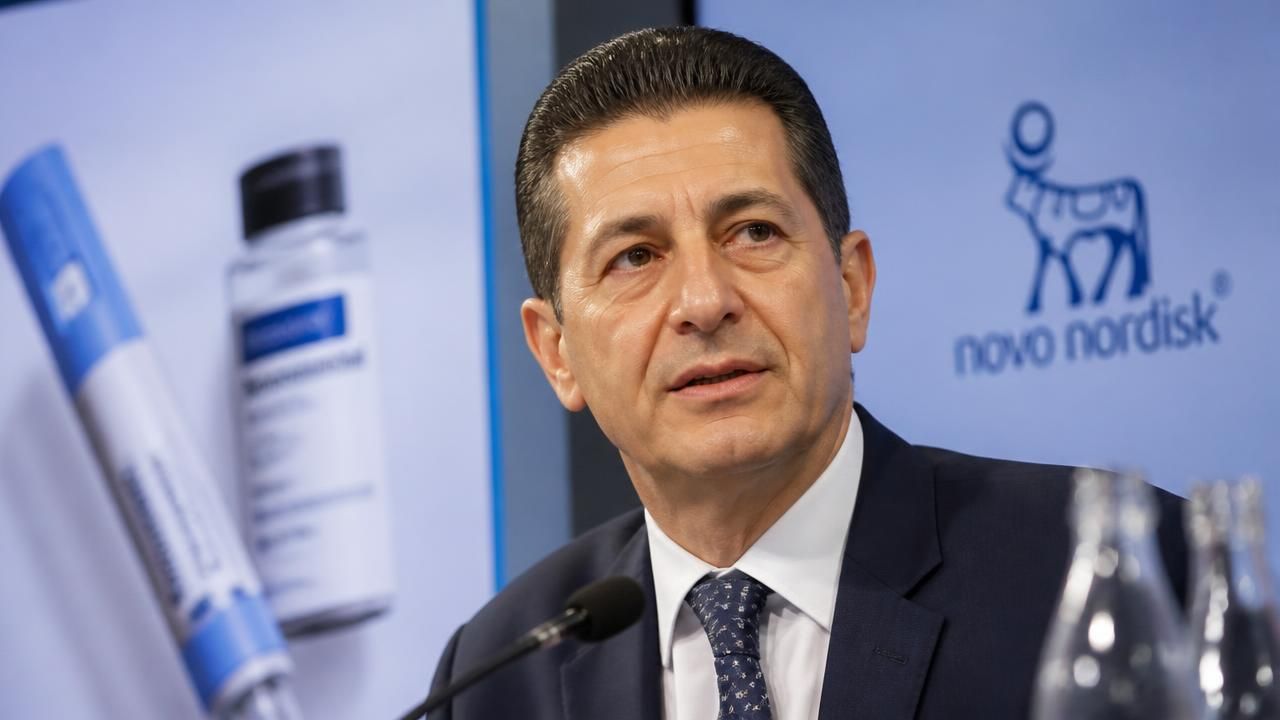
Novo Nordisk arrived at its latest earnings update with a raised outlook and a fresh growth story. It left with an 8% hole in its market value and a question it has so far failed to answer: whether anyone outside the company still believes the plan.
The Danish drugmaker once again lifted its full-year forecast, buoyed by the launch of a new Wegovy pill and the enduring strength of Ozempic, the older injectable that turned semaglutide into a household name and briefly made Novo Europe's most valuable listed company. Chief executive Mike Doustdar used the moment to point forward — to CagriSema, the company's next-generation obesity combination, and to a launch he believes is now within reach.
"We are hopeful that we will be able to get the timely approval from the FDA at the end of this year and launch it at the beginning of next year," Doustdar told Bloomberg Television, adding that he was "very optimistic" about the asset.
It was, by the standards of a pharmaceutical earnings call, a confident performance. It was not, by the standards of the market, a convincing one.
Two readings of a single briefing
The striking feature of this week's coverage is how completely the same set of remarks was refracted through different lenses.
Bloomberg Markets framed the update around momentum: a company that had again raised guidance, with a chief executive openly enthusiastic about a pipeline that could extend its franchise. MSN's account of the same day told a starkly different story — that Doustdar "delivered a warning that sank its stock by 8%," casting the chief executive's caveats, rather than his forecast, as the day's real news. Morningstar reported that the shares tumbled "as doubts persist about Ozempic maker's strategy," locating the problem not in any single disclosure but in a persistent, unresolved skepticism. CNBC went further, arguing that Novo's new strategy "hinges on something it can't manufacture: investor trust." And FiercePharma described a management team "struggling to appease restive investors" with a mix of consumer-facing commercial plans and blockbuster ambitions.
All four readings can be true simultaneously. That is precisely the problem. When a guidance raise is met with a selloff, the market is not repricing the numbers — it is repricing the narrator.
The CagriSema question
CagriSema is the clearest test of that credibility. The once-weekly combination of cagrilintide, an amylin analogue, and semaglutide was designed to attack obesity through two complementary mechanisms and was expected to deliver weight loss in the region of 25% — a threshold that would have placed it ahead of anything on the market.
When Phase 3 data showed roughly 22.7% weight reduction at 68 weeks, the result was excellent in absolute terms and disappointing relative to Novo's own framing. Investors had been encouraged to expect more; the shares fell sharply, and the episode became a case study in how guidance can become a liability. Every subsequent CagriSema disclosure now carries that history with it, which is why Doustdar's FDA timeline is being met with caution rather than applause.
Chasing the oral market
The strategic logic extends well beyond a single molecule. Novo is racing to own the oral obesity market, a segment widely viewed as the key to reaching patients who will not accept injections and to unlocking payer coverage at scale. The new Wegovy pill is central to that push, and the company has pursued pipeline deals to broaden its reach across cardiometabolic disease.
But the oral frontier is exactly where scrutiny is sharpest, because it is where competition is most intense. Eli Lilly has its own oral candidate advancing toward the market, and a generation of biotech entrants is targeting the same biology. Novo's challenge is no longer scientific primacy alone; it is commercial execution in a category it once defined and no longer monopolizes.
The trust deficit
The company's recent history explains the reflex. Since peaking in mid-2024, Novo's valuation has been compressed by trial disappointments, a costly pipeline write-down, high-profile departures in its research leadership, and the relentless advance of Lilly's rival franchise. Each event was survivable. Cumulatively, they have trained investors to discount Novo's forward statements.
Management's response — leaning into consumer channels, direct-to-patient pharmacy offerings and telehealth partnerships, alongside aggressive blockbuster messaging — is an attempt to control its own narrative rather than cede it to analysts. FiercePharma's characterization of "restive investors" suggests the effort is not yet working.
What to watch
- The FDA decision on CagriSema. Doustdar's stated timeline — approval at the end of this year, launch at the start of next — is now the single most concrete promise management has made.
- Oral Wegovy uptake. Prescription volumes and payer coverage in the first two quarters will indicate whether the pill is a genuine growth engine or a defensive product.
- US pricing dynamics. Any sign of a discount war with Lilly would hit margins and further strain the credibility of guidance.
- Pipeline deals. Bolt-on acquisitions can restore the growth narrative — or read as an admission that organic R&D has stalled.
Doustdar's task is not really scientific. Novo still sells more obesity medicine than anyone, and its forecast went up, not down. The gap is between what the company says and what the market is willing to believe — and trust, unlike semaglutide, cannot be manufactured at scale.