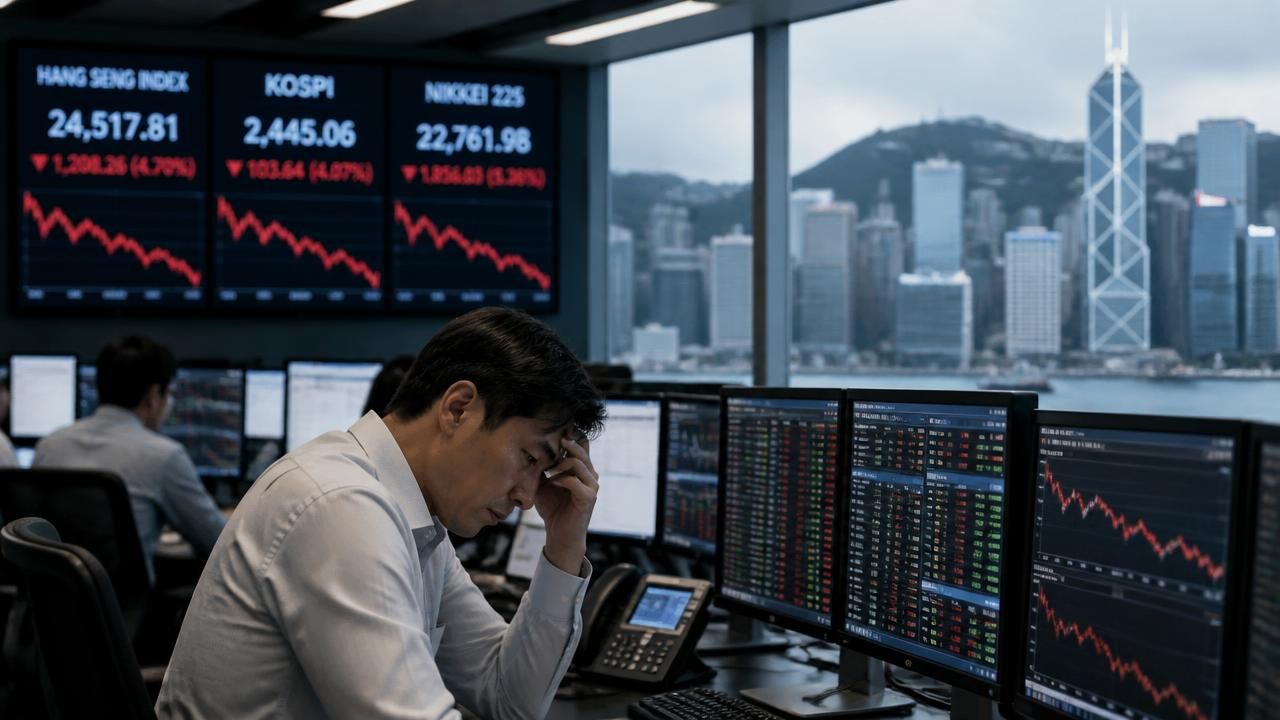
Asian equities slid to their weakest level in more than six months on Wednesday, as early Democratic victories in the U.S. midterm elections compounded an existing selloff in artificial intelligence shares and renewed anxiety about the cost of financing the sector's capital-intensive expansion.
The session's decline was broad but concentrated in technology and AI-linked names, which had been the market's principal engine of returns over the past two years. Bloomberg Markets framed the move as a reaction to political risk: investors, it reported, were unsettled by early Democratic gains that "fueled concerns about tighter oversight of the artificial intelligence industry." Other outlets covering the same session distilled the story into its simplest form — "Asian stocks fall as Democrats lead US midterms" — while analysis pieces pivoted to the question investors are actually asking: what the outcome means for Wall Street, AI valuations and Treasury yields.
Three Pressures, One Selloff
The composite picture from coverage across Bloomberg Markets, MSN and Yahoo Finance is of a market absorbing three distinct shocks simultaneously rather than a single trigger.
- Political risk: Democratic momentum in the U.S. midterms raises the probability of a divided or more interventionist Washington, and with it the prospect of hearings, disclosure rules and potential legislation aimed at frontier AI models.
- Financing costs: Yahoo Finance, citing Bloomberg, emphasized that "rising financing costs threaten [the] spending boom" underpinning AI infrastructure — data centers, chips, power contracts and the debt that increasingly funds them.
- Monetary policy: Seeking Alpha headlined the session as an "AI tech selloff," noting that the Hong Kong Monetary Authority mirrored the Federal Reserve's decision to hold rates steady.
Why AI Is Suddenly Rate- and Politics-Sensitive
The AI trade has always been a duration trade in disguise. Hyperscalers and their suppliers are valued on cash flows projected years into the future, which makes them acutely vulnerable when discount rates stay elevated for longer. The Fed's pause, mirrored in Hong Kong by the HKMA under the city's currency peg, removes the relief rally that some investors had positioned for. A hold is not a cut, and the absence of easing keeps pressure on the leveraged build-out of computing capacity.
Politics adds a second, less familiar variable. Until now, AI regulation has been discussed largely as a European and Chinese question. A stronger Democratic presence in Washington shifts that calculus for U.S. companies and, by extension, for the Asian suppliers — foundries, memory makers, substrate manufacturers and server assemblers — whose order books depend on American hyperscaler spending plans.
"Early victories by the Democrats in the US midterm elections fueled concerns about tighter oversight of the artificial intelligence industry." — Bloomberg Markets
How Different Outlets Framed It
The divergence in framing is instructive. Bloomberg led with the political catalyst, treating the election as the marginal driver of a market that had already been wobbling. MSN's headline stripped the story to its market mechanics — a straightforward risk-off session. Yahoo Finance, relaying Bloomberg's reporting, shifted the emphasis to financing conditions, effectively arguing that the election was a trigger rather than the underlying cause. Seeking Alpha connected the dots across asset classes, treating the Fed hold, the HKMA's mirror move and the AI selloff as one linked narrative.
The common thread: no outlet treated this as a one-day event. All five point toward the same underlying question of whether the AI capital-expenditure cycle can sustain itself if money remains expensive and regulation becomes a live legislative risk.
What to Watch
Investors will focus on three near-term markers. First, the final composition of the U.S. Congress, which determines whether AI oversight becomes rhetoric or statute — committee control matters more than campaign language. Second, the trajectory of Treasury yields, which transmit directly into the discount rates applied to long-duration technology stocks and into the cost of the corporate debt financing data-center construction.
Third, earnings guidance from the largest cloud and chip companies, where any hint of a pause in capital spending would validate the bears' case that the boom was partly a function of cheap money.
The Bigger Picture
For Asian markets, the exposure is structural rather than incidental. The region supplies a disproportionate share of the world's semiconductors, advanced packaging and server hardware, making local indices a leveraged proxy on American AI sentiment. That worked spectacularly on the way up. It is now working in reverse — and with an election result, a Fed hold and a repricing of credit all arriving in the same week, the market has little cushion to absorb the next surprise.
Wednesday's session was, in that sense, less a verdict on AI than a repricing of the conditions under which AI gets built. Cheap capital and light-touch regulation were two of the trade's invisible inputs. Both are now in question.