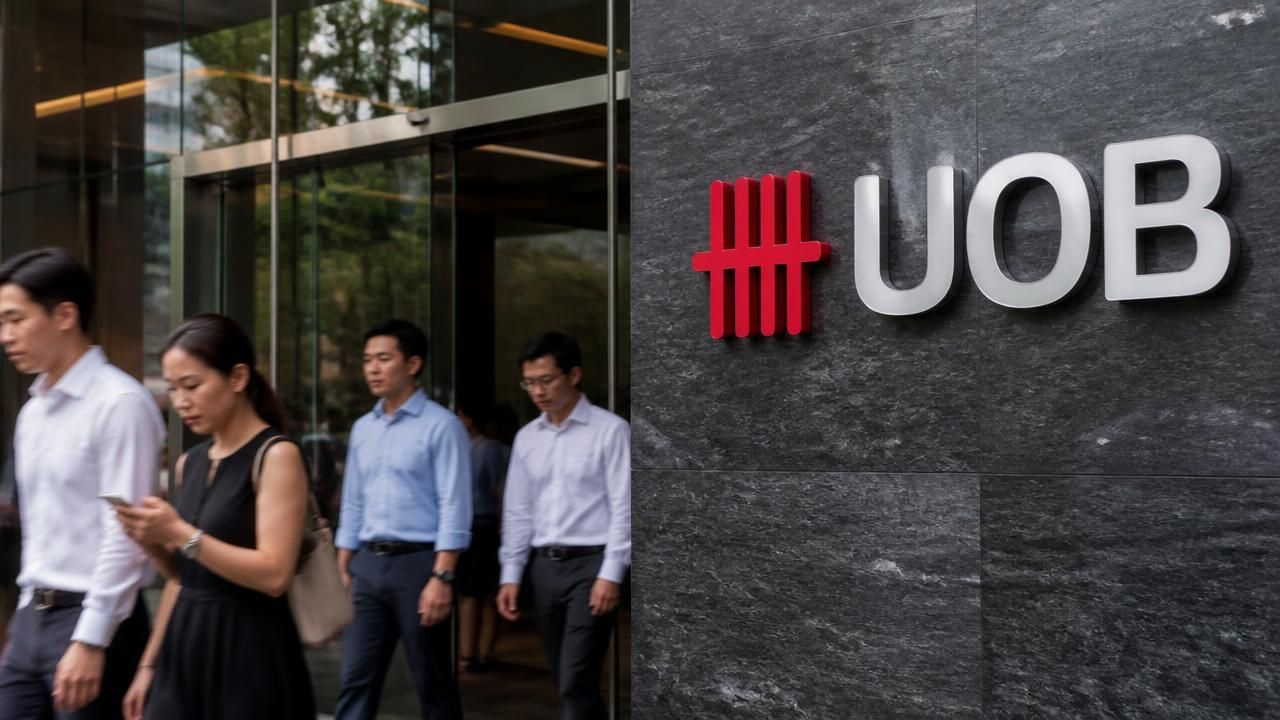
Shares in United Overseas Bank Ltd. fell more than 5% on Thursday, touching a four-month low, after Singapore's third-largest lender reported third-quarter net profit that fell short of analyst estimates — a miss driven by a sharp decline in trading and investment income and a narrowing net interest margin that bled into otherwise steady lending and fee income.
The results, flagged in headlines across Bloomberg, Reuters and other financial outlets, landed as a rare setback for a Singapore banking sector that has spent the past two years riding elevated interest rates to record profits. UOB's stock reaction was swift and pronounced, with the sell-off intensifying through the session as investors digested the composition of the miss.
What went wrong in the quarter
According to Bloomberg Markets, the shortfall stemmed from a combination of two pressures: a drop in trading and investment income, and a narrowing interest margin that crimped the gains the bank would normally wring from its core lending and fee-generating businesses. In other words, the miss was not the product of a single bad line item but of softening across the revenue stack.
Trading desks across the region have had a difficult year, with volatility spikes that hurt positioning and thinner client flows in foreign exchange and rates products. At the same time, margin compression — the gap between what banks pay depositors and what they earn on loans — has become the sector's central worry as central banks, including the U.S. Federal Reserve, move into an easing cycle.
The bank's core lending franchise and fee income did not collapse; rather, they were not strong enough to offset the drag from markets-related revenue. That distinction matters for how investors read the quarter: it is a revenue-mix problem more than a credit-quality problem.
Markets react: a four-month low
Yahoo Finance, citing the Edge, reported that UOB shares hit a four-month low as the profit miss became public, while MSN carried a parallel headline noting the stock fell more than 5% following the earnings release. The uniformity of the coverage — from Bloomberg's terminal audience to retail-facing portals — reflects how closely UOB is watched as a bellwether for Singapore's economy and for Southeast Asian credit conditions more broadly.
The magnitude of the move is notable for a stock that has historically been one of the more defensive names in the city-state's benchmark index. A single-digit percentage drop on results day signals that positioning ahead of the print had been optimistic, and that the market is repricing the bank's earnings trajectory rather than reacting to a one-off.
The bright spot: wealth momentum
Not everything disappointed. Reuters framed the quarter around a more constructive thread, headlining that UOB's wealth momentum continued even as net profit missed forecasts. That framing reflects a genuine split in the story: the bank's affluent-client franchise — private banking, wealth advisory and investment product distribution — has been a structural growth engine as Asia's wealthy populations expand and as capital continues to flow into Singapore as a wealth hub.
"Singapore's UOB Q3 net profit misses forecasts; wealth momentum continues" — the Reuters headline captured the two-sided nature of the quarter.
The divergence in emphasis between outlets is instructive. Bloomberg led with the miss and the mechanics of the revenue decline — the language of a markets audience focused on earnings quality. Reuters led with the miss but foregrounded the wealth franchise, a lens closer to how long-term institutional investors assess the bank's strategic direction. Retail-facing outlets, meanwhile, compressed the story into its simplest form: the stock fell because profits disappointed.
The rate-cut backdrop
UOB's result cannot be read in isolation. Singapore's banks — DBS, OCBC and UOB — have been among the biggest beneficiaries of the global rate-hiking cycle, with net interest margins expanding sharply as policy rates climbed. As that cycle reverses, the arithmetic turns against them. Each quarter of easing erodes the margin buffer, and analysts have been warning for months that the sector's earnings growth would decelerate.
What makes this quarter significant is that it offers an early, concrete data point for that thesis. Margin pressure is no longer theoretical or forward-looking; it is showing up in reported numbers and moving share prices.
What to watch
- Guidance on margins: Whether management signals further compression in coming quarters, and how aggressively it expects deposit costs to reprice.
- Capital returns: Singapore banks have leaned on dividends and buybacks to support valuations; any change to payout plans will be closely scrutinized.
- Wealth and fee income: Whether the momentum Reuters highlighted can offset markets-related weakness.
- Credit costs: With regional growth slowing, provisioning trends will determine whether the miss proves cyclical or the start of a more durable earnings reset.
For now, the market's verdict is clear: UOB's third quarter was a reminder that the easy money of the rate-hike era is over, and that even the region's most conservative lenders are not immune to the turn.