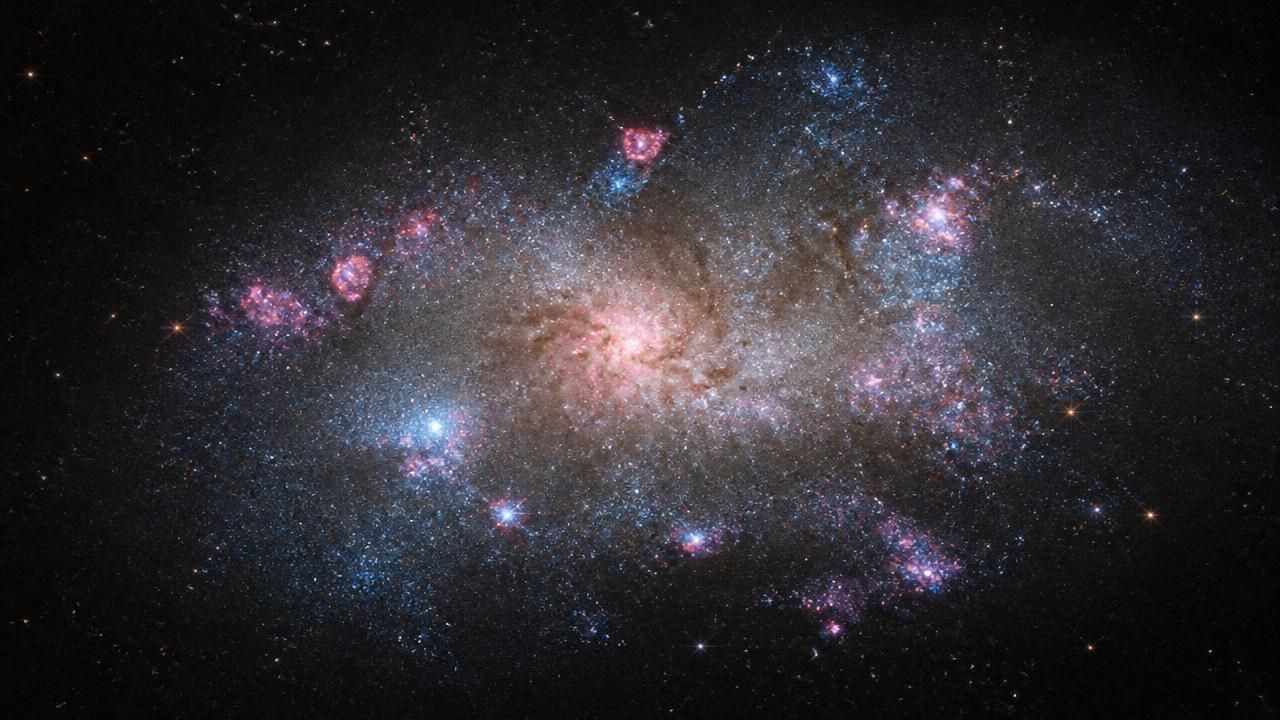
NASA's Hubble Space Telescope has helped astronomers identify a striking cosmic accounting problem: nearby dwarf galaxies appear to be missing most of the oxygen their stars have produced. The new research, organized under the banner of the Galaxies Losing Oxygen via Winds, or GLOW, study, suggests that small galaxies can hold onto only a small fraction of the oxygen created by their stellar populations. Hubble observed a set of nearby dwarf galaxies, including NGC 4449, a well-known starbursting system whose image NASA released with the findings.
The result is not about the oxygen molecules humans breathe. In astronomy, oxygen is a heavy element forged deep inside massive stars and released into interstellar space when those stars explode as supernovae or shed their outer layers. Because oxygen is relatively easy to detect in galaxy spectra, it serves as a tracer of how galaxies enrich their gas and how they lose material to their surroundings. Dwarf galaxies are especially sensitive tests because their shallow gravity makes them vulnerable to galactic winds driven by star formation and supernova explosions.
The case of the missing oxygen
According to NASA, the Hubble data show that dwarf galaxies retain only a fraction of the oxygen made by their stars. The implication is that much of the element has been pushed out of the galaxies, or otherwise redistributed, rather than staying in the interstellar gas where astronomers can easily count it. The GLOW name itself points to the favored explanation: winds capable of carrying oxygen-rich gas out of small galaxies and into the circumgalactic or intergalactic medium.
Researchers found that dwarf galaxies can hold onto only a small fraction of the oxygen made by their stars.
That finding fits into a broader picture of galaxy evolution. Dwarf galaxies are considered building blocks of larger systems, and their low metallicities make them sensitive recorders of feedback processes. When star formation heats and stirs gas, supernova explosions can drive outflows that remove not only gas but also the heavy elements created inside stars. In low-mass systems, those winds can be especially efficient because the galaxy cannot hold tightly onto its gas.
What Hubble observed and why it matters
Hubble's contribution is to provide a detailed look at nearby dwarf galaxies, where individual structures and star-forming regions can be studied more clearly than in distant systems. NGC 4449, featured in the NASA image, is a nearby dwarf galaxy with vigorous star formation, making it a natural laboratory for studying how stellar activity affects a galaxy's supply of gas and heavy elements. The new analysis adds to evidence that galactic winds are not a minor detail in galaxy evolution but a major mechanism for redistributing matter.
The missing oxygen may not be gone from the universe, of course. It may reside outside the galaxies in extended halos of gas, or it may be locked up in dust and other phases that are harder to measure. But the discrepancy between the oxygen produced by stars and the oxygen retained in the galaxies suggests that models of dwarf galaxy evolution must account for significant loss of heavy elements over time.
Why small galaxies are big tests
Dwarf galaxies are small enough that a single burst of star formation can have an outsized effect. Their shallower gravitational wells mean outflows can escape more easily than in massive galaxies, and their relatively simple histories can make them cleaner laboratories for studying feedback. If the GLOW results hold across a larger sample, they could help explain why dwarf galaxies appear metal-poor and how the building blocks of larger galaxies evolved before merging into bigger systems.
How the story is being framed
Different outlets have emphasized different angles. NASA's headline called the result a case of missing oxygen, casting Hubble as the detective in a cosmic mystery. MSN and Newswise amplified the mystery framing, while Mirage News described Hubble as finding the missing oxygen in nearby dwarf galaxies. Phys.org stressed the physical process, noting that stars make oxygen for small galaxies but the galaxies lose most of it. Sci.News focused on the bottom line: nearby dwarf galaxies are missing most of their oxygen, according to Hubble data.
The variations reflect the story's dual nature. It is partly an observational whodunit about where the oxygen has gone, and partly a broader statement about how galaxies regulate their gas, stars, and chemical enrichment. The common thread is that dwarf galaxies are not closed boxes. They leak.
What remains unknown
- Where the oxygen ends up: in circumgalactic halos, intergalactic space, dust, or other gas phases that are difficult to observe.
- How outflow efficiency varies with a galaxy's mass, star-formation rate, and history.
- Whether the GLOW sample is representative of dwarf galaxies more broadly or reflects a particular phase of their evolution.
Future observations with Hubble and other telescopes will be needed to trace the oxygen beyond the galaxies and to test whether the winds are as powerful as the missing-oxygen budget implies. For now, the GLOW study offers a clear reminder that galaxy evolution is a story of gain and loss. Stars create oxygen, but small galaxies may not be able to keep it.