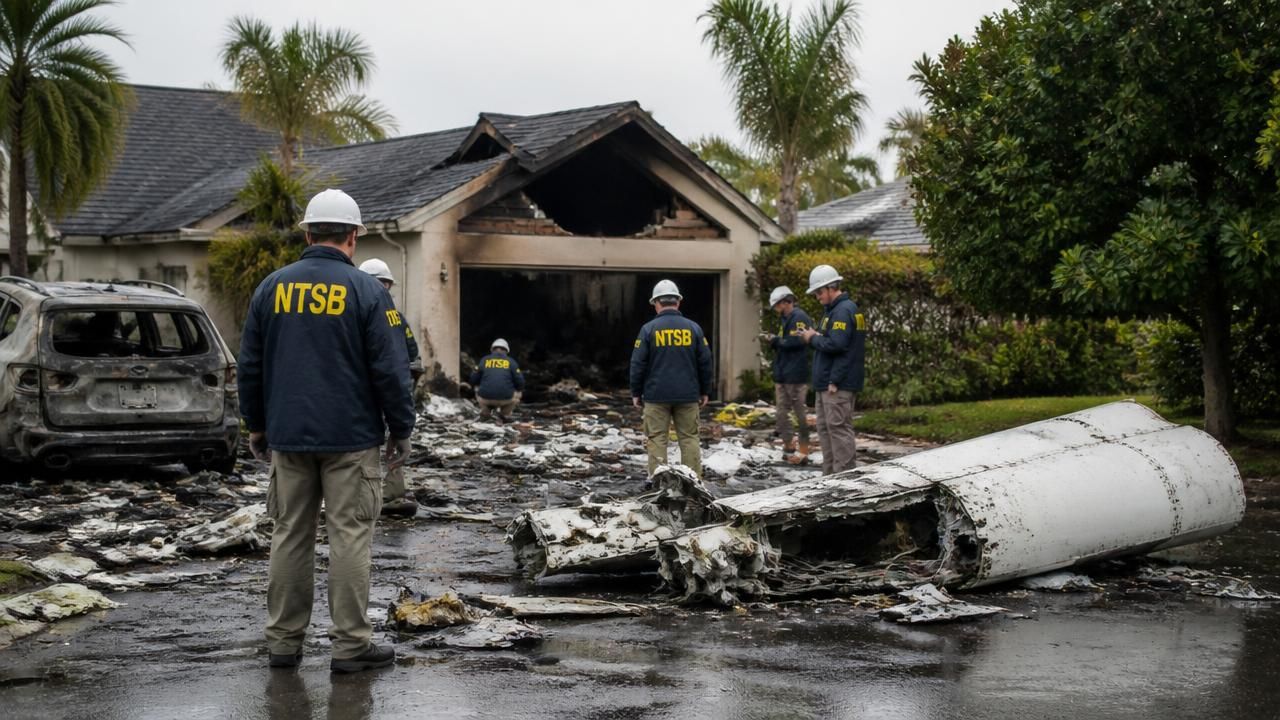
The Learjet 60 that went down in Palm Beach, Florida, on Sunday may have come apart in the air before it ever reached the ground, US air safety investigators said, a preliminary finding that helps explain both the ferocity of the crash and the scant, widely scattered wreckage left behind.
All nine people on board were killed, and at least one person on the ground was injured, according to the National Transportation Safety Board's initial account as reported by Bloomberg, NBC 6 South Florida and ABC News. The victims have been identified in multiple reports as a 45-year-old technology entrepreneur, his 40-year-old wife, their two young children, the family's nanny, a second couple traveling with them, and the two pilots — one of whom was just 20 years old.
The case has drawn intense attention for two reasons: the profile of the passengers, described by outlets including The Sun and Yahoo as a family of four plus their caretaker and friends, and the unusual physical evidence at the scene. Investigators say the debris pattern does not look like a conventional crash site.
What investigators have said so far
The NTSB's early assessment, relayed in the hours after the accident, was carefully hedged but striking. As Bloomberg reported, the agency said there were “early indications” the aircraft “had broken up before impacting the ground.” That language matters: it shifts the focus of the investigation from the final seconds of flight to the structural integrity of the airframe in the minutes before impact.
“There are early indications the Learjet 60 that crashed in Palm Beach, Florida, on Sunday had broken up before impacting the ground.” — NTSB assessment, as reported by Bloomberg
Adding to that picture, the crew reported icing conditions and moderate turbulence in the seconds before the aircraft plunged, according to a headline account from the USA Herald. Neither detail is conclusive — pilots routinely report icing and turbulence and land safely — but in combination with a suspected in-flight breakup, investigators will examine whether ice accretion, airspeed problems or a structural failure set off a chain of events the crew could not recover from.
The victims
Reporting across outlets converged on a similar roster of the dead. The Sun described a “tech tycoon,” his wife and their two toddlers, along with a nanny and two friends; Yahoo characterized the group as “a family of 4, including 2 young children, their caretaker and another couple.” NBC 6 South Florida confirmed that the flight crew was among the fatalities and highlighted that the co-pilot was 20 years old — a detail that has prompted questions about crew experience and pairing on private charter and corporate flights.
The victims' identities spread quickly across tabloid and regional outlets, while the wire services and network affiliates focused more tightly on the investigative record. One outlet, MSN, published a report referencing questions about the role of a person named Nathalia Filgueiras in the incident; that element has not been corroborated in the NTSB's public statements and should be treated with caution as the agency's factual record develops.
Why there is so little recognizable wreckage
Coverage from MSN noted the striking absence of an intact fuselage or a clearly defined impact crater, a feature that initially confused observers at the scene. Aviation accident specialists say that is consistent with a break-up sequence: when an aircraft disintegrates at altitude, components tumble on separate trajectories, producing a long, narrow debris field rather than a single concentrated site, and lighter structures are often consumed by fire or scattered beyond easy recovery.
For investigators, that same fragmentation is a form of evidence. Fracture surfaces, skin deformation and the distribution of parts can indicate whether a failure began at a specific point on the airframe and spread — the central question in any suspected in-flight break-up.
How different outlets framed the story
- Financial and wire coverage (Bloomberg, syndicated via livemint.com and jetss.com) led with the NTSB's technical finding and the possibility of a pre-impact break-up.
- Local and network reporting (NBC 6 South Florida, ABC News, southfloridareporter.com) emphasized the human toll, the number of dead and the age of the co-pilot.
- Tabloid and lifestyle outlets (The Sun, Yahoo, MSN) foregrounded the victims' identities, the family's profile and the emotional impact.
- Aggregator and regional sites (msn.com, usaherald.com, broncoswire.usatoday.com) split between headlines about icing and turbulence and headlines about the passengers' identities.
The divergence is typical of breaking aviation disasters, when official information arrives in fragments. It also creates a risk: speculative detail — including unverified claims about individuals' roles — can harden into public narrative long before the NTSB produces findings.
The wider context
The crash lands in a difficult stretch for business aviation, a sector that has boomed since the pandemic as fractional ownership, charter and private jet card programs expanded. Learjet 60s, workhorse midsize jets long popular with corporate operators, have been involved in a number of high-profile accidents over the years, and icing has been a recurring concern across the jet fleet — a hazard regulators have addressed repeatedly through certification changes and operating rules.
The accident also raises practical questions for the industry: how charter operators vet crew pairings, how weather decisions are made on short-notice private flights, and how much margin exists when a crew encounters ice and turbulence simultaneously.
What happens next
The NTSB is expected to issue a preliminary report within weeks, typically a factual summary without conclusions. A full probable-cause determination — covering aircraft systems, weather, crew performance and maintenance history — usually takes a year or more. Investigators will want the flight data and cockpit voice recorders, radar and ADS-B tracks, meteorological data and the recovered structural components.
For the families in Palm Beach, the timeline offers little comfort. For an industry that sells speed and privacy, it is another reminder that the same aircraft that compress distances also concentrate risk into a very short window of time.