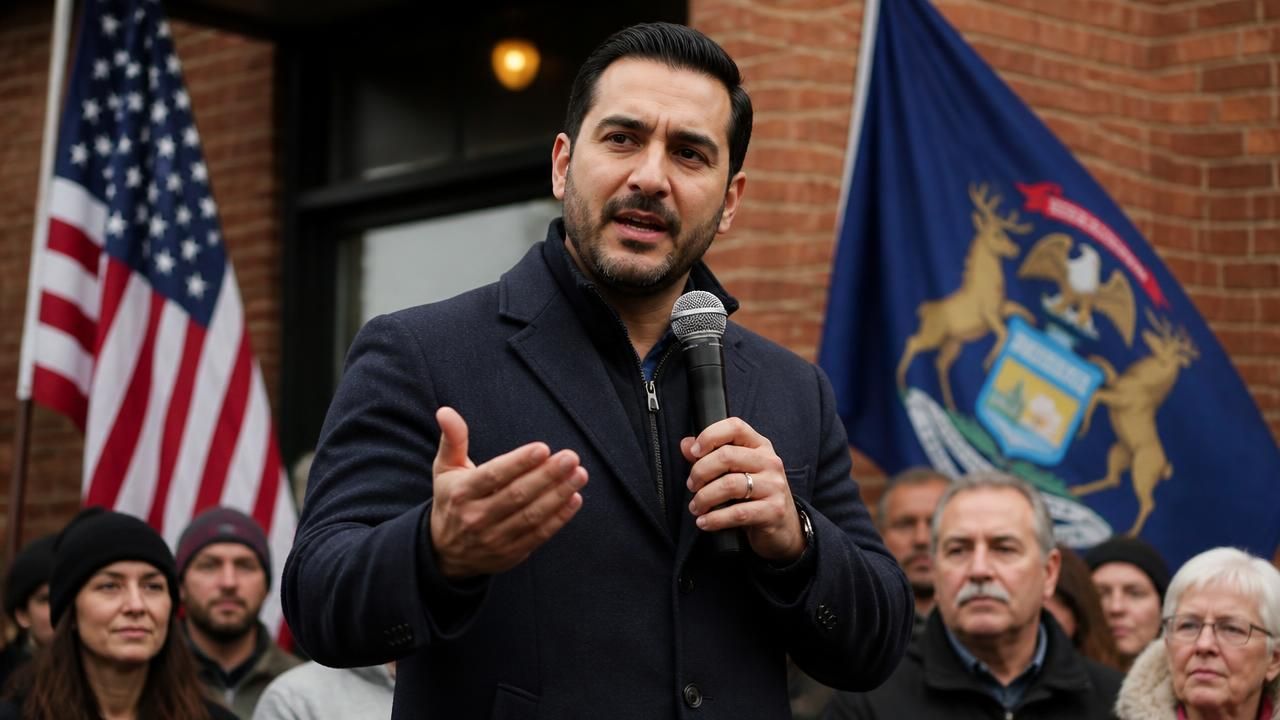
Dr. Abdul El-Sayed, the physician, epidemiologist and former Detroit health director, is running for the U.S. Senate in Michigan — and the question his campaign has forced onto the national stage is as blunt as it is consequential: can a progressive actually win a swing state? The New York Times framed the race in precisely those terms this week, with national political correspondent Shane Goldmacher examining why a victory for El-Sayed could ripple well beyond Michigan's borders and into the 2028 presidential cycle.
The framing matters. Michigan is not a safely blue state; it is a state that has swung between parties, that Donald Trump carried in 2016 and that Democrats clawed back in 2020 and 2024's down-ballot contests. For progressives, that makes El-Sayed's candidacy a stress test of a long-held centrist argument: that left-wing positions on health care, corporate power and foreign policy are electoral poison in the industrial Midwest. For the party's moderate wing, a loss would be proof; for the left, a win would be a permission slip.
A movement, not a moment
El-Sayed is not a newcomer to this fight. He ran for governor in 2018, building a grassroots, small-dollar campaign that drew national attention before losing the Democratic primary to Gretchen Whitmer, who went on to win the general election. That race established the template now on display: heavy emphasis on Medicare-for-all-style health policy, aggressive criticism of corporate influence in the party, and an appeal aimed squarely at young voters and organized labor.
The current Senate bid arrives at a moment when that template is being applied across the country. As MSN's analysis put it, progressives are prospering — and centrist Democrats, rather than conceding the argument, are "moving the goalposts." The dynamic is familiar: when left-leaning candidates outperform expectations, moderates reframe the benchmark, arguing that primary victories in deep-blue districts are not evidence of general-election viability, or that progressive energy does not transfer to swing-state turnout.
Can a progressive win a swing state? The question, as Goldmacher's reporting suggests, is less about Michigan than about what the Democratic Party wants to be after 2028.
On campus: 'sick and tired'
At Michigan State University, the progressive surge is less an abstraction than a mood. The State News, MSU's student newspaper, reported on what the movement means to students on campus, capturing a phrase that recurs among young voters: they are "sick and tired" — of stagnant wages, of housing costs, of what they describe as a political system that responds to donors more reliably than to them.
That sentiment is the engine of El-Sayed's coalition and, simultaneously, its central vulnerability. College campuses and college towns are dense with progressive enthusiasm but thin on the persuadable, swing-voting moderates who decide statewide races in Michigan. Turning campus energy into margins in Macomb County and along the I-75 corridor is the operative challenge — one that progressive campaigns have historically struggled to solve.
What the moderates are saying
The centrist counter-argument runs roughly as follows: Michigan's Senate seat is a must-hold for Democrats, and nominating a candidate whose brand is built on ideological confrontation hands the opposition a ready-made attack. Moderates point to the party's performance in suburban districts, where college-educated swing voters — particularly women — have powered Democratic gains on a platform of pragmatism rather than revolution.
Progressives counter that this logic has been used to justify caution for a generation, and that the party's erosion among working-class voters stems precisely from a refusal to offer material, universal programs. El-Sayed's camp argues that authenticity, not moderation, is the scarce commodity in an era of deep distrust in institutions.
Why 2028 looms over 2026
Goldmacher's reporting places the race in the longer arc of Democratic party-building. A progressive Senate victory in a genuine swing state would immediately reshape the 2028 primary landscape, providing the left with its strongest-ever general-election data point and complicating any attempt by the party establishment to argue that electability and progressivism are in tension.
Conversely, a decisive loss would likely be read as a verdict on the movement's reach — an outcome moderates would use to reassert control of the party's message and its donor networks.
- The candidate: El-Sayed, a physician and former Detroit health director, making his second statewide run.
- The stakes: A Senate seat in a pivotal battleground, and a data point for the left's national ambitions.
- The dividing line: Whether progressive policy is an asset or a liability with Michigan's persuadable voters.
- The backdrop: A national progressive resurgence that centrists argue is being oversold.
The broader picture
Michigan is only one arena in a wider contest over the direction of American liberalism — a contest playing out simultaneously in school board meetings, state legislatures and campus organizing drives. The outcome will depend less on ideological argument than on arithmetic: which coalition can be assembled, and in which counties.
For students at MSU and voters like them, the appeal of the progressive message is bound up with immediacy — rent, wages, debt, health care. For party strategists, the appeal is bound up with risk. El-Sayed's campaign is where those two calculations collide, and where the Democratic Party will learn, one way or another, whether the left can carry a state it cannot afford to lose.