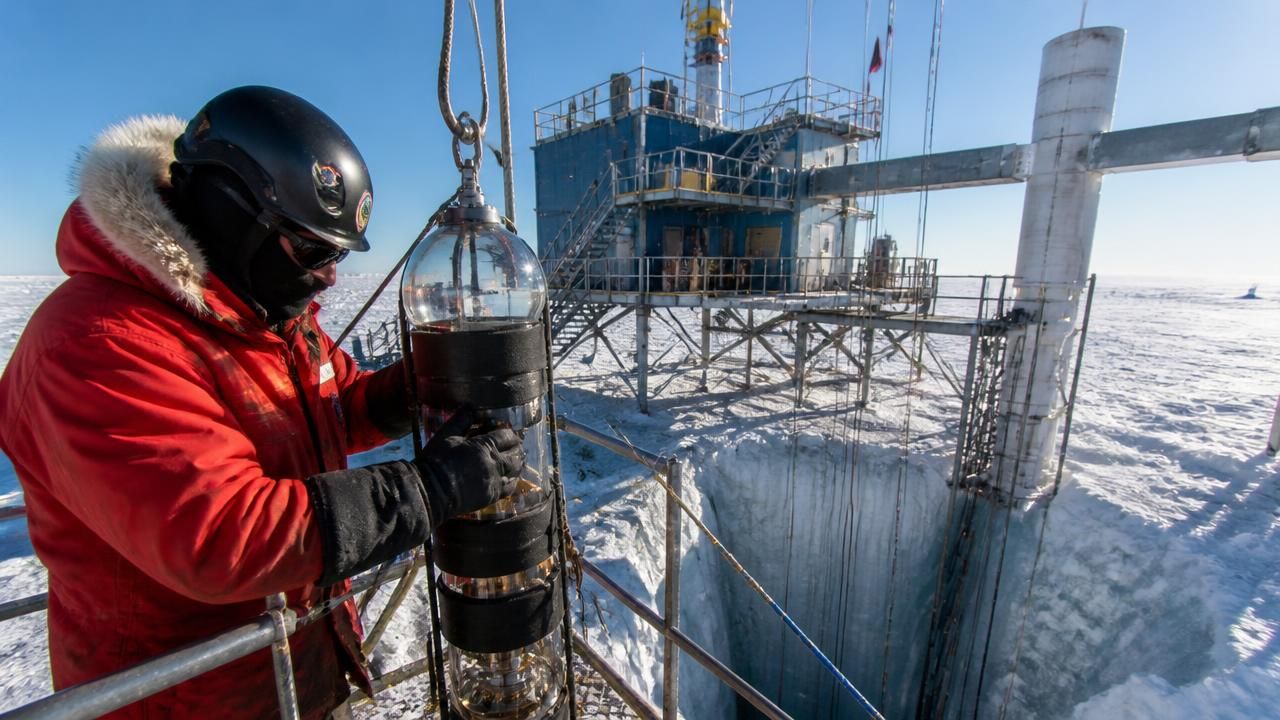
Deep beneath the South Pole, in a cubic kilometer of ancient, ultra-clear ice, a vast instrument is quietly catching particles that have traveled across the universe. This week, scientists reported that the IceCube Neutrino Observatory has detected elusive "ghost particles" — neutrinos — carrying roughly 10 billion times the energy of the neutrinos produced by our own Sun, arriving from distant cosmic sources.
The finding, which builds on more than a decade of data from the Antarctic detector, is being framed by researchers as a significant step toward understanding some of the most violent and least understood phenomena in the cosmos — from supermassive black holes to the conditions that prevailed moments after the Big Bang. It also comes as the Nobel Foundation's physics prize has been awarded to a scientist whose career has been defined by the hunt for these particles in Antarctic ice, thrusting a once-obscure field into the global spotlight.
The who, what and where: a detector the size of a city
IceCube is not a conventional telescope. It is an array of 5,160 basketball-sized digital optical modules suspended on 86 cables, drilled as deep as 2,450 meters into the Antarctic ice sheet, with a companion surface array, IceTop, above. The instrument watches for the faint blue flashes of Cherenkov light that occur when a neutrino — almost never interacting with matter — collides with an ice nucleus and spawns a cascade of secondary particles.
Because neutrinos pass through planets, stars and human bodies essentially unimpeded, they carry information that light cannot. They escape the dense, chaotic environments where cosmic rays are accelerated, traveling in straight lines from their sources. In effect, they are astronomical messengers that arrive unmuffled.
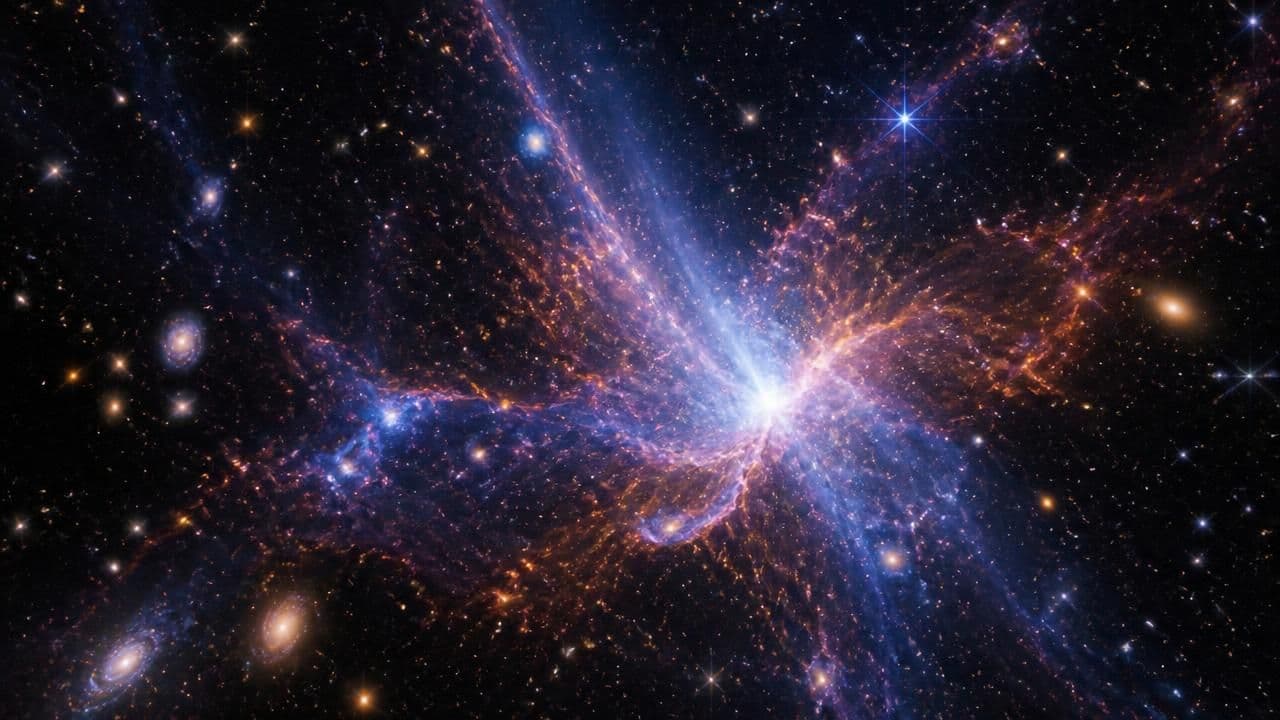
These elusive "ghost particles" could hold extraordinary clues about the Big Bang, extreme cosmic events, and some of the universe's greatest mysteries.
How the hunt unfolded
The detection of ultra-high-energy cosmic neutrinos did not happen overnight. It rests on decades of basic research into a particle first postulated in the 1930s and not directly observed until the mid-1950s. That slow, unglamorous groundwork — in nuclear reactors, mines, and massive water tanks — gave physicists the tools to build detectors large enough to catch particles arriving from space.
IceCube was the first observatory to trace high-energy neutrinos back to deep space, announcing in 2013 the discovery of a diffuse flux of astrophysical neutrinos. That breakthrough, nicknamed for the Sesame Street characters Bert and Ernie after the two highest-energy events, proved that such detections were possible at all.
Subsequent milestones followed. In 2018, the collaboration linked a single high-energy neutrino to TXS 0506+056, a blazar roughly 4 billion light-years away. In 2022, it presented strong evidence that the active galaxy NGC 1068, a relative neighbor at about 47 million light-years, is a neutrino factory. Each identification narrowed the list of candidate accelerators — but none explained the most energetic events, the ones now being reported.
Why the energy scale matters
The distinction between solar neutrinos and cosmic neutrinos is not one of degree but of kind. Neutrinos produced in the Sun's fusion core carry energies measured in millions of electron volts. The events IceCube is now reporting reach into the peta-electron-volt range — an energy scale achieved only by the most extreme accelerators known, such as supernova remnants, gamma-ray bursts, or the jets of active galactic nuclei.
At these energies, neutrinos become probes of physics beyond the standard astrophysical picture. Their arrival could help test whether the universe's most powerful particle accelerators behave as theory predicts, and could offer indirect evidence of exotic processes in the early universe.
The Nobel spotlight
The field's growing profile was underscored by the physics Nobel awarded to a scientist best known for hunting these ghost particles in Antarctic ice. The recognition is being read by researchers as validation not just of one career, but of an entire experimental approach that requires decades of patience, international collaboration and infrastructure in one of the least hospitable places on Earth.
The prize also has a practical effect: it draws funding agencies, students and media attention to a field that operates on long time horizons and enormous upfront costs. Collaborators describe the IceCube effort as a model of big science — dozens of institutions, hundreds of researchers, and a single shared detector at the bottom of the world.
The next frontier: pinning down the origins
Detecting the particles is only half the challenge. Figuring out precisely where cosmic neutrinos come from remains notoriously difficult, because IceCube can only reconstruct an approximate arrival direction for most events. That is why radio telescopes are increasingly being enlisted in the search.
Radio arrays can monitor enormous swaths of sky and catch the radio afterglow of the same cataclysmic events that produce neutrinos. By coordinating IceCube's detections with radio observations in near-real time, astronomers hope to catch a source in the act — tightening the triangulation of neutrino origin points far beyond what any single instrument can achieve.
Other observatories are joining the effort. A rival Mediterranean detector, KM3NeT, has already reported a record-setting high-energy event, and upgrades to IceCube — including the planned IceCube-Gen2, which would expand the instrument's volume roughly eightfold — promise to increase detection rates by orders of magnitude.
What it all means
- A new window on the universe: Neutrino astronomy complements light-based astronomy by revealing objects opaque to photons.
- Multiple messengers: Combining neutrinos, radio waves, X-rays and gamma rays is becoming the standard approach to identifying cosmic accelerators.
- Fundamental physics: Ultra-high-energy neutrinos offer a rare probe of particle interactions at energies no Earth-based collider can reach.
- Big-science economics: The Nobel recognition highlights how long-term, multinational investment pays off decades after construction begins.
For now, the ghost particles remain just that — fleeting, almost undetectable traces of the most violent events in the universe. But with bigger detectors, faster alerts and a widening network of telescopes, researchers are increasingly confident that the next decade will bring something even more significant: a definitive answer to where the highest-energy neutrinos are born.