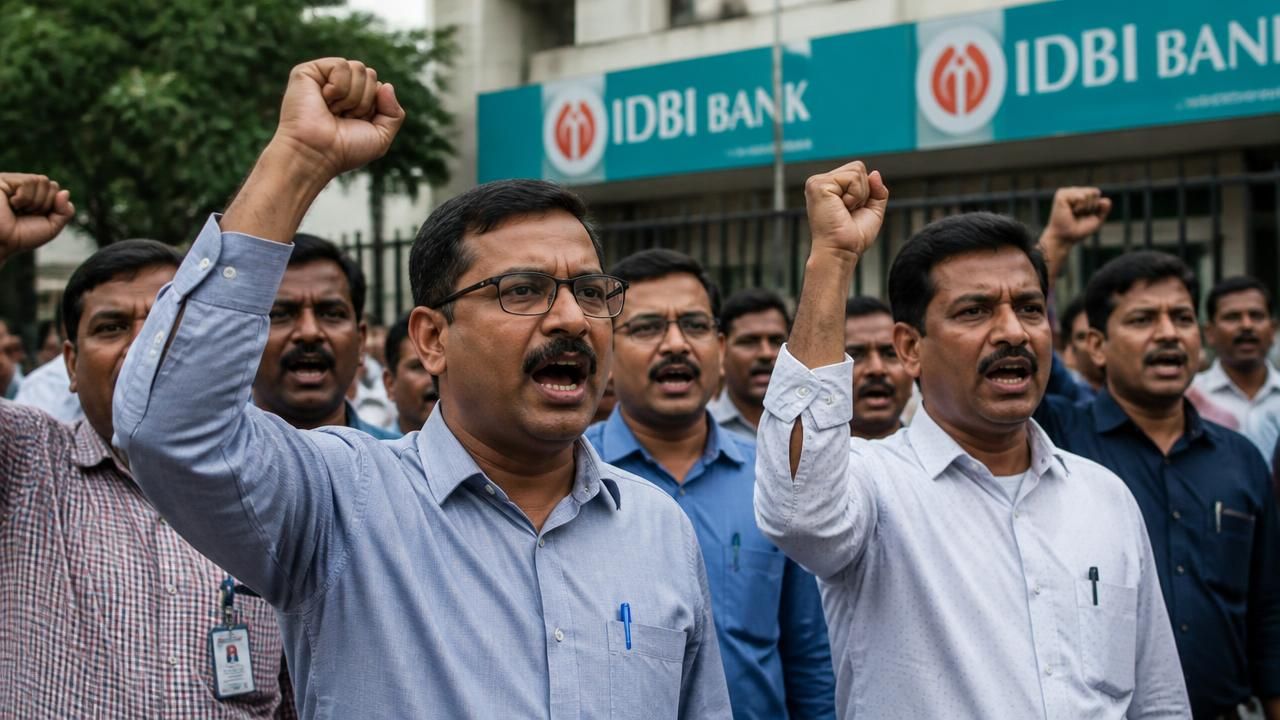
Employees of IDBI Bank Ltd. began a two-day nationwide strike on Monday, walking off the job at branches and offices across India to protest the federal government's decision to sell a majority stake in the lender to Canada's Fairfax Financial Holdings Ltd., according to Bloomberg Markets. More than 10,000 officers and staff were expected to participate in the action, which runs through Tuesday, November 3, and is the sharpest escalation yet in a months-long campaign against the landmark deal.
The transaction — valued at roughly $5.56 billion — is the largest sale of an Indian bank to a private, foreign-controlled owner, and it has drawn competing reactions from financial newswires, Indian political outlets and labour groups. International business media, including Reuters, The Wall Street Journal and Insurance Journal, have framed the sale primarily as a record-breaking cross-border banking deal and a signature moment for Prime Minister Narendra Modi's privatisation agenda. Indian outlets, by contrast, have led with the strike, the political backlash and demands for parliamentary scrutiny.
The deal at the centre of the dispute
Under the terms, Fairfax — the Toronto-based insurance and investment group controlled by Indian-born billionaire Prem Watsa — will acquire a controlling stake in IDBI Bank, with the Indian government and state-owned Life Insurance Corporation of India (LIC) together offloading the majority of their holdings. Reuters reported the purchase price at $5.56 billion, while Insurance Journal described it as the biggest India bank deal on record.
IDBI Bank's history explains much of the emotion surrounding the sale. Founded in 1964 as the Industrial Development Bank of India, a state development finance institution, it was converted into a commercial bank in 2004. Saddled with stressed assets, it was placed under the Reserve Bank of India's prompt corrective action framework in 2017 and only exited in 2021. In 2019, LIC took a 51% stake for roughly ₹21,600 crore, a rescue that made the insurer its dominant shareholder — and which critics now say is being unwound at a loss to the public exchequer.
The federal government formally approved Fairfax as the buyer for the majority stake, a decision that followed a bidding process and regulatory screening of the Canadian group's credentials. Fairfax already has a presence in Indian banking through its stake in Kerala-based CSB Bank, an overlap that will test the RBI's fit-and-proper standards for promoters.
Workers demand the sale be scrapped
At the heart of the strike is the IDBI Bank employees' forum, which has formally opposed the Fairfax stake sale and demanded a parliamentary review of the entire process. Union leaders argue that privatisation will bring branch closures, job losses and a decline in lending to priority sectors, and that IDBI's improved balance sheet means the government is selling a recovering asset at the wrong moment.
"Stop selling the golden goose to foreigners," the People's Commission on the IDBI deal said in a statement, opposing the transfer of a public institution into foreign hands.
In a striking escalation, the employees' forum has urged President Droupadi Murmu to suspend the sale and order an inquiry, taking the campaign directly to the head of state. The appeal, reported by the National Herald India, argues that the disposal of a public asset of this scale warrants presidential and parliamentary scrutiny rather than an executive decision.
Political heat over a cross-border takeover
The opposition has seized on the sale, with workers and politicians joining forces to frame the transaction as an erosion of national economic sovereignty. MSN reported that the Canada–India $5.5 billion takeover has "attracted opposition from workers, politicians," and several parties have demanded that the deal be referred to a parliamentary standing committee before completion.
Supporters counter that IDBI has already been recapitalised with taxpayer money and that private ownership — with Fairfax's deep capital base and Watsa's track record — is the best route to a durable turnaround. The government has consistently defended the process as transparent and competitive.
Markets and ratings weigh in
Financial markets initially cheered the deal, lifting IDBI shares, but the stock slid on profit booking once the Fairfax purchase was confirmed, Reuters reported — a reminder that the transaction had been substantially priced in beforehand. Ratings agency Moody's, meanwhile, said it sees limited impact on Fairfax's leverage from the takeover, signalling confidence among creditors that the Canadian group can absorb the acquisition without straining its balance sheet.
The divergence in coverage has been telling: bond and equity analysts have focused on capital adequacy, valuation and the precedent for future bank sales, while domestic political and labour outlets have concentrated on the fate of employees, depositors and public money.
What happens next
- The two-day strike is likely to disrupt branch services, cheque clearing and loan processing, and unions have warned of further action if the sale is not paused.
- Completion remains subject to remaining regulatory sign-offs, including clearances tied to Fairfax's existing Indian banking holdings.
- Opposition parties and the employees' forum are pressing for parliamentary review and, via the President, a formal inquiry before the transfer is executed.
For the government, the IDBI sale is a test case. As India's first privatisation of a state-run bank, its handling will shape investor confidence in the broader disinvestment programme and set the template for how — and whether — New Delhi can sell public lenders against organised resistance on the streets and in Parliament.