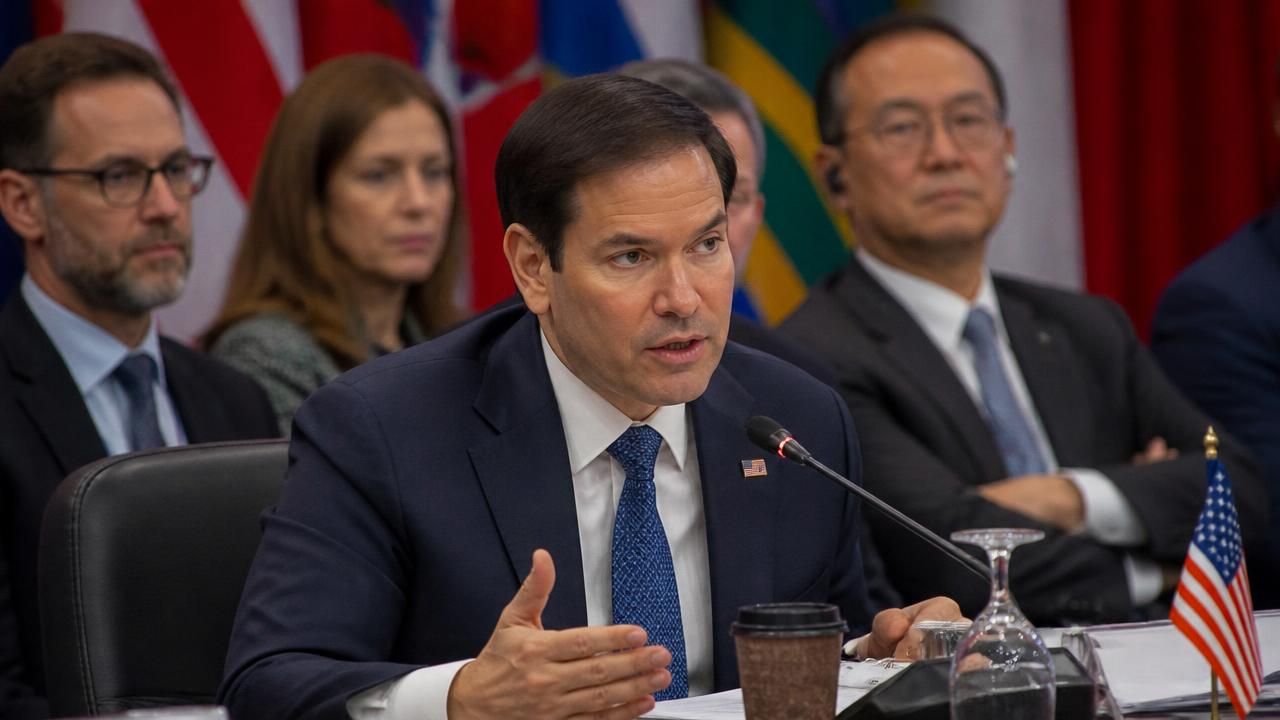
Secretary of State Marco Rubio on Friday defended the United States' decision to include Russia in this year's Group of 20 proceedings, pushing back against criticism from the European Union and other allies as a meeting of G20 foreign ministers in Atlanta broke up without agreement on the agenda's most contentious items.
The gathering ended without a consensus statement, and a planned group photograph was scrapped after European delegations objected to standing alongside Russian representatives — a small procedural detail that captured a much larger breakdown. According to accounts from multiple outlets covering the talks, the dispute over Moscow's participation overshadowed the formal agenda and left ministers unable to project the unified front the G20 typically aims for.
Rubio's Argument: Dialogue Over Isolation
Rubio framed Russia's seat at the table as a practical necessity rather than a concession, telling counterparts that engagement is the only viable route to ending the war in Ukraine. Bloomberg reported that the secretary of state characterized dialogue as the sole path to a settlement, and MSN's coverage emphasized that Rubio was explicitly defending the invitation extended to Moscow rather than merely tolerating it.
"Dialogue is the only way to end the war in Ukraine," Rubio argued, according to accounts of his remarks — a formulation that places the US in the position of insisting that talking to Moscow is a precondition for peace rather than a reward for aggression.
That framing reflects a broader strategic argument inside the administration: that isolating Russia entirely removes the channels through which any ceasefire or territorial arrangement would eventually have to be negotiated. Officials sympathetic to the position note that the G20 is an economic forum, not a sanctions regime, and that excluding a major energy and commodity exporter limits what the body can realistically accomplish.
Europe's Objection — and the Photo That Wasn't
European capitals see the same decision very differently. For EU members that have spent nearly four years coordinating sanctions, price caps, and military assistance, a photograph of European foreign ministers alongside Russian counterparts carries symbolic weight that outweighs any procedural benefit. Yahoo's reporting on the collapse of the group photo made clear that the objection was not logistical but political: European delegations declined to participate in a set piece that would have normalized Moscow's presence.
The result was an unusual public display of disunity. Where G20 foreign ministers' meetings have often produced at least a chair's statement papering over differences, this one concluded with the consensus question unresolved — a detail flagged bluntly in CNBC's headline on the meeting's close, even as the full text of that report was inaccessible to readers.
How the Story Is Being Framed
- Financial media (Bloomberg) centered Rubio's rationale, treating the dispute as a question of diplomatic strategy and war termination.
- US broadcast business media (CNBC) foregrounded the institutional outcome: no consensus on key issues, a process failure for the forum.
- Aggregated and wire coverage (MSN) led with the political clash — Rubio defending the invitation against allied criticism.
- Yahoo's account reduced the summit's dysfunction to a single vivid image: the group photo that never happened.
Read together, the coverage describes the same event along a spectrum from justification to consequence. The White House's preferred story is about keeping a channel open; the European story is about the cost of appearing to reward aggression; the institutional story is about whether the G20 can still produce agreed language on anything involving Russia.
Deepening Fractures in a Fragile Forum
The G20's modern history is a record of managed disagreement over exactly this question. At the 2022 summit in Bali, leaders labored to produce a declaration that "most members" condemned the war in Ukraine while acknowledging others dissented. The 2023 New Delhi summit required intensive sherpa negotiations to preserve that formula. Each subsequent presidency has inherited the same arithmetic: Russia is a member, the G20 operates by consensus, and consensus on Ukraine does not exist.
What is different now is the tone from Washington. The US, which holds the G20 presidency this year and will host the leaders' summit, is not merely accommodating Russia's membership as an unavoidable artifact of the forum's design but actively defending it — a shift that puts Washington at odds with the European allies it has spent four years coordinating with.
Why It Matters Beyond the Communiqué
For markets, the absence of a joint statement is less consequential than the signal it sends about coordination on sanctions, energy, and sovereign debt restructuring, all of which depend on shared political cover among the largest economies. A G20 that cannot agree on a photograph is unlikely to agree on a debt-relief framework or a common line on sanctions evasion.
For diplomacy, the Atlanta outcome raises the question of whether the leaders' summit can succeed where ministers failed. Rubio's bet is that direct engagement — including with Moscow — produces more than symbolic isolation. Europe's bet is that normalization without accountability erodes the pressure that has defined Western policy since 2022. Neither side appears close to persuading the other, and the empty space where a group photo would have hung is, for now, the most accurate picture of the G20 available.