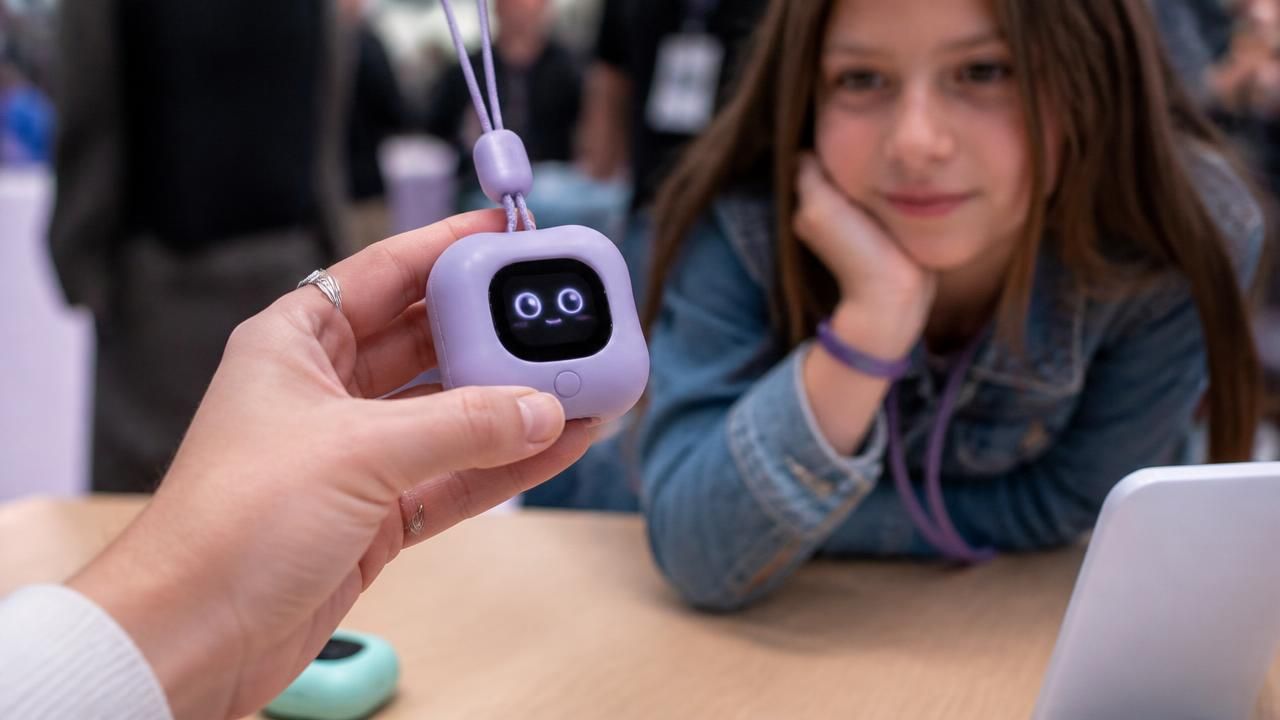
Meta has spent the past year positioning itself as an AI company first and a social network second. This week it made that pitch physical. In a reveal styled as a classic "one more thing" moment, Mark Zuckerberg unveiled the Muse Charm, a squishy, Tamagotchi-style pendant designed to carry the company's Muse AI agent around your neck — or in your pocket — just in time for the holiday shopping season.
The device is small, deliberately cute, and built around a single idea: that talking to an AI should feel less like opening an app and more like tending to a pet. It has a face. It has moods, or at least the simulation of them. And according to Meta, it is meant to be a companion.
What Meta Actually Announced
The Muse Charm is the consumer-facing tip of a broader push. Alongside the pendant, Meta is releasing an open-source project that lets developers and hobbyists build their own AI gadgets running the Muse agent — for free. The company is also quietly shipping other AI-powered consumer apps, including a fashion tool for virtually trying on clothes, as it works to push Muse onto as many devices and surfaces as possible.
That combination — a cute, kid-adjacent wearable on one side, an open developer platform on the other — is the tell. Meta is not really selling a toy. It is trying to establish Muse as the default conversational layer across hardware it controls and hardware it doesn't, much the way Android once spread across a fragmented phone market.
Build Your Own (Kind Of)
The open-source release has already produced the most entertaining coverage of the launch. The Verge's reporter declined to buy the official Charm and instead built a functional clone for roughly $50, using off-the-shelf parts. Their version lacks the cameras and 5G cellular radio of Meta's device, but it talks to Muse, displays cute avatars, doubles as a pocket watch and remote camera viewfinder, and can — in theory — control a smart home.
"I won't be buying one, because we have Muse Charm at home. It cost just $50, and I've decided the learning experience was worth it."
That framing matters. For a certain slice of the tech press, the story isn't the pendant — it's the fact that the pendant is reproducible. If a determined tinkerer can approximate the experience in an afternoon with "a lot of extra vibe code," the value proposition of a mass-market AI charm becomes a question about design polish and ecosystem lock-in rather than raw capability.
The Backlash
Not everyone finds it charming. The sharpest criticism has focused on the device's obvious appeal to children and teenagers. Coverage in Israeli outlet Ynet captured the charge directly: an "attempt to get kids hooked." Child-safety advocates and some parents argue that a always-listening, always-present AI companion aimed at young users raises familiar questions about data collection, emotional dependence, and the substitution of algorithmic interaction for human relationships.
Meta has not detailed exactly how the Charm handles consent, parental controls, or audio retention — details that will determine whether the device is a novelty or a genuine regulatory problem. The timing is not helpful: the launch lands amid growing public concern over AI generally, and specifically over the effects of AI companions on adolescent mental health.
The Youth Question
Deccan Herald framed the launch as an open commercial question — whether a "smart digital AI pal" can actually win over younger users who are already saturated with apps and largely unimpressed by hardware gimmicks. The answer isn't obvious. The generation Meta is courting grew up with free, frictionless software. Charging them for a plastic face is a different sale.
A Crowded, Bruised Category
Meta is entering a market with a graveyard. The Humane AI Pin and the Rabbit R1 both promised to replace the phone with an AI-first gadget and both were widely panned for unreliable performance and unclear utility. Smart speakers followed a similar arc — enormous early enthusiasm, then stagnation once the novelty wore off.
CBS News framed the launch as part of a wider wave: "Ready or not, here come the AI gadgets, from 'charms' to smart speakers." That's the right lens. Meta isn't alone. Rivals including OpenAI have been pursuing dedicated AI hardware, and the entire consumer-electronics industry is betting that the chatbot will eventually escape the rectangle in your pocket.
The difference is distribution. Meta already has billions of users and a shipping Muse agent. It doesn't need the Charm to be a hit product; it needs it to be a beachhead — a cheap, cheerful object that normalizes talking to Meta's AI in public.
Why It Matters
Three things are happening at once. First, Meta is converting AI from a feature inside its apps into an ambient presence with its own hardware identity. Second, it is courting developers with an open platform, betting that ecosystem breadth beats a single polished device. Third, it is doing both while the reputational cost of AI — especially AI aimed at young people — is rising.
The result is a launch that reads very differently depending on where you stand. For The Verge, it's a challenge accepted, a $50 weekend project that demystifies the product. For Digital Trends, it's a developer opportunity. For Ynet and parent groups, it's a hook dressed in a cute face. For Meta, it's all three at once — and the company is hoping the charm wins.
What none of the coverage answers yet is the only question that matters for the category: after the novelty fades, does anyone still want to carry a chatbot on a lanyard? The Charm will be the first real test of that since the AI pin era flamed out — and this time, the stakes are children as well as dollars.