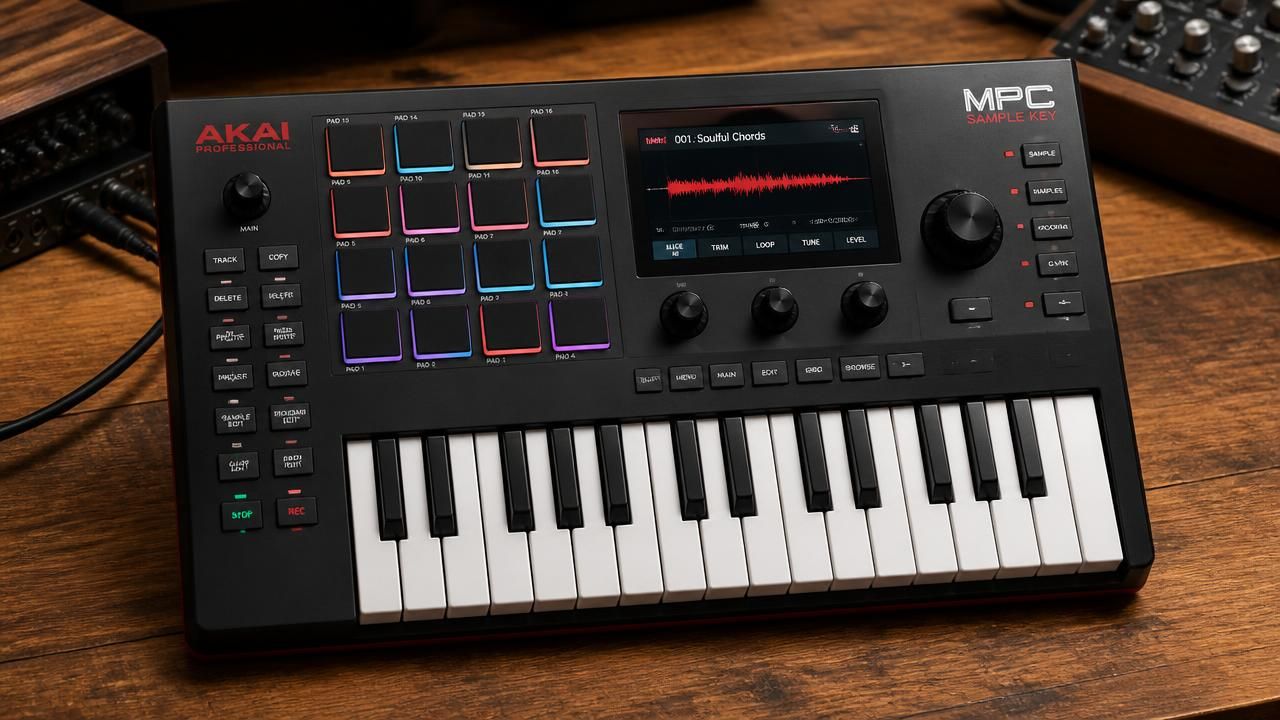
Akai has given the music-production world its clearest look yet at the MPC Sample Key, a new instrument that the company teased on Instagram earlier this week—and that it says will ship with open-source software intended to let the modding community tinker freely. The teaser arrived without a launch date or price, leaving producers and hardware hackers to parse the clues. The Verge has obtained exclusive images of the device that fill in some of the blanks, showing a compact machine that borrows heavily from Akai's existing MPC Sample but appears tuned for a different creative workflow.
A familiar MPC layout, retuned for pitched samples
According to The Verge, the Sample Key shares many of the same controls as the MPC Sample, including three context-sensitive encoders and a large main encoder. Those controls have become a signature of Akai's modern MPC line, giving users tactile access to parameters without burying them in menus. But the resemblance appears to stop at the control surface. The Verge reports that the Sample Key seems designed for pitched sample playback rather than chopping up drums. That distinction matters: drum chopping is about slicing breaks and one-shots into playable pads, while pitched playback is about turning samples into melodies, chords and harmonic parts.
The images also suggest that the chop button found on the MPC Sample has been changed or removed—The Verge's report highlights the 'chop' button as a point of difference. Akai has not detailed the full feature set, so it is not yet clear whether the Sample Key will include a keyboard-style interface, pad grid or another performance surface. The name itself implies a keys-oriented approach, but the company has not confirmed those specifics.
Open source as a product strategy
The most consequential detail may be Akai's promise to open-source the Sample Key's software. The company said it plans to open the software so that the modding community can 'hack it to their hearts' delight,' according to The Verge. That is an unusual move for a mainstream music-hardware maker. Most commercial grooveboxes and samplers run closed firmware, with official updates controlled by the manufacturer. Opening the software could invite custom workflows, alternative firmwares, community-made features and longer product life. It also raises questions about support, security and quality control: open platforms can flourish, but they can also fragment the user experience if mods vary widely.
Akai plans to open-source its software so the modding community can "hack it to their hearts' delight."
For Akai, the strategy could strengthen loyalty among tinkerers and educators who want instruments they can adapt. For the broader industry, it is a signal that open-source principles are moving deeper into consumer music gear, where hobbyists have long modified hardware but rarely received official permission to alter firmware.
Timing, competition and the Behringer comparison
MSN's coverage placed the Sample Key in a competitive frame, with one headline noting that the teaser landed a day after 'Behringer's open-source kick.' The wording positions Akai's announcement not in isolation but in a broader contest over accessible, community-friendly music tools. Behringer has built a reputation for aggressive pricing and controversy, and any open-source move from a legacy brand like Akai will inevitably be read against that backdrop. The timing may be coincidental, but it gives the Sample Key a narrative: established manufacturers are now competing on openness as well as specs.
The Verge's exclusive, by contrast, focuses on the product itself—controls, workflow and the images that reveal what Akai has not yet said publicly. MSN's 'inside look' headline promises a feature breakdown, though the available excerpt offers little beyond the teaser. Yahoo's headline takes a longer view: 'Akai's MPC Sample is Bridging the Gap for Generations of Music Producers.' That framing emphasizes culture and continuity over incremental hardware details, casting the MPC line as a bridge between older sampling traditions and newer production communities.
Why the MPC name still matters
Akai's MPC series dates back to the 1980s, when the MPC60 helped define the idea of a self-contained sampling and sequencing workstation. Its pad-grid interface became central to hip-hop, electronic music and beat-driven production. Modern MPC devices have expanded into touchscreens, plugins and standalone workflows, but the core appeal remains the same: hands-on control over samples. The Sample Key, if it delivers pitched playback in a compact form, could appeal to producers who want to play samples chromatically rather than simply trigger them.
The open-source promise adds a new layer. It could turn the instrument into a platform, with users sharing scripts, custom mappings and alternate firmwares. That is attractive to the modding community, but it also complicates Akai's role: the company must support a product that users are invited to change. How Akai handles warranties, updates and community contributions will determine whether open source becomes a genuine differentiator or a marketing gesture.
What remains unknown
Akai has not announced a launch window or price for the MPC Sample Key. Those omissions are critical in a market where affordable hardware competes with software and mobile production tools. The Verge's images offer the best available look at the device, but they do not answer questions about storage, connectivity, sampling time, battery power or how deeply the open-source software can be modified.
For now, the Sample Key is a teaser with a clear message: Akai wants to be seen as friendlier to modders than the average hardware maker. The next test will be whether the final product delivers on that promise without sacrificing the reliability and immediacy that MPC users expect. If it does, the Sample Key could be less about one instrument than about a new contract between manufacturers and the communities that keep their gear alive.