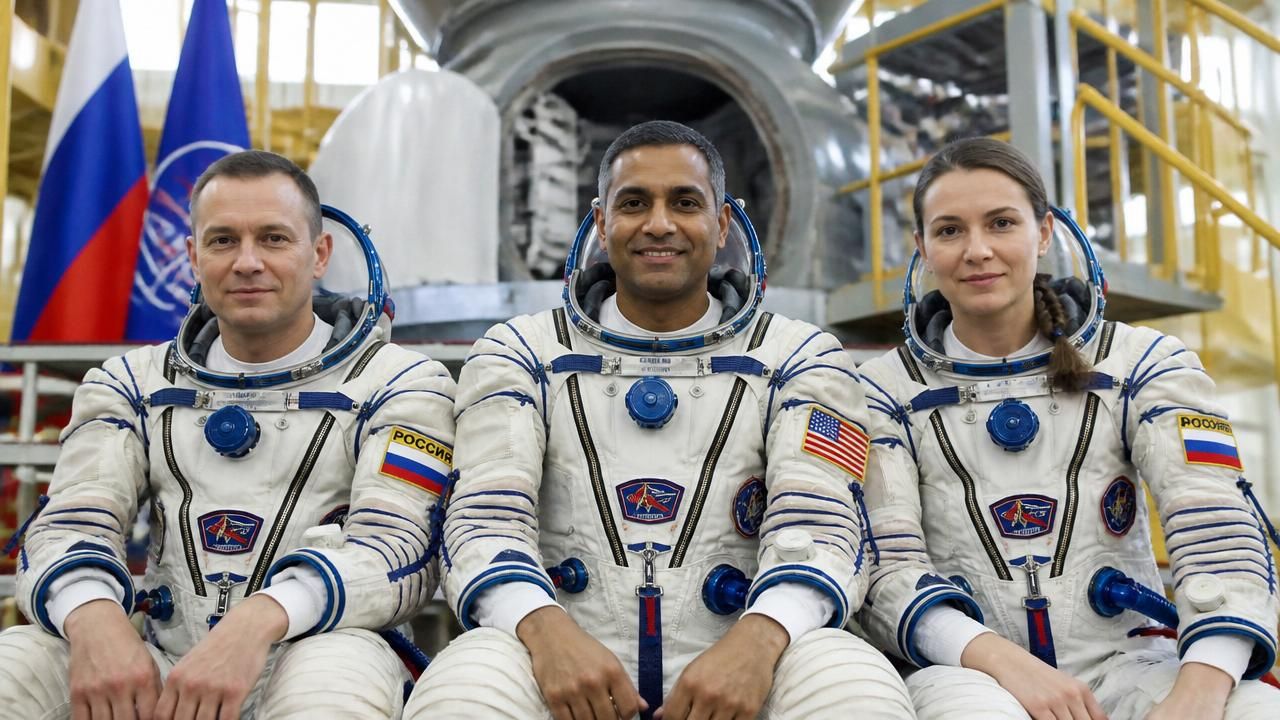
NASA astronaut Dr. Anil Menon is poised to make history on Tuesday, July 14, when he launches aboard the Roscosmos Soyuz MS-29 spacecraft to the International Space Station (ISS) for an eight-month mission. The Indian-origin physician and former SpaceX flight surgeon will be accompanied by Russian cosmonauts Pyotr Dubrov and Anna Kikina, joining Expedition 74 to advance scientific research and technology demonstrations.
A Diverse Background: From Everest to Space
Dr. Menon, 48, brings a unique blend of experiences to the ISS. Born to Indian immigrants in the United States, he is of Malayali heritage, making him the first astronaut of Malayali origin to travel to space. Before his selection by NASA in 2021 as part of the Artemis astronaut corps, Menon served as a flight surgeon for SpaceX, supporting the company's Crew Dragon missions. He also holds a medical degree and has climbed Mount Everest, a feat that underscores his resilience and physical endurance. According to NASA, Menon's diverse background makes him an ideal candidate for long-duration spaceflight, where adaptability and teamwork are crucial.
Mission Details: Soyuz MS-29 and Expedition 74
The Soyuz MS-29 spacecraft is scheduled to lift off from the Baikonur Cosmodrome in Kazakhstan at 10:00 p.m. EDT on July 13 (3:00 a.m. BST, 7:30 a.m. IST on July 14). The crew will dock with the ISS approximately three hours later, joining the current Expedition 74 crew. Menon, Dubrov, and Kikina will spend about 240 days aboard the station, conducting over 200 experiments in biology, physics, and human health. NASA's official portrait, taken on Jan. 8, 2026, shows Menon in a spacesuit at Johnson Space Center, reflecting his readiness for the mission.
“Dr. Menon’s work on the ISS will help us understand how the human body adapts to long-duration spaceflight, which is critical for future missions to the Moon and Mars,” said a NASA spokesperson.
Scientific Research and Technology Demonstrations
During his stay, Menon will focus on several key research areas. These include studying the effects of microgravity on cardiovascular health, testing new water recycling systems, and conducting experiments on plant growth in space. One notable project involves using a portable MRI scanner to monitor brain changes in astronauts, a collaboration with the University of Texas. Menon will also test a new robotic arm designed for satellite servicing, developed by the Canadian Space Agency. These experiments aim to benefit life on Earth by improving medical technologies and resource management.
Human Health in Microgravity
Menon's medical background will be invaluable for studying bone density loss, muscle atrophy, and vision changes—common issues for astronauts. He will participate in a study on the effectiveness of a new exercise device that uses artificial gravity to counteract these effects. “Understanding these changes is vital for planning missions to Mars, which could last up to three years,” noted Dr. Jennifer Fogarty, chief scientist at NASA's Human Research Program.
Technology Demonstrations
The mission will also test a new 3D printer that uses lunar regolith simulant to create tools, a precursor to in-situ resource utilization on the Moon. Additionally, Menon will deploy a set of CubeSats to monitor Earth's climate, providing data on ice melt and atmospheric changes.
Perspectives from Different Outlets
Coverage of Menon's mission has highlighted different angles. Indian media outlets like The Week and Rediff emphasize his Indian heritage and the pride it brings to the diaspora. CNBC TV18 focuses on the financial and technological implications, noting that the mission underscores growing international cooperation in space. Meanwhile, U.S. sources like MSN and NASA stress the scientific objectives and Menon's path from SpaceX to NASA. The Russian state news agency TASS highlighted the continued partnership between Roscosmos and NASA despite geopolitical tensions, with Kikina's inclusion symbolizing collaboration.
“This mission is a testament to the power of international cooperation,” said cosmonaut Anna Kikina in a pre-launch interview. “We work together for the benefit of all humanity.”
Historical Context and Implications
Menon's flight comes at a time when NASA is preparing for the Artemis program, aiming to return humans to the Moon by 2025. The ISS serves as a testbed for technologies needed for deep space exploration. The Soyuz MS-29 mission also marks the continued reliance on Russian spacecraft for crew transport, as Boeing's Starliner faces delays and SpaceX's Crew Dragon handles most U.S. missions. Menon's eight-month stay is longer than standard ISS rotations, which typically last six months, allowing for more comprehensive research.
Conclusion
As Dr. Anil Menon prepares to launch, his journey represents a convergence of medical expertise, adventurous spirit, and international collaboration. The experiments he conducts will not only advance space exploration but also offer tangible benefits for life on Earth. With the countdown underway, the world watches as a new chapter in spaceflight unfolds.