Amazon’s latest Alexa device refresh is not just about better sound or a new screen. It is about turning the smart speaker into a more active sensor for the home. The centerpiece is the Echo Studio with Home Camera, a version of Amazon’s high-fidelity speaker that adds an integrated camera. It arrived alongside a new Echo Dot with a built-in smart-home hub and the Echo Show 16, a large-screen device whose camera capabilities are already prompting debate. Across coverage from Ars Technica, Android Authority, PCMag, MSN and The New York Times’ smart-speaker guide, one theme is clear: Amazon is pushing Alexa deeper into daily life—adding AI processing, home-automation control and cameras—while inviting fresh questions about price, usefulness and privacy.
A high-fidelity speaker that watches back
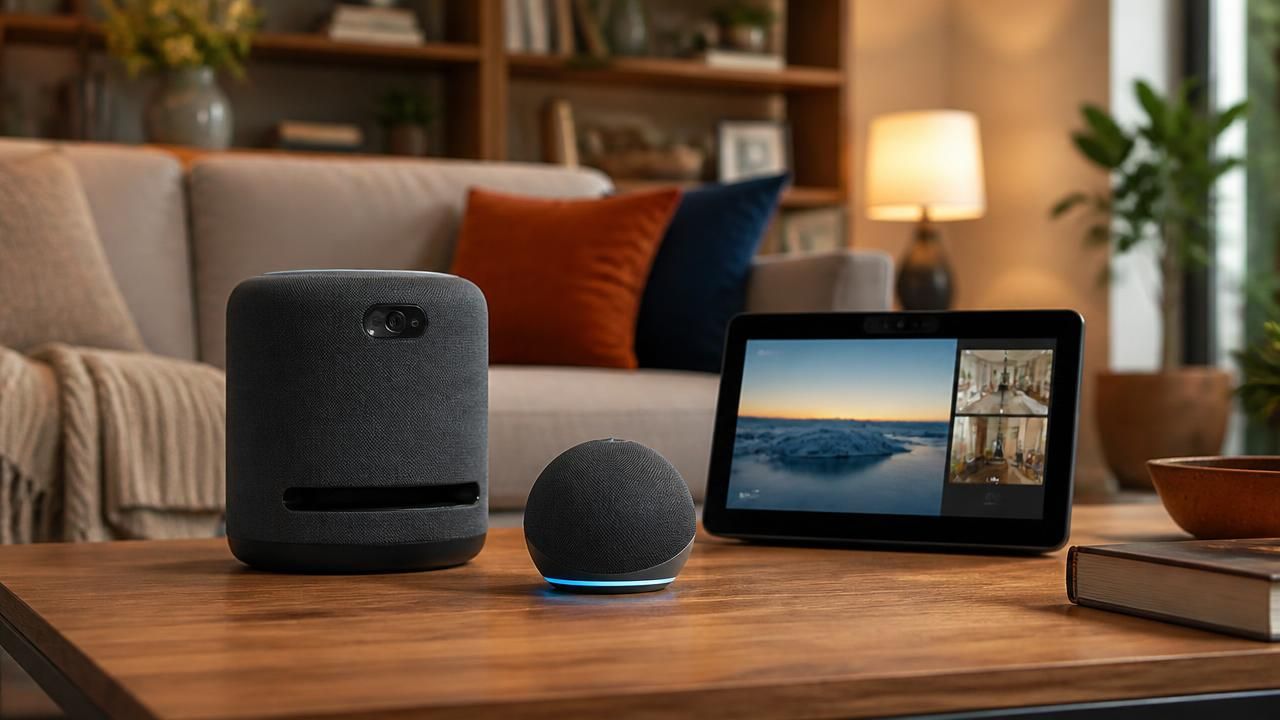
Since debuting in 2019, the Echo Studio has been aimed at users who wanted superior audio from an Alexa speaker. The new Echo Studio with Home Camera does not radically rewrite that audio recipe. According to Ars Technica, it shares the same core speaker hardware as the standard Echo Studio: one 3.75-inch high-excursion woofer and three full-range drivers. Both support Dolby Atmos and Amazon’s proprietary algorithm for creating a surround-sound-like effect from stereo audio. They also offer lossless HD audio, four-microphone arrays and the same AZ3 Pro processor Amazon introduced a year ago.
The bigger changes are in sensing and software. Amazon announced Advanced Room Adaptation for the new model, saying the feature “continuously tunes the sound to your space, automatically adapting to the room’s acoustics.” The AZ3 Pro processor includes an AI accelerator designed to support Alexa+, Amazon’s generative AI chatbot. And then there is the camera itself, which changes the product’s role: this is no longer only a speaker for music and voice commands, but a potential home-monitoring device.
Gear-focused coverage at MSN framed the device as Amazon’s most hi-fi smart speaker getting its biggest upgrade in years. That is true in one sense—the Studio line has been due for a meaningful refresh—but the upgrade is less about acoustics than about ambient computing. The camera, the AI accelerator and the room-tuning software point to a future in which Alexa does more than respond to requests. It may also watch, listen and infer context.
A broader lineup, and a higher barrier to entry
The Echo Studio is only one piece of Amazon’s push. Android Authority reported that Amazon also upgraded the Echo Dot with a built-in smart-home hub, but users will have to pay up for the privilege. That matters because the Dot has long been Amazon’s low-cost entry point into Alexa. Adding a hub makes the device more central to a connected home, potentially reducing the need for separate bridges or hubs, but a higher price could weaken the Dot’s traditional appeal.
At the other end of the lineup is the Echo Show 16. PCMag’s headline captured the tension around the device: it can see everyone walking past your house, which is “amazing…and terrifying.” The phrase is not just a clever framing. It gets at the core trade-off of camera-equipped smart devices. A wide view of the street or yard can be useful for security, deliveries and automation. It can also capture neighbors, passersby and household members who did not choose to be recorded.
The New York Times’ best Alexa smart speakers guide reflects a more consumer-facing question: with so many overlapping Echo models, which one actually belongs in your home? Amazon now offers audio-first speakers, display-first devices and hub-equipped models, all connected to the same assistant. The new lineup makes that choice more complicated—and more consequential.
Why Amazon is making cameras part of Alexa
Amazon’s strategy is not hard to read. Alexa+ needs hardware that can showcase generative AI features, and the AZ3 Pro processor’s AI accelerator is meant to support that shift. Smart-home hubs make Alexa more central to connected devices. Cameras add another kind of utility: security, monitoring, presence detection and visual context. In a competitive market against Google and Apple, Amazon wants its devices to be the default interface for the home.
There are business reasons, too. Smart speakers are often sold as low-margin gateway products. The more Amazon can tie Alexa to security, automation, subscriptions and services, the more valuable the ecosystem becomes. But that strategy depends on trust. Consumers must believe the convenience is worth the cost, and that the camera is not just an always-present sensor they cannot control.
The privacy question is now central
PCMag’s “amazing…and terrifying” framing is the most direct expression of the privacy debate, but it is not the only one. Camera-equipped speakers and displays raise familiar concerns about consent, data retention, cloud processing and whether footage or derived data could be accessed by law enforcement or third parties. They also raise less obvious questions: What happens when a device can see a public sidewalk from inside a private home? How are guests notified? What controls exist to limit recording?
PCMag’s headline—that the Echo Show 16 can see everyone walking past your house, which is “amazing…and terrifying”—captures the promise and the problem in a single phrase.
Amazon has previously emphasized privacy controls across its Echo and Ring products, and it will need to make those controls clear and usable as cameras spread across more devices. The risk is not only regulatory. It is reputational. A smart speaker that watches back may offer real utility, but it can also feel intrusive in a way that a microphone-only speaker does not.
What to watch next
The success of this refresh will depend on three tests. First, pricing: the Echo Dot’s hub feature may be useful, but only if buyers see the value. Second, privacy: Amazon must show that camera features are transparent, optional where possible and tightly controlled. Third, usefulness: Alexa+ and Advanced Room Adaptation need to feel like meaningful improvements, not marketing labels.
For now, the new Echo Studio, Echo Dot and Echo Show 16 show Amazon betting that the next phase of the smart home is not just voice-controlled but sensor-rich. The company wants Alexa to hear, see and control more of the home. Consumers—and privacy regulators—will decide whether that feels like progress or overreach.