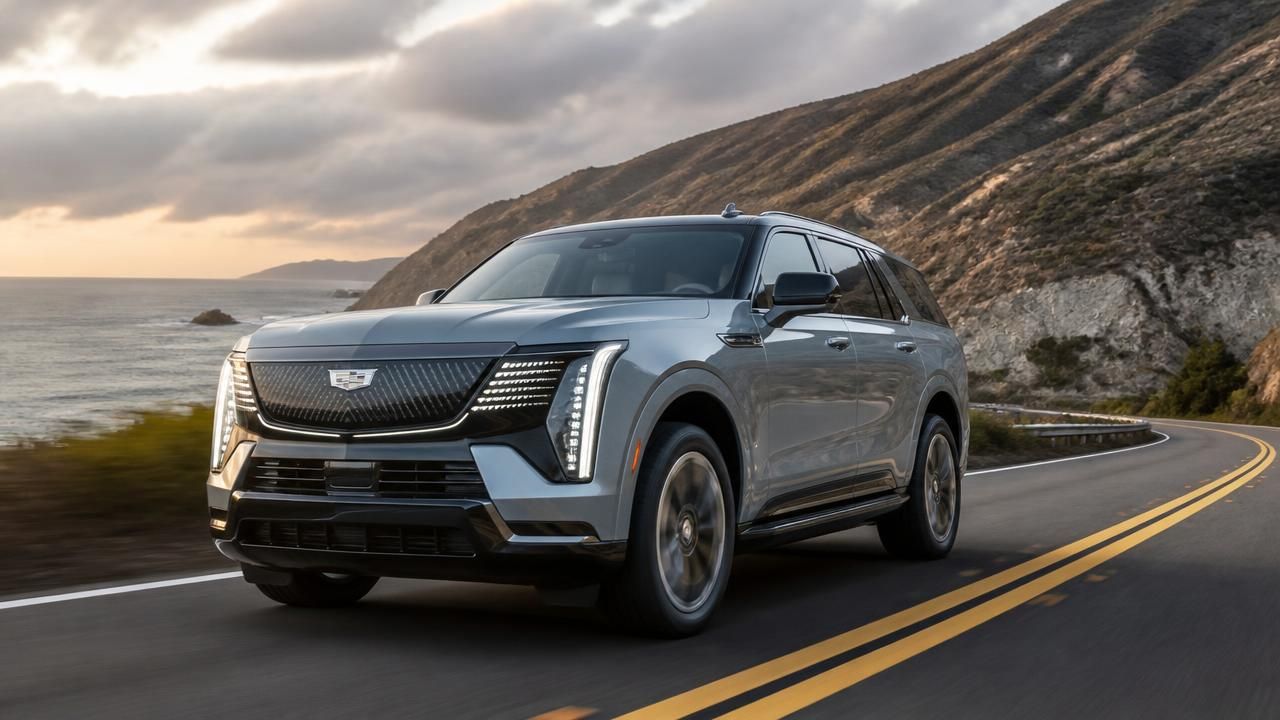
Cadillac's electric flagship has arrived at reviewers' doors with a specification sheet that reads less like a crossover and more like a small utility substation. The Escalade IQ packs more than 200 kWh of lithium-ion battery between its axles, a figure that dwarfs nearly everything else on the road and produces an indicated range of roughly 440 miles (708 km) on a full charge. Cadillac itself claims 460 miles (740 km) on the EPA test cycle.
The numbers are so large that they change the practical ritual of evaluating an electric vehicle. Ars Technica's reviewer opened with the handover instructions from the team that manages Cadillac's press fleet: "Please have at least 125 miles of range left when we pick it up." It was, the publication noted, an easy promise to keep — a week of work barely dented the state of charge.
A battery built to end the argument
That is the central pitch, and it is one echoed across coverage. MSN's framing of the vehicle is blunt: the Escalade IQ is "laughing in the face of range anxiety." Where most EV reviews spend paragraphs on charging curves and route planning, the Escalade IQ inverts the conversation — the battery is so oversized relative to typical daily use that the vehicle's main anxiety is not whether you will reach your destination, but how rarely you will ever need to think about electrons at all.
A second MSN piece makes a related, subtler point: living with the Escalade IQ "changed the way we think about EV charging." That is a meaningful shift in consumer framing. For most EV owners, charging is a planning discipline; for Escalade IQ drivers, it becomes an occasional errand, closer to filling a truck's diesel tank than to managing a phone battery. It is a luxury argument as much as a technical one — the vehicle sells convenience by brute force rather than efficiency.
Four tons of Cadillac
The brute force has consequences. Ars Technica measured the Escalade IQ's curb weight at 9,046 lb (4,103 kg) — a third heavier than the last gas-powered Escalade and heavy enough to push the SUV into the Class 3 truck category. It is, as the review notes, just small enough to fit into a standard parking space, but the mass is extraordinary for a passenger vehicle.
Regulators have already caught up to the physics. Because the vehicle exceeds the weight threshold at which occupant-protection rules assume a passenger car, it does not legally require the same airbag fitment as a lighter vehicle — though Cadillac has fitted plenty anyway. Reviewers also noted engineering workarounds that follow from the mass and the aerodynamics: flat side mirrors, for instance, are a drag-reduction measure on a shape that is otherwise a two-box brick.
The mass is the point on which coverage diverges most sharply. Consumer-facing outlets frame the Escalade IQ around capability and freedom from charging anxiety; enthusiast and engineering-focused coverage cannot quite set aside the inefficiency of moving 4,103 kg with a 200 kWh battery. Both are describing the same vehicle. The question is whether the Escalade IQ is an EV done right for its buyers or an EV that sidesteps the hard problems by adding battery.
Shared bones with Silverado, Sierra and Hummer
The Escalade IQ is not a standalone engineering exercise. It shares its battery pack and much else with the other full-size GM electric trucks and SUVs — the Chevrolet Silverado EV, the GMC Sierra EV and the Hummer EV line. That platform strategy explains both the vehicle's strengths and its compromises: the enormous pack, the heavy-duty architecture and the packaging are inherited from a program designed to electrify the most profitable, least aerodynamic corner of GM's lineup.
It also explains the timing. The Escalade IQ was designed and debuted during a period of considerably greater EV optimism than the market now exhibits. Cadillac has since signaled that its future will include a mix of electric and combustion models beyond 2030 — a recalibration that makes the Escalade IQ something of a monument to an earlier set of assumptions.
The long-wheelbase IQL and a 2027 refresh
The lineup is already expanding. Cars.com's coverage points to the Escalade IQL, the long-wheelbase variant that stretches the formula further for buyers who use the second and third rows seriously. Separately, GM Authority reports that a 2027 Cadillac Escalade IQ debuts under a "Curated By Cadillac" banner — language that suggests the brand is leaning into personalization and limited-edition trim curation as a differentiator, the kind of margin-boosting strategy luxury marques have increasingly pursued as mainstream EV pricing compresses.
Those details remain thin, and Cadillac has not yet published full specifications for the updated model year. What is clear is the cadence: GM is treating the electric Escalade as a continuing franchise rather than a one-off halo vehicle, refreshing it on a conventional product cycle even as the surrounding market cools.
What it all means
The Escalade IQ is best understood as a translation rather than a reinvention. It takes the attributes Escalade buyers already pay for — size, presence, effortless long-distance travel — and reproduces them with electric motors. On those terms, it succeeds emphatically.
- Range: roughly 440 miles indicated; 460 miles claimed on the EPA cycle.
- Battery: more than 200 kWh, shared with GM's full-size electric trucks and SUVs.
- Weight: 9,046 lb (4,103 kg), a third more than the combustion Escalade.
- Lineup: standard Escalade IQ plus the long-wheelbase IQL; a 2027 refresh is expected.
But it also demonstrates the limits of that approach. Every mile of range is purchased with battery mass, and every pound of mass is purchased back with a bigger battery — a spiral that works for a $100,000-plus luxury SUV and would be ruinous in a mass-market car. For now, Cadillac's customers get a vehicle that genuinely makes range anxiety look quaint. Whether that remains a viable engineering philosophy as the industry's optimism cools is the question the next generation will have to answer.