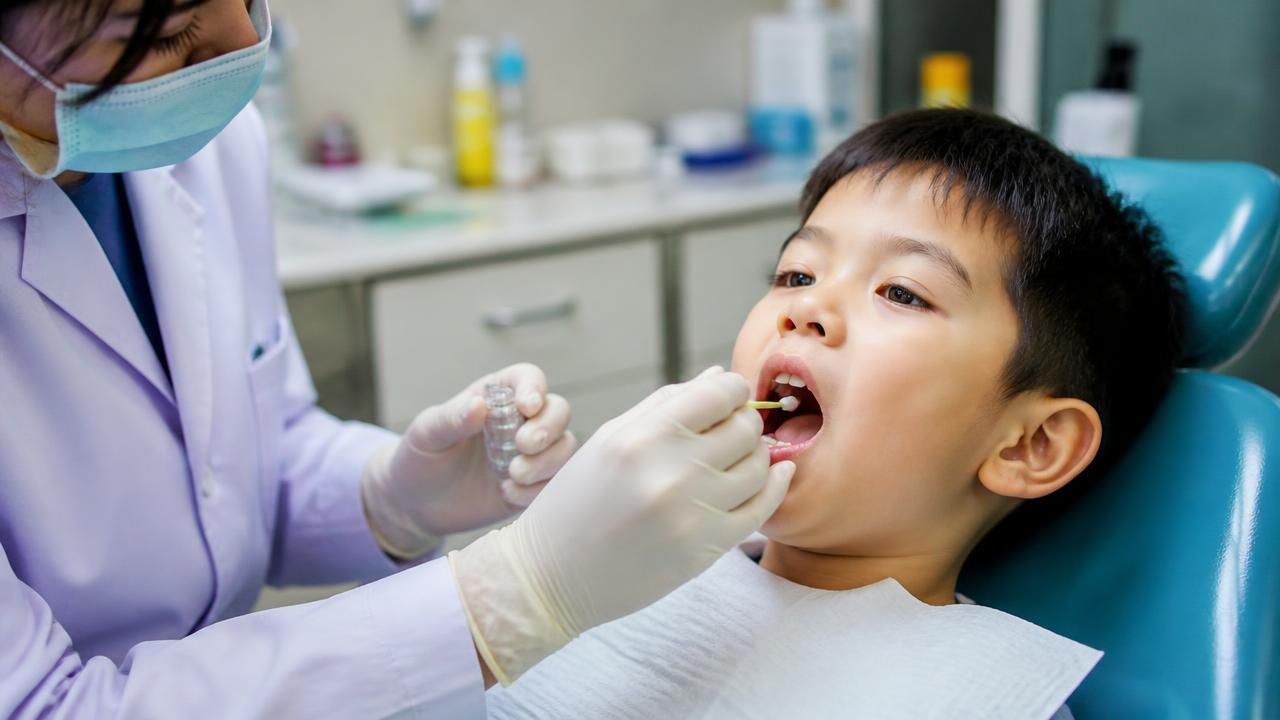
A major clinical trial involving young children has confirmed that a simple, inexpensive liquid painted onto decayed teeth can halt cavities without drilling, injections or anesthesia — a finding that could reshape pediatric dentistry and spare thousands of children painful surgical procedures.
The results, which have circulated widely across science and consumer-health outlets this week, center on a treatment that takes seconds to apply and costs a fraction of a conventional filling. Researchers and clinicians describe it as one of the most promising — and most underused — tools in the fight against tooth decay, the world's most common chronic childhood disease.
What the treatment actually is
The liquid in question is silver diamine fluoride (SDF), a colorless solution that a dentist or even a trained nurse can dab onto a carious lesion with a small brush. The silver kills the bacteria driving decay; the fluoride remineralizes the damaged tooth structure. The result is not a restored tooth in the cosmetic sense — the treated spot typically darkens to black or brown — but a cavity that has been stopped in its tracks rather than drilled out.
Real Clear Science framed the finding bluntly in its headline, describing the therapy as "liquid fluoride" that can stop cavities without drilling. Men's Journal emphasized the low cost and the pediatric focus, reporting that the U.S. trial shows a cheap liquid can arrest kids' cavities without a drill. MSN's coverage leaned into patient experience, with the promise of "bye-bye painful dentist visit." Science Daily, the most clinically detailed of the outlets, stressed that the treatment is painted on "in seconds" and could spare thousands of children painful dental procedures and surgery.
Why a pediatric trial matters
Early childhood caries is a disease of inequity. It is the leading cause of hospitalization among young children in many high-income countries, and general anesthesia for pediatric dental surgery is expensive, scarce and carries real risk — particularly for children under six. In the United States, waiting lists for operating-room time can stretch for months, during which decay continues to progress.
Because primary teeth are small and enamel is thin, decay spreads quickly. By the time a child reaches a dentist, extraction or full-mouth rehabilitation under sedation is often the only option. A paint-on intervention that can be deployed in schools, community clinics or even primary-care settings changes that calculus entirely.
"An easy and inexpensive way to treat tooth decay — in seconds." That is how the researchers behind the work characterize the approach, a phrase echoed across coverage of the trial.
The cost argument
Health economists have long flagged SDF as one of the cheapest interventions in dentistry. A single application can cost a few dollars in materials, compared with hundreds — sometimes thousands — for a pulpotomy, crown or operating-room procedure under general anesthesia. Repeated applications may be needed, but the arithmetic still favors the liquid by an order of magnitude.
- Application time: seconds, versus 20–45 minutes for a restorative appointment.
- Anesthesia required: none — no needle, no drilling, no sedation.
- Setting: can be delivered by nurses or hygienists in schools and community clinics.
- Trade-off: arrested lesions turn black, a cosmetic side effect that has slowed adoption in some markets.
- Recognition: SDF was added to the World Health Organization's Model List of Essential Medicines, a signal of its global public-health value.
The regulatory gap
Despite decades of use — SDF has been deployed in Japan since the 1970s and is standard practice in parts of Asia and Latin America — no product is currently approved by the U.S. Food and Drug Administration specifically for arresting cavities. In America it is used off-label, most often under a 2014 clearance for treating tooth sensitivity. That status has limited uptake among risk-averse clinicians, complicated insurance reimbursement and slowed the kind of large-scale training that would make the treatment routine.
That is why the trial's scale matters as much as its result. A rigorously controlled, randomized study in young children gives regulators, payers and professional bodies the evidence base they have said they lack. Science Daily noted the work could pave the way for broader FDA-approved use — a shift that would let manufacturers market the product directly for caries arrest and could push insurers to cover it explicitly.
Earlier school-based research, including NYU's CariedAway trial, already suggested that SDF performs comparably to fluoride varnish and minimally invasive sealants in preventing new decay. The new findings extend that case from prevention into treatment — the more consequential claim.
The caveats
Not everyone is enthusiastic. Some pediatric dentists argue that arresting decay without restoring tooth structure leaves a weakened tooth and an esthetic problem that parents dislike, particularly in visible front teeth. Others worry that a cheap alternative could be used as a substitute for — rather than a bridge to — comprehensive care in under-resourced communities. Silver can also stain clothing and temporarily alter taste, and it is not recommended for children with a silver allergy or significant ulceration.
Researchers involved in the work counter that the comparison is not SDF versus ideal care, but SDF versus no care at all — which is the reality for millions of children who never reach a dental chair.
What happens next
The near-term path runs through regulation and reimbursement. If a manufacturer secures an FDA label for caries arrest, procurement, insurance codes and dental-school curricula are likely to follow. Public-health advocates, meanwhile, are pressing for SDF to be embedded in school-based programs alongside fluoride varnish and sealants, where the cost per cavity prevented is lowest.
For parents, the practical message from the trial is narrower but striking: for many cavities in young children, the drill may no longer be the default — a small brush and a few seconds may be enough.