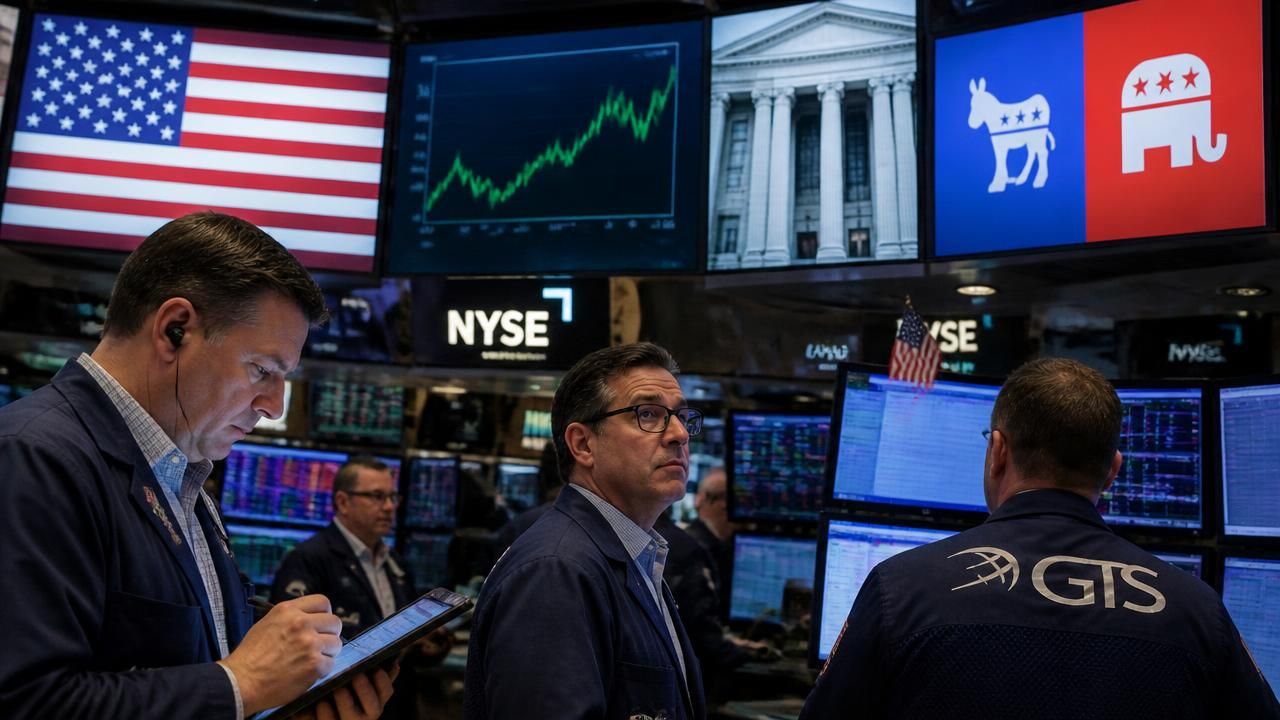
Wall Street is heading into one of the most crowded catalysts weeks of the year, with three forces converging at once: a Federal Reserve policy decision, an earnings slate dominated by Big Tech, and a midterm election now just nine days away. Each is significant on its own. Together, they are forcing investors to re-examine a stock rally that has become deeply dependent on a handful of mega-cap technology names and the artificial-intelligence narrative attached to them.
The stakes are visible across trading desks and television studios alike. Bloomberg's weekend markets program devoted its run of show to the collision — booking MetLife Investment Management chief market strategist Drew Matus, Financial Times associate editor and "Sea Change" author Rana Foroohar, former Israeli Prime Minister Ehud Olmert, Texas Representative Dan Crenshaw, former U.S. Ambassador to Israel Daniel Shapiro, and CBS News political correspondent Ed O'Keefe — a lineup that mirrors how the story is being framed: part macroeconomics, part geopolitics, part election handicapping.
The Midterm Playbook — and Why 2022 May Break It
For decades, a dependable seasonal script has circulated on trading floors: midterm years are ugly going in and generous coming out. Equities have historically tended to find a bottom in the September–October window of a midterm year and then rally over the following twelve months, as the removal of electoral uncertainty unleashes pent-up risk appetite. That is the thesis behind the widely circulated seasonal argument that October and November of a midterm year have been an unusually good time to buy stocks.
"History Shows The Smartest Midterm Strategy Is Not A Political One."
That line, the framing of a Forbes analysis, captures the counterargument now gaining ground: investors who trade on their political preferences, or who assume the historical pattern must repeat, have historically done worse than those who simply stayed invested. But the same historical record now looks less reliable to strategists, who note that this cycle arrives with inflation still uncomfortably high, interest rates rising at the fastest pace in a generation, and a Federal Reserve explicitly committed to slowing demand. The usual post-election tailwind assumes a Fed that is not actively fighting the market. That assumption is no longer safe.
Big Tech Earnings Meet the Dispersion Trade
The second catalyst is earnings, and specifically the results of a handful of mega-cap technology companies whose index weight has made them the market's de facto central bank. Bloomberg reported that tech earnings are looming large for hedge funds that have crowded into the dispersion trade — a strategy that profits when individual stocks move very differently from one another and from the broader index. That trade depends on single-name volatility, and nothing delivers single-name volatility like a mega-cap earnings report in a fragile macro environment.
The concentration cuts both ways. If results and guidance hold up, the rally extends and the doubters are punished. If guidance disappoints, the crowded positioning that has built up around the trade could unwind quickly, amplifying moves well beyond the companies reporting.
Beyond Big Tech: The Rest of the Tape
Not everything hinges on the largest names. Seeking Alpha's earnings-season preview flagged four stocks worth watching outside the Big Tech and AI complex, a reminder that the market's leadership question — whether the rally broadens or narrows further — will be answered in the same stretch of trading days. Breadth, or the lack of it, has been among the most persistent worries for strategists all year.
A Divided Congress and the Sector Map
The third variable is politics itself. Markets generally prefer gridlock to sweeping legislative change, and a divided Congress has historically been read as a benign outcome for equities: fewer surprises on taxes, regulation and spending. But the sector-level consequences are more nuanced. Coverage of the election has highlighted a slate of tech-stock winners that could benefit from a divided Congress — companies whose prospects rest less on new legislation than on the absence of it, particularly in areas where regulation has been threatened.
- Gridlock as a baseline: Divided government typically reduces legislative risk, a mild positive for broad indices.
- Sector rotation: Defense, energy and healthcare have historically traded differently depending on which chamber flips.
- Tech and regulation: Antitrust and privacy efforts tend to stall in a split Congress, a tailwind for large platforms.
- The Fed overrides: With policy rates rising, the macro backdrop may matter more than any single race.
What to Watch
For investors, the practical question is sequencing. The Fed decision comes first, and the language around future hikes will set the tone. Earnings from the largest technology companies follow, and hedge-fund positioning means the reaction function may be sharper than fundamentals alone would suggest. Then the votes are counted, and the historical midterm script gets its latest test.
"Wall Street week ahead: Big tech earnings and Fed decision to test US stock rally."
That framing — a rally on trial — is the common thread running through coverage from Bloomberg to MSN to Forbes. The bull case rests on history, on earnings resilience, and on the idea that political uncertainty is about to be removed. The bear case rests on the possibility that this time the calendar is a distraction, and that the real driver is a tightening cycle that does not care who controls Congress.
What is clear is that the next several sessions will be unusually dense with information, and that the market's reaction will say as much about positioning and sentiment as about the underlying economy. For a rally that has leaned on a narrow group of companies and a single technological theme, that is a meaningful test.