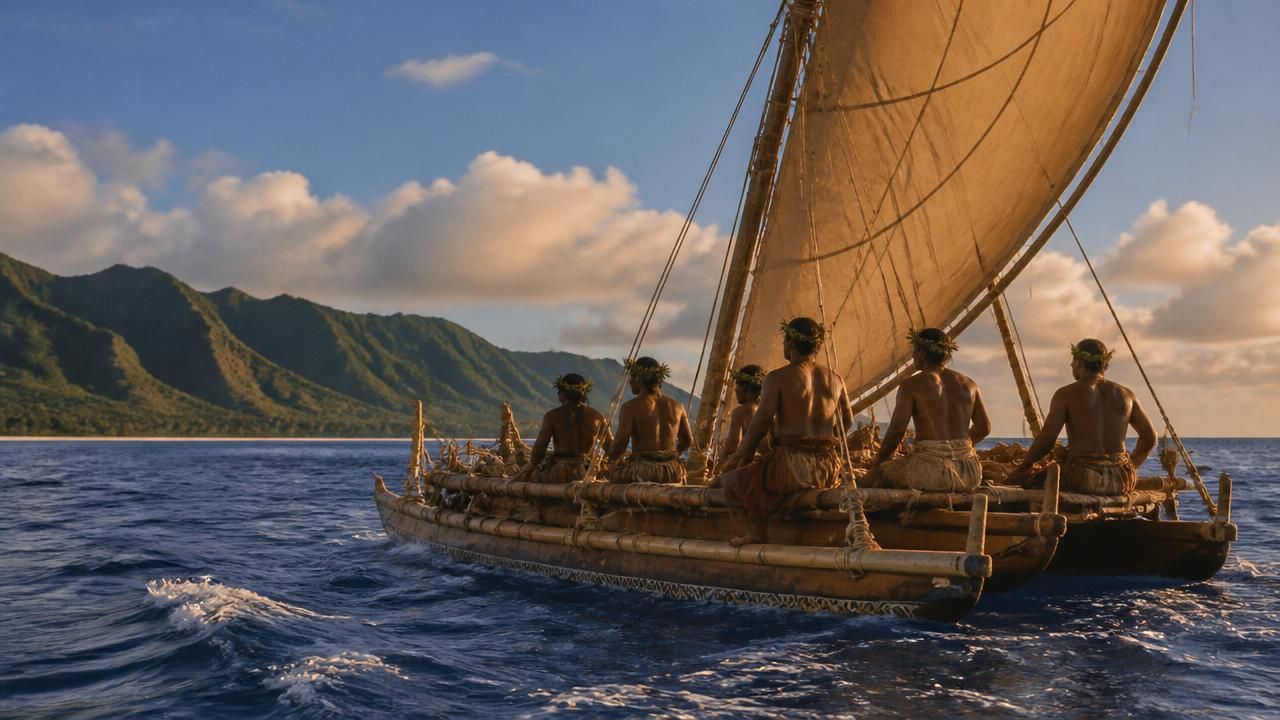
For centuries, Polynesian navigators were masters of their domain, voyaging across the vast Pacific with remarkable skill. But for roughly 1,700 years, their explorations remained largely within a defined region. Then, suddenly and seemingly without explanation, they began sailing east, settling islands thousands of kilometers away—including Hawaii, Easter Island, and New Zealand. This dramatic shift is the central historical puzzle that underpins both the animated Disney film Moana and decades of archaeological research. Now, new climate evidence may provide the answer.
The Great Polynesian Expansion
The Polynesian expansion is one of the most extraordinary feats of human migration. Around 3,000 years ago, the ancestors of modern Polynesians—the Lapita people—began moving eastward from the Bismarck Archipelago near Papua New Guinea. They reached Fiji, Tonga, and Samoa by about 1000 BCE. Then, for nearly two millennia, their eastward advance stalled. It was not until around 800–1000 CE that voyagers again pushed east, colonizing the far-flung islands of the Pacific.
Archaeologists and historians have long debated what triggered this sudden burst of exploration. Theories range from population pressure and resource depletion to social competition and technological innovation. But a growing body of evidence points to a more fundamental driver: climate change.
Climate as a Catalyst
Recent studies suggest that a shift in wind patterns and ocean currents may have made eastward voyages more feasible. During the Medieval Warm Period (roughly 800–1300 CE), the trade winds that normally blow from east to west across the Pacific weakened or reversed, allowing Polynesian canoes to sail east with greater ease. Conversely, the subsequent Little Ice Age may have made westward return voyages more difficult, stranding settlers on remote islands.
Dr. Fiona Petchey, a paleoclimatologist at the University of Southampton, explains: “The evidence points to a window of opportunity when the climate was unusually favorable for eastward sailing. This likely reduced the risk of long voyages and encouraged exploration.” Her team’s research, published in Nature Geoscience, reconstructs past wind patterns using sediment cores and coral growth bands, showing a distinct shift around 800 CE.
“The climate data aligns remarkably well with the archaeological timeline of Polynesian expansion. It suggests that environmental conditions, not just human ingenuity, played a crucial role.” — Dr. Fiona Petchey, University of Southampton
Different Perspectives on the Puzzle
The story has been covered by multiple outlets, each emphasizing different angles. Ars Technica frames the mystery as a blend of science and storytelling, noting that the same question drives both Moana and academic research. “The real mystery behind Moana,” they write, “is why, after centuries of relative stability, did Polynesian voyagers suddenly begin settling islands thousands of kilometers away?”
MSN and Yahoo! News have echoed this narrative, highlighting the role of climate evidence. However, Yahoo!’s article was partially inaccessible due to technical issues, underscoring the challenges of digital reporting. Meanwhile, the University of Southampton’s press release focuses on a colossal erosion event that reshaped Earth’s surface hundreds of millions of years ago—a separate story that underscores the power of geological processes but is unrelated to Polynesian migration.
This divergence in coverage illustrates how a single scientific discovery can be contextualized differently. While some outlets zero in on human history and culture, others use it as a springboard to discuss broader Earth systems.
The Cultural and Historical Context
Polynesian voyaging was not merely a feat of endurance; it was a sophisticated science. Navigators used stars, ocean swells, bird flight patterns, and cloud formations to guide their double-hulled canoes across thousands of miles. The sudden eastward expansion, when it came, was rapid: within a few centuries, Polynesians had settled nearly every habitable island in the Pacific.
The Disney film Moana (2016) brought this heritage to a global audience, with its protagonist setting out on a daring voyage to save her people. The live-action adaptation currently in production promises to delve even deeper into the cultural significance of wayfinding. But as scientists note, the real story is even more remarkable than fiction.
Implications for the Present
Understanding past climate-driven migrations offers lessons for today. As modern climate change alters wind patterns and sea levels, coastal communities may face similar pressures to relocate. “Polynesian history shows that humans can adapt to environmental change, but it often comes at a cost,” says Dr. Petchey. “We must learn from their resilience.”
For now, the mystery of why Polynesians sailed east appears to be solved. Yet, as with all great historical puzzles, each answer raises new questions. How did societies maintain their navigational knowledge over generations? What role did social and political factors play? The voyage of discovery continues.