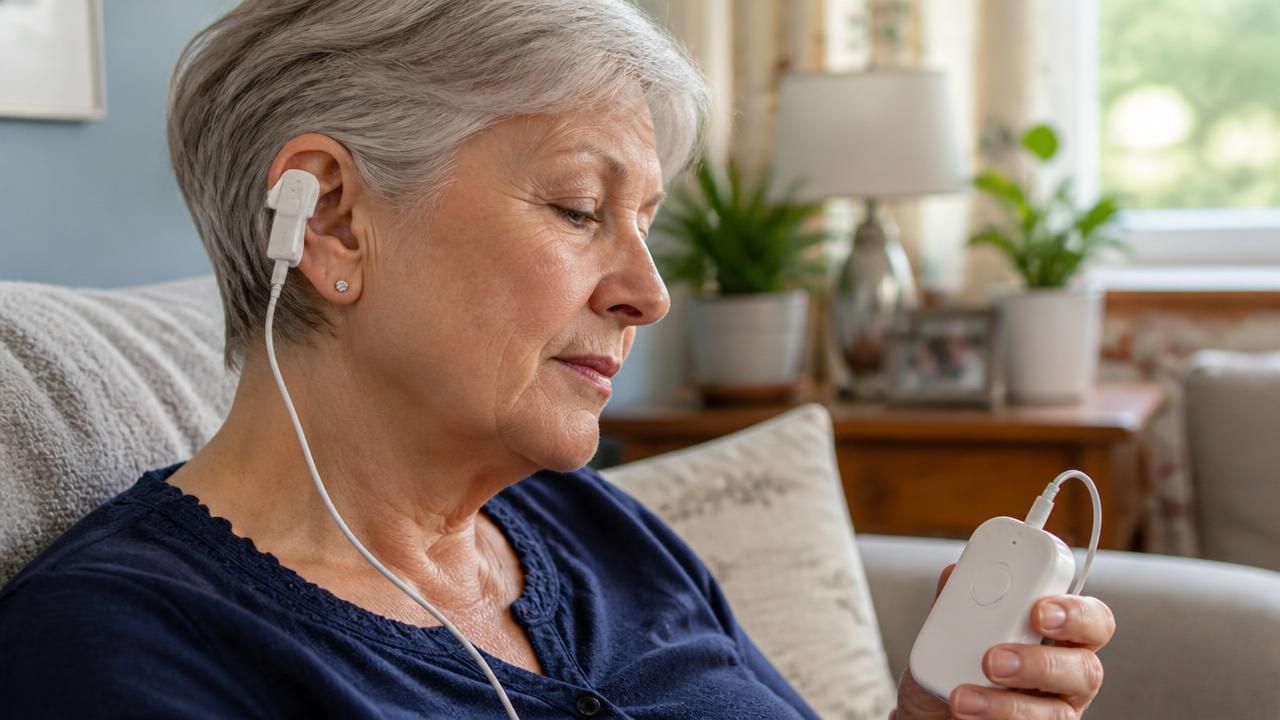
A small device that gently stimulates nerves through the skin of the ear could offer a new, drug-free way to chip away at stubborn high blood pressure, according to a clinical trial of 63 patients already taking medication. The results, which have circulated widely this week under headlines promising surprising new ways to fight hypertension, paint a picture that is more nuanced — and more interesting — than the initial coverage suggested.
The trial found the treatment was safe, easy for patients to use at home and well tolerated. But it did not significantly outperform a placebo across the full study population. The signal that has researchers paying attention came from a subgroup: patients with more severe hypertension, who showed promising reductions in blood pressure.
How the technology works
The approach belongs to a family of techniques known as auricular neuromodulation, in which small electrical pulses are delivered to nerve endings in the ear that connect to the vagus nerve and, through it, to the brainstem circuits that help regulate heart rate and blood vessel tone. The idea is that calming overactive sympathetic signaling could, over time, translate into lower blood pressure.
What distinguishes this device from earlier laboratory-bound experiments is its form factor. It is designed to be worn and operated at home, without clinical supervision for each session — a practical requirement for any therapy aimed at a condition that must be managed for decades.
In the trial of 63 patients already taking medication, the treatment proved safe, easy to use at home, and well tolerated — though it did not significantly outperform a placebo overall.
The placebo problem
The trial's mixed result is not a surprise to researchers who work in device-based hypertension care. Blood pressure is unusually susceptible to the placebo effect: participation in a trial, the ritual of daily use, increased attention to one's health and regression toward the mean can all produce measurable drops. Sham-controlled designs, in which patients receive an inactive version of the device, are the gold standard precisely because they neutralize that effect.
The fact that the device did not clear that bar across the whole cohort is a meaningful caution — and a reason the initial wave of coverage deserves scrutiny. But subgroup signals in a trial of 63 people are also, by definition, fragile. With fewer participants, a promising result in sicker patients can look stronger than it would in a larger study, and it can vanish entirely when tested again.
Why severe hypertension may respond differently
There is a plausible biological story behind the subgroup finding. Patients with more severe hypertension typically have greater sympathetic nervous system activity and are more likely to be taking multiple drugs without reaching target. A therapy that modulates autonomic tone could therefore have more room to work in those patients than in someone whose blood pressure is already modestly elevated and well controlled on a single pill.
Still, the researchers' conclusion is likely to be restrained: this is a signal worth pursuing in a larger, longer, sham-controlled trial, not a reason for patients to change their treatment.
How different outlets framed the story
The coverage illustrates a familiar split in science journalism. Science-focused outlets led with the hedged finding — safety, tolerability, home usability, and the honest admission that the device did not clearly beat placebo — and treated the subgroup result as a hypothesis generator rather than a breakthrough.
Aggregator and consumer-health outlets, by contrast, leaned into the promise. One headline declared that scientists had discovered a "surprising new way to fight high blood pressure — through the ear." Others shifted the frame entirely toward rapid at-home fixes, with headlines asking whether blood pressure could be lowered at home "in less than two minutes" and rounding up "simple exercises" that lower blood pressure naturally. Those stories speak to a real appetite among patients for self-directed solutions, but they are answering a different question than the trial asked.
The bigger picture: a crowded field
Hypertension is the world's leading modifiable risk factor for cardiovascular disease, affecting an estimated 1.3 billion adults globally, according to the World Health Organization. Roughly half are unaware of their condition, and among those treated, a substantial share remain above target — a gap that has fueled interest in device-based alternatives.
Renal denervation, which ablates nerves around the kidney arteries, has travelled a similarly bumpy road: early enthusiasm, a failed sham-controlled trial, then a revival with better-designed studies and a U.S. regulatory approval in 2023. That history is instructive. Device therapies in hypertension rarely fail outright; they more often require years of refinement in dosing, patient selection and trial design before finding their place.
What patients should take away
- This is not a replacement for medication or lifestyle change. Participants in the trial continued their existing drugs.
- The evidence is early. Sixty-three patients is a small study, and a subgroup finding needs confirmation in a larger trial.
- Established measures still carry the strongest evidence: reducing sodium, the DASH dietary pattern, regular aerobic activity, weight loss, limiting alcohol and — critically — home blood pressure monitoring with a validated upper-arm cuff.
- Ask your clinician before adding any device to your regimen; blood pressure effects and interactions with existing therapy need supervision.
What comes next
The obvious next step is a larger, sham-controlled trial adequately powered to test the severe-hypertension subgroup prospectively — and to track blood pressure over months rather than weeks, since neuromodulation effects may build with repeated use. Cost, adherence and durability will matter as much as efficacy: a device that works only when used daily faces the same real-world challenges as a pill that patients stop taking.
For now, the ear-stimulation story is best read as a carefully worded "maybe" — a small, safe, home-friendly intervention with an intriguing signal in the patients who need help most. That is a legitimate scientific development. It is not yet a shortcut.