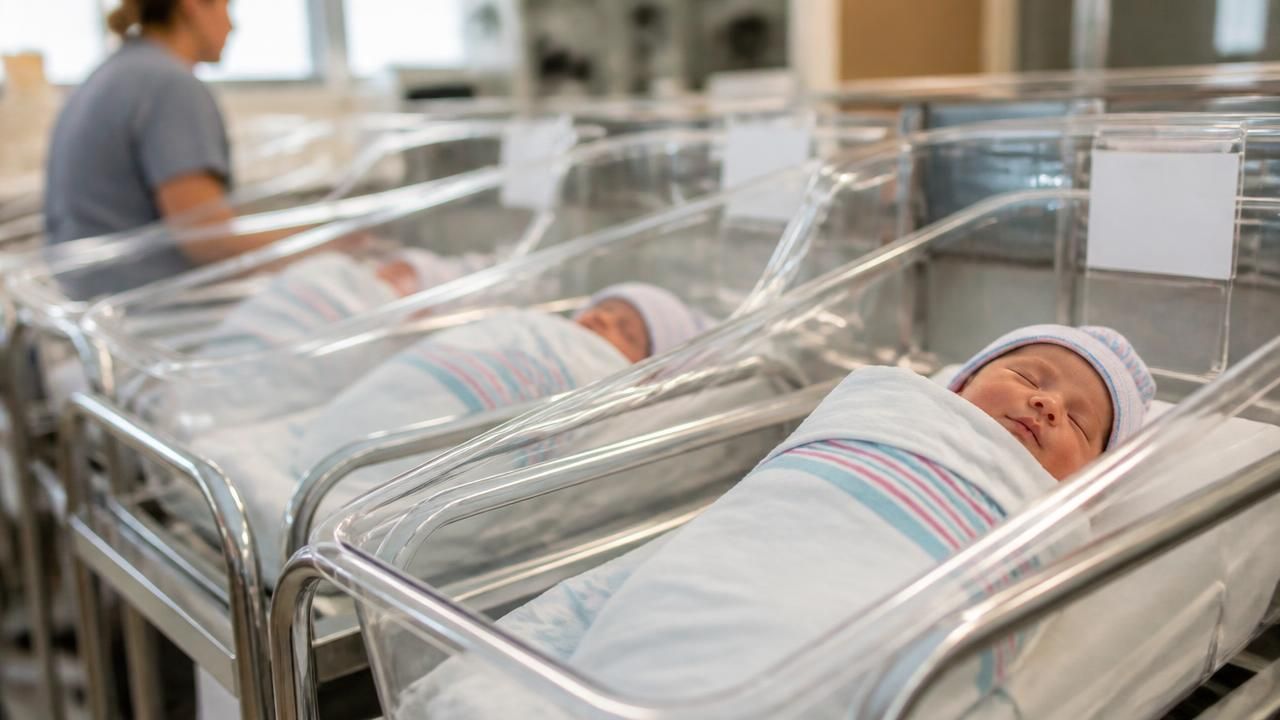
The United States is having fewer babies than at any point since the federal government began keeping reliable records, according to a new report from the Centers for Disease Control and Prevention — a milestone that lands with unusual weight in a country whose economic model, school systems and social safety net have long assumed steady population growth.
The CDC's National Center for Health Statistics found that the national birth rate fell to its lowest level ever recorded. The decline would have been even steeper were it not for one countervailing trend buried in the data: women over age 30 are having more children than their predecessors did, partially cushioning a collapse in births among younger Americans.
What the Numbers Show
The headline figure is the general fertility rate — the number of births per 1,000 women of childbearing age — which has now posted a record low. The more closely watched measure among demographers is the total fertility rate, an estimate of how many children a typical woman would have over her lifetime at current age-specific rates. That figure now sits in the neighborhood of 1.6 children per woman, a historic low and far beneath the "replacement level" of roughly 2.1 needed to keep a population stable absent immigration.
In raw terms, the United States recorded approximately 3.6 million births in the most recent reporting year. That is a substantial number in isolation — more than the entire population of Puerto Rico — but it continues a downward drift that has now persisted, with brief interruptions, for roughly a decade and a half.
The Age Story Behind the Headline
The most consequential detail in the report is not the total but its composition. Birth rates among teenagers and women in their early twenties have fallen dramatically — a trend public health officials have largely welcomed, given that teen births are associated with worse outcomes for both mothers and children. Meanwhile, birth rates for women in their thirties and early forties have risen.
The result is a quiet demographic transformation: American motherhood is becoming older, more concentrated and more economically stratified. Women with college degrees and stable careers are delaying childbearing and, in many cases, having the children they planned — just later. Women without those advantages are increasingly reporting that they are having fewer children than they want, or none at all.
"The drop would have been greater, but women over age 30 are having more children."
That framing, used in coverage from NPR and WWNO, captures the central tension: the older-mother effect is real, but it is not large enough to reverse the overall trajectory.
Good News or Bad News?
NBC News posed the question directly in its headline: "The U.S. fertility rate has hit another record low, CDC finds. Is that good or bad?" The answer, demographers say, depends entirely on which trend you are looking at and who is doing the asking.
On the optimistic reading, falling fertility is a symptom of expanded opportunity. Women are more educated than ever, more likely to hold jobs and more able to control whether and when they become parents. Teen pregnancy — long a target of public health campaigns — has plummeted. Countries with the lowest fertility rates, including Japan, South Korea and much of Southern Europe, have among the world's highest life expectancies and education levels.
On the pessimistic reading, the numbers reflect constraint rather than choice. Surveys consistently find that American adults want more children than they end up having. The gap is explained by housing costs, student debt, the price and scarcity of child care, limited parental leave and a cultural expectation that parenting should be an intensive, expensive undertaking.
- The economic view: Fewer working-age adults per retiree strains pension systems and health care financing, and can slow GDP growth absent sustained immigration.
- The equity view: Fertility declines are steepest among lower-income and less-educated Americans, meaning the choice to delay or forgo children is unevenly distributed.
- The global view: The U.S. remains comparatively fertile among wealthy nations, propped up historically by immigration and higher birth rates among some immigrant groups.
Historical Context
The United States once recorded fertility rates above 3.5 during the Baby Boom. The rate fell below replacement in the early 1970s, rebounded modestly, and then began a long, irregular slide after the 2007–2009 recession. What makes the current period distinctive is that the decline has continued through a strong labor market and, briefly, a pandemic-era bump that many analysts had hoped would mark a turning point.
The mechanics matter. A falling total fertility rate can reflect delayed births — which are theoretically recoverable — or forgone births, which are not. Most evidence now points to a mix of both, with the balance tilting toward the latter.
What Comes Next
The report arrives as policymakers in Washington and in state capitals debate child tax credits, paid family leave, child care subsidies and immigration reform — the levers most plausibly capable of shifting the trend. The experience of other wealthy nations offers a cautionary note: generous pronatalist policies in Europe and East Asia have generally produced modest, temporary upticks rather than sustained reversals.
Demographers are careful to warn against reading a single report as destiny. Fertility is famously cyclical, and projections of population collapse have repeatedly been wrong. But the direction of travel is now unmistakable across nearly every wealthy society, and the United States — long an outlier — is no longer exempt.
What the CDC data ultimately documents is less a crisis than a slow, structural reordering of American family life: later, smaller and increasingly shaped by class. Whether that is read as liberation, precarity, or both is a question the statistics alone cannot answer.