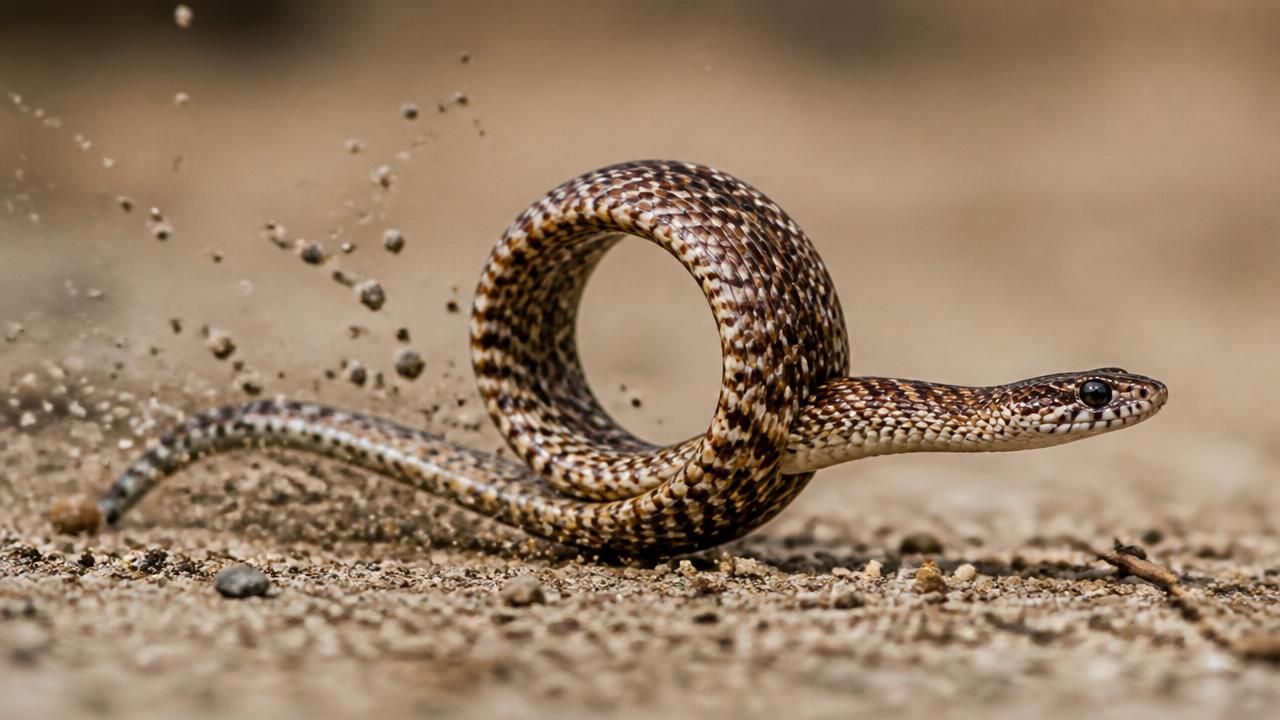
A tiny snake found in Southeast Asia has an escape move that sounds more like a circus trick than a reptile behavior: it cartwheels. Dwarf reedsnakes can roll across the ground at speeds up to four times faster than they can slither, according to research covered by Science Daily, Yahoo and MSN. The behavior, captured with high-speed cameras in Japan, reveals a precisely coordinated form of locomotion in which the snake's body rotates like a wheel while its head remains remarkably stable.
The story has emerged through several media frames. Science Daily emphasized the biomechanics and the striking speed ratio, reporting that the snakes achieve the feat through coordinated body movements. Yahoo highlighted the role of high-speed cameras in Japan, which allowed researchers to see how a tiny snake rolls like a wheel to escape danger. MSN's coverage leaned on the visual and accessible language of the phenomenon, describing snakes that escape by spinning like wheels and, in one headline, Borneo snakes that cartwheel away at 12 feet per second. Together, the reports point to the same core finding: a small, limbless animal has evolved a temporary wheel-like gait that is far faster than its normal slither.
A sprint without legs
Most snakes move by lateral undulation, throwing their bodies into S-shaped waves that push against obstacles and uneven ground. Some use concertina movement, sidewinding or other specialized gaits. The dwarf reedsnake's rolling behavior is different. Rather than sliding forward in a wave, the snake appears to throw its body into a rotating loop, using coordinated muscle contractions to keep the roll going. The head stays stable even as the rest of the body turns over, a detail that researchers say is central to the behavior.
The snakes' bodies rotate while their heads remain remarkably stable, a feat that requires precise timing across the body, researchers say.
That stability matters. A snake's head carries its eyes, tongue and sensory systems for tracking predators and choosing escape routes. If the head tumbled wildly with the body, rolling might be fast but disorienting. Instead, the reedsnake seems to keep its forward sensors trained on the environment while its body does the work of propulsion. The result is a controlled escape maneuver rather than a passive tumble.
High-speed cameras expose the mechanics
The Yahoo report notes that high-speed cameras in Japan were used to reveal how the tiny snake rolls. Such cameras are essential for studying fast animal movements because the human eye cannot resolve the sequence of body bends, contacts and rotations that occur in a fraction of a second. By slowing down the action frame by frame, scientists can see whether the snake is pushing off the ground, using stored elastic energy or continuously adjusting its posture to maintain momentum.
The MSN headline citing Borneo snakes at 12 feet per second adds a useful speed benchmark. Twelve feet per second is roughly 8 miles per hour, or about 13 kilometers per hour. For a human, that is faster than a brisk walk but slower than a sprint. For a tiny snake, however, it is a dramatic burst, especially when compared with ordinary slithering. The four-times-faster figure reported by Science Daily makes the rolling gait one of the more striking examples of relative speed in small animals.
Why roll instead of slither?
The most likely answer is escape. Small snakes are vulnerable to birds, mammals, larger reptiles and other predators. A sudden burst of speed can mean the difference between being caught and reaching cover. Rolling may also be useful on open ground or in leaf litter where a conventional slither is less effective. But the behavior probably comes with tradeoffs. Rolling could be harder to steer than slithering, more energetically costly over long distances or more conspicuous to predators. The fact that it is used as an escape tactic rather than a routine way of getting around suggests the snake is trading maneuverability for short-term speed.
Researchers will want to know more. How often do dwarf reedsnakes roll in the wild? Do they roll only when threatened, or also when moving between microhabitats? How does the gait perform on uneven forest floor, mud or vegetation? And is the behavior widespread among related species or limited to a few populations? The media reports establish the headline finding, but the underlying biology is richer than a single speed record.
Different outlets, different frames
The coverage shows how a scientific finding can be packaged for different audiences. Science Daily led with the comparative speed and the biomechanical coordination. Yahoo led with the method, emphasizing high-speed cameras in Japan and the dramatic reveal of a snake rolling like a wheel. MSN led with vivid imagery and a location, Borneo, plus a concrete speed figure. Each frame is accurate, but each emphasizes a different part of the story: the mechanism, the visualization and the spectacle.
That combination is useful. The mechanism explains why the behavior is biologically interesting. The high-speed footage shows how scientists know what they know. The speed figure gives readers a way to grasp the performance. For a general audience, the cartwheeling snake is memorable; for biologists, it is a case study in how limbless animals can repurpose a body plan for unusual locomotion.
Implications for biology and robotics
The dwarf reedsnake's roll fits into a broader interest in animal movements that resemble wheels. Caterpillars can roll, some salamanders and spiders have rolling or tumbling escape behaviors, and researchers have long studied how organisms stabilize sensory platforms while moving. The reedsnake's ability to keep its head steady while its body rotates could inspire robotic designs that need a stable sensor package on a rolling or spinning platform.
For biology, the finding raises questions about evolution and neural control. Did rolling evolve from a modified slither, or from a startle response that became more coordinated over time? What muscles and nerves are involved? How does the snake decide when to roll? The answers could illuminate how small animals solve the problem of moving quickly without limbs.
Bottom line
The dwarf reedsnake is a reminder that evolution can produce locomotion that looks engineered. A tiny Southeast Asian snake can turn its body into a temporary wheel, keep its head stable and escape at speeds up to four times faster than its normal slither. High-speed cameras in Japan have helped expose the mechanics, while reports from Borneo have added a striking speed benchmark of 12 feet per second. The story is charismatic, but it is also scientifically serious: it asks how animals coordinate complex movements under pressure, and it offers a natural design that engineers may one day imitate.