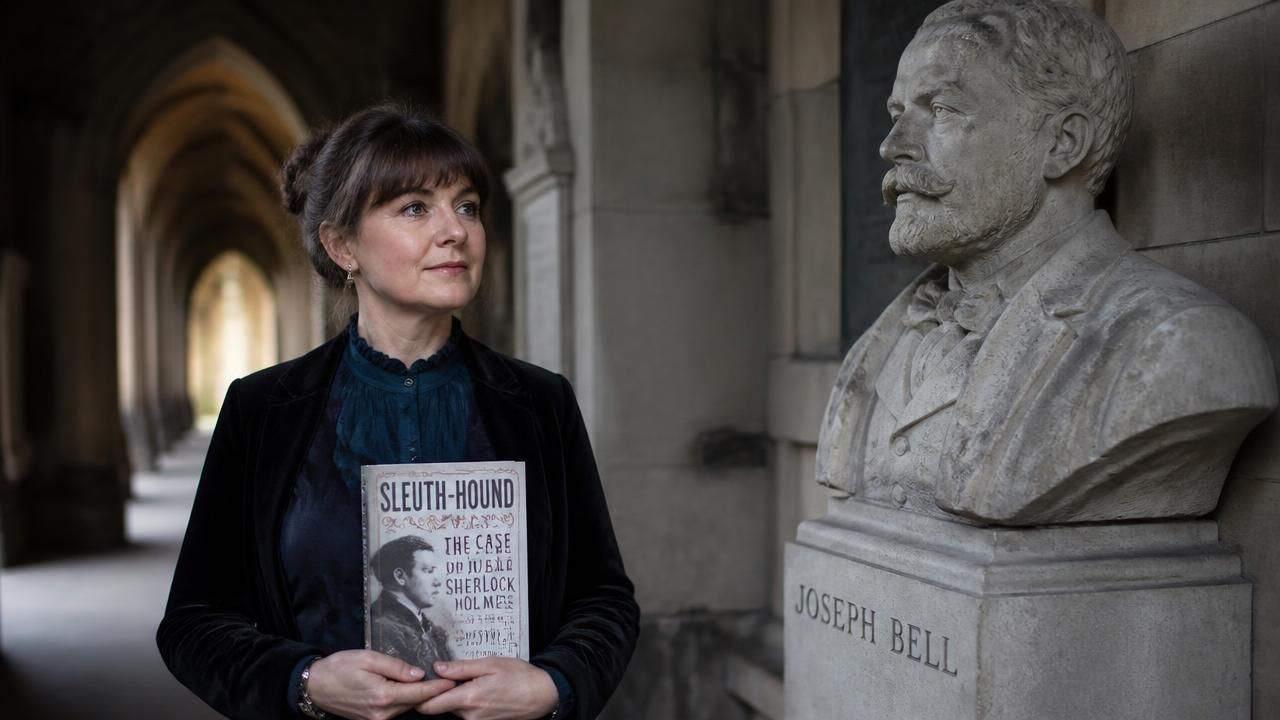
He never chased a suspect through fog-bound London streets and he never lived at 221B Baker Street, but the man widely credited as the real-life model for Sherlock Holmes is finally getting a book of his own. In Sleuth-Hound: The Case of the Real Sherlock Holmes, medical historian Lindsey Fitzharris examines the life of Joseph Bell, the Edinburgh surgeon whose almost unnerving powers of observation so impressed a young medical student named Arthur Conan Doyle that he would eventually build the world's most famous fictional detective around him.
Fitzharris discussed the book in an interview on Bloomberg This Weekend with hosts Christina Ruffini and Lisa Mateo, describing how Bell's diagnostic method — reading a patient's occupation, habits and history from physical clues before a word was spoken — translated directly into Holmes's signature art of deduction. The book, she argues, rescues a largely forgotten figure from the shadow of the character he helped create.
A surgeon who read the body like a crime scene
Bell (1837–1911) spent most of his career at the University of Edinburgh and the Royal Infirmary of Edinburgh, where he was renowned as a teacher and diagnostician. His method was less mysticism than disciplined observation: a calloused hand, a peculiar gait, a trace of clay on a boot, a regional accent, the state of a patient's clothing. From these fragments he would infer occupation, background and likely illness — a performance that delighted students and unnerved patients in equal measure.
That pedagogical showmanship is precisely what caught the imagination of Conan Doyle, who enrolled at Edinburgh's medical school in 1876 and later served as Bell's outpatient clerk. Conan Doyle took the method, sharpened it into literature, and gave it to a consulting detective who debuted in A Study in Scarlet in 1887. The author was candid about the debt. In a letter to Bell, he wrote:
"It is most certainly to you that I owe Sherlock Holmes... Round the centre of deduction and inference and observation which I have heard you inculcate I have tried to build up a man."
From the lecture hall to actual casework
The most consequential part of Fitzharris's account, and the one that distinguishes Bell from a mere parlor trickster, is his move from the clinic into genuine forensic work. Bell applied his diagnostic eye to criminal investigations, most notably the 1893 Ardlamont murder trial in Scotland, where he gave expert testimony. His reasoning in the courtroom — reconstructing events from physical traces rather than confessions — anticipated techniques that would later become standard in forensic pathology and crime-scene analysis.
This is the thesis that runs through coverage of the book. Smithsonian magazine frames Bell squarely as "a real-life Scottish surgeon who used deduction to diagnose patients and investigate crimes," emphasizing that the Holmes connection was rooted in legitimate medical practice rather than literary coincidence. The Daily Mail's take leans on the same idea with a more populist flourish, describing a "genius doctor whose powers of deduction helped him diagnose patients at a glance."
The reviews: 'masterful' — and a headline writer's dream
Critical reception has been strong. The Scotsman's review of Sleuth-Hound calls the book "masterful," praising Fitzharris's ability to reconstruct Victorian Edinburgh's medical world and to make the mechanics of diagnosis read like detection. The New York Times, meanwhile, could not resist the obvious pun, headlining its coverage "Who Inspired Sherlock? Elementary!" — a nod to Holmes's most quoted (though never actually uttered in that form) line.
Not every outlet leads with the literary angle. Yahoo and MSN both ran versions under the framing "Sherlock Holmes may be a renowned detective, but his real life inspiration was not" — a reminder that the reading public's appetite is as much for the demythologizing of Holmes as for the celebration of Bell. The real man, these outlets suggest, was not a brooding bohemian with a cocaine habit and a landlady; he was a sober Scottish academic with a teaching practice, a family, and a taste for careful, unglamorous evidence.
Why the story resonates now
Fitzharris, a historian of medicine whose previous work has focused on Victorian surgery and its brutal, pre-anaesthetic realities, is working in a rich seam. The history of diagnosis is undergoing something of a popular revival, partly because the language of algorithmic inference — pattern recognition, probabilistic reasoning, the machine that sees what humans miss — has made the Victorian diagnostician look oddly contemporary. Bell's method was, in essence, an early exercise in feature extraction: gather the signals, weight them, and reach a conclusion before the patient has finished sitting down.
That parallel is not merely rhetorical. Modern clinicians wrestle with the same tension Bell did — between the speed of pattern recognition and the danger of premature certainty — while artificial-intelligence diagnostic tools raise fresh questions about whether medicine is an art of observation or a science of data. Bell, who did both, is a useful case study.
There is also the simpler appeal of a good origin story. Sherlock Holmes has been adapted, rebooted and reinterpreted more times than almost any character in fiction, from Basil Rathbone to Benedict Cumberbatch. Sleuth-Hound returns to the source: a lecture hall in Edinburgh, a professor with a piercing eye, and a student taking notes that would become literature.
Fitzharris's book arrives with the machinery of a well-published historian behind it — a Bloomberg interview, prominent reviews, and feature coverage across science and general-interest titles. What remains to be seen is whether it does for Joseph Bell what Bell did for Conan Doyle: take a figure who existed mostly as a footnote and give him a life of his own.