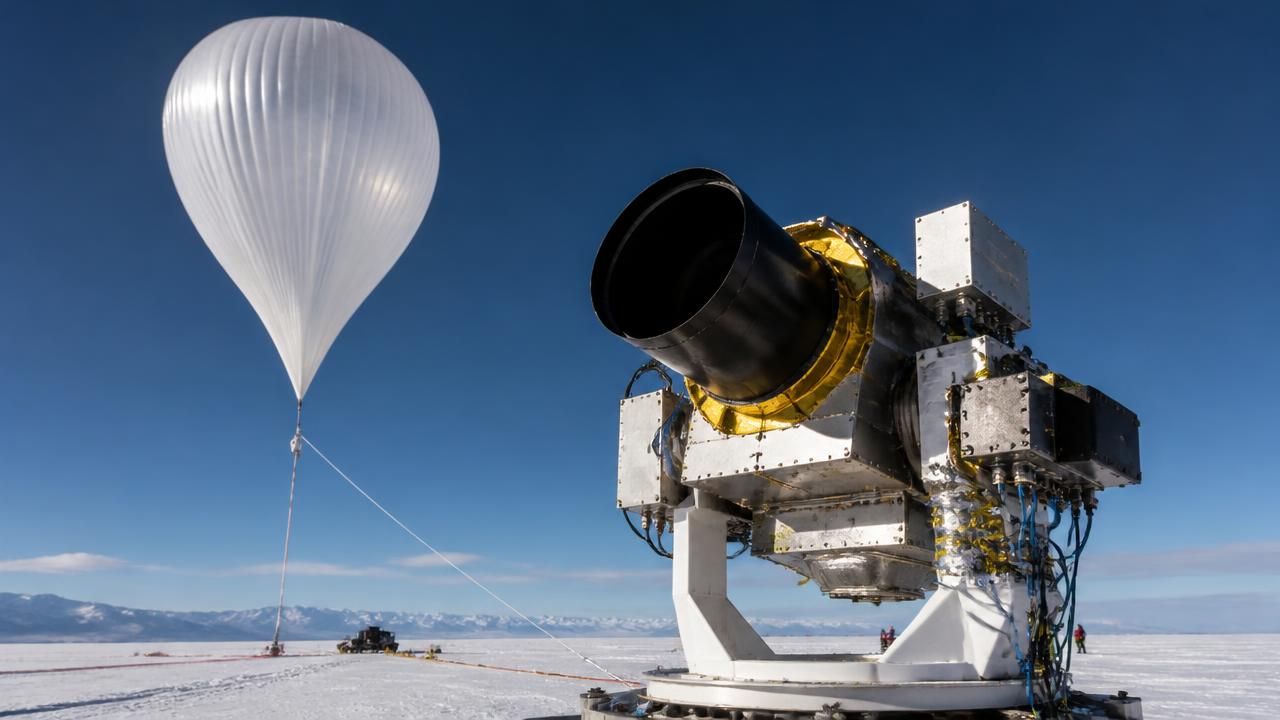
For centuries the Sun's "quiet" regions have been treated as the solar equivalent of calm seas — bland expanses between the violent active zones that spawn sunspots, flares and coronal mass ejections. New observations suggest that picture is badly incomplete. Using a balloon-borne telescope flying high above the bulk of Earth's atmosphere, a team of solar astronomers has found delicate, thread-like magnetic structures woven throughout the solar atmosphere, apparently twisted into shape by churning motions on the Sun's visible surface.
The same campaign also produced something researchers have long struggled to obtain: direct maps of the magnetic field inside towering jets of solar material hurled upward from the surface, showing for the first time how those fields reorganize with altitude. Together, the results point to a magnetic engine far more intricate — and far less understood — than standard models assume.
A telescope on a balloon
Studying the Sun's magnetic field is notoriously difficult. The field is invisible; astronomers infer it indirectly through the polarization of light emitted by atoms in the solar atmosphere, a signal that is faint, easily swamped by noise, and largely blocked by the atmosphere's own interference. That is why the sharpest magnetic measurements have historically come from a handful of space telescopes and from a new generation of ground-based instruments such as the Daniel K. Inouye Solar Telescope in Hawaii, which began science operations in 2022.
Balloon observatories occupy a useful middle ground. Suspended roughly 30 to 40 kilometers up — above 99 percent of the atmosphere's water vapor and turbulence — they deliver space-telescope-like clarity at a fraction of the cost, and they can be recovered, refurbished and flown again. The trade-off is a short window: a flight lasts from hours to a few weeks, dictated by winds and the balloon's endurance. Every observation must be planned to the minute.
Threads in the quiet Sun
What that window revealed is a chromosphere — the layer between the visible surface and the corona — stitched with slender magnetic filaments. Rather than being static, the threads appear to be shaped by twisting, swirling motions at the photosphere, the Sun's visible surface, where convective plasma rolls like water in a boiling pot. Those motions tangle and braid the field lines, dragging them upward into the outer atmosphere.
The finding matters because the chromosphere is the gateway through which all energy must pass on its way to the corona, where temperatures inexplicably leap to millions of degrees — hundreds of times hotter than the surface beneath. This is the celebrated "coronal heating problem," one of the longest-standing unsolved questions in astrophysics. Proposed solutions generally fall into two camps: wave heating, in which magnetic waves carry energy upward and dissipate it, and reconnection heating, in which tangled field lines snap and release energy. The newly resolved braided threads offer tangible evidence for the tangle-and-braid picture, and give theorists a concrete geometry to test against.
Inside the jets
The second result is arguably the more novel. Solar jets — collimated columns of plasma that shoot tens of thousands of kilometers into the atmosphere — have been observed for well over a century, since Angelo Secchi sketched them in the 1870s. But their internal magnetic architecture has remained opaque. By measuring polarization signals at multiple heights within the jets, the team traced how the field's strength and orientation shift with altitude, effectively producing a vertical cross-section of a jet's magnetic skeleton.
The coverage of the work has emphasized the mystery rather than the mechanics. Where the scientific account describes threads and jets, several aggregators led with the language of anomaly: the Sun's magnetic field "behaving oddly," "mysterious behaviour," hidden magnetic waves "deep inside" the Sun. That framing is not wrong — the observations do not yet have a complete theoretical explanation — but it risks conflating genuine scientific mystery with something closer to breakthrough. The structures were predicted in general terms; what is new is the ability to resolve them and to measure their fields directly.
The Sun's quiet regions turn out not to be quiet at all. They host a delicate, dynamic magnetic architecture that we are only now able to resolve — and that architecture appears to be the key to how energy reaches the corona.
Why it matters
The stakes extend well beyond solar physics. The Sun's magnetic field drives space weather: flares and coronal mass ejections can disable satellites, disrupt GPS and radio communication, endanger astronauts, and — in extreme cases — overload power grids on Earth. The 1859 Carrington Event, a geomagnetic storm that set telegraph offices aflame, remains a benchmark for how vulnerable modern infrastructure could be. Better models of how magnetic energy is stored and released in the lower atmosphere are a prerequisite for forecasting such events with useful lead time.
- What was found: thread-like magnetic structures in the quiet solar atmosphere, shaped by surface twisting motions.
- How: a balloon-borne telescope flying above most of Earth's atmosphere, measuring polarized light at multiple heights.
- Also mapped: the internal magnetic fields of solar jets and how they change with altitude.
- Why it matters: the observations feed directly into the coronal heating problem and space-weather forecasting.
- What's unresolved: no complete theory yet explains the observed geometry or the jets' full energy budget.
The road ahead
Solar physics is in the middle of a data windfall. NASA's Parker Solar Probe has flown deep inside the corona, sampling the magnetic field at close range. The European Space Agency's Solar Orbiter is returning the first images of the Sun's polar regions. DKIST is resolving structures at tens of kilometers across. Balloon campaigns add the sustained, high-resolution polarization measurements that no single facility can provide alone.
The next step, researchers suggest, is to combine these datasets: to link what a balloon sees threading the chromosphere with what a spacecraft measures as the same field sweeps past it, and with what a ground-based telescope resolves at the surface. Whether the Sun's magnetic behavior is truly "odd" or simply more complex than our instruments could previously see, the answer will come from that synthesis — and from the balloons that keep the observations flying.