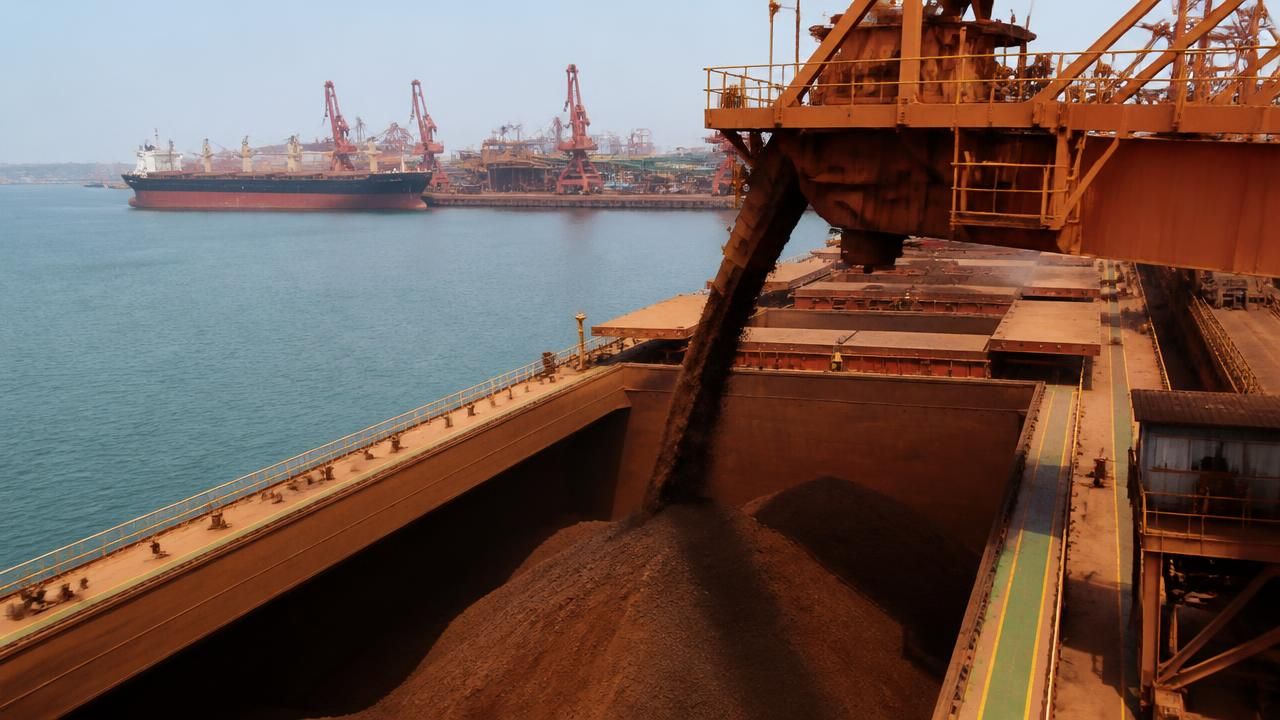
Rio Tinto Group and China's state-backed iron ore buying consortium have reached a new supply agreement covering the steel-making staple, according to reports that circulated across financial and mining trade outlets on the same day — though the headlines framing the news diverged sharply enough to leave the market uncertain about what, exactly, has been settled.
Bloomberg Markets first reported that China's state-backed buyer and Rio Tinto had reached a multiyear agreement on iron ore supplies, adding to a run of similar deals the consortium has struck with leading global producers. Within hours, mining.com, LSE.co.uk, MarketScreener and Singapore's Edge reported the same event differently: a new annual supply contract between Rio Tinto and China Mineral Resources Group (CMRG), attributed to people familiar with the matter. Several of those pages were returning access errors when checked, leaving the primary sourcing — Bloomberg — as the only fully readable account.
Who is CMRG, and why does one contract matter?
CMRG was established in 2022 with a mandate to centralise China's iron ore procurement, turning a fragmented field of dozens of independent steel mills into a single, coordinated buyer. The logic was straightforward: China imports well over a billion tonnes of iron ore a year and depends on seaborne supply for the overwhelming majority of it, yet its mills had historically negotiated as price-takers against three dominant producers — Rio Tinto, BHP and Vale.
Consolidating buying power into one entity was intended to flip that dynamic. In practice, CMRG has pursued a strategy of signing term contracts with each major supplier in turn — a pattern Bloomberg referenced directly, noting the Rio agreement "adds to deals that the group has struck with leading global producers." That framing presents the announcement as the orderly next step in a deliberate procurement architecture rather than a one-off commercial win.
Multiyear or annual? The detail that matters
The discrepancy between "multiyear" and "annual" is not trivial. An annual contract aligns with the traditional April-to-March Japanese fiscal-year benchmark system and leaves room for renegotiation each cycle; a multiyear deal locks in volumes and, typically, pricing mechanics for longer — reducing spot-market exposure for both sides. Which structure was actually signed will determine how much of Rio's Pilbara output is now contractually insulated from spot volatility.
The counter-signal: a reported pause on purchases
The same reporting cycle carried a markedly less conciliatory headline. Seeking Alpha, citing Bloomberg, reported that China had told its steel mills to hold off buying iron ore from Rio Tinto.
"China tells steel mills to hold off buying iron ore from Rio Tinto" — Bloomberg headline, as relayed by Seeking Alpha
Taken at face value, the two stories pull in opposite directions: a signed supply contract alongside an instruction to stop buying. The most coherent reading is that commercial agreement and political pressure are running on separate tracks — a term contract can be concluded at the corporate level while procurement guidance from Beijing remains a live lever in a broader negotiation. CMRG's leverage derives precisely from its ability to direct where Chinese mills source, and that lever can be pulled whether or not a contract exists on paper.
Fortescue's warning widens the frame
The story is not confined to Rio. MSN carried a report that Australia's Fortescue warned of a possible hit to its operations as talks with China's state buyer rumbled on. Fortescue is the most China-exposed of the big Australian producers, with a customer base concentrated almost entirely in Chinese steel mills.
Read together, the three threads suggest the CMRG negotiation cycle is proving harder than the headline deal count implies: some agreements close, some drag, and the pressure being applied to one producer can be read as a signal to the others about the terms available this cycle. Chinese steel margins have been under sustained pressure, and a consolidated buyer facing squeezed mills has every incentive to push hard on price and on the use of non-dollar settlement.
Simandou and the long game
Kalkine Media framed the Rio news around a different question entirely — what a Simandou shipping agreement means for the ASX-listed miner. Simandou, the vast high-grade iron ore deposit in Guinea, is the single largest new supply source due to come online this decade, and Rio Tinto is a partner in the project. High-grade ore from Guinea is strategically attractive to Chinese mills under emissions-reduction mandates, and it also serves as a bargaining counter: the credible promise of alternative supply weakens the incumbents' position at the negotiating table.
That is the context in which a CMRG term contract should be read — not simply as a demand signal, but as part of a multiyear repositioning of who controls the seaborne iron ore trade.
Winu, and the market's verdict
Ad-hoc-news.de reported that Rio Tinto stock slipped as a Winu mine agreement and the China dispute reshaped the outlook. Winu, a copper-gold project in Western Australia, is a diversification story rather than an iron ore one; its inclusion in the same news cycle illustrates how investors are weighing Rio's growth pipeline against near-term revenue risk in its dominant division.
The share-price reaction — a modest slip rather than a rout — is itself informative. Investors appear to be treating the contract as incrementally positive and the hold-off instruction as negotiating noise, not a structural break in the Australia-China trade relationship.
What to watch
- Contract confirmation: whether Rio Tinto formally discloses the term, volume and pricing basis of the CMRG agreement.
- The scope of the pause: whether the instruction to mills applies to spot cargoes only or extends to contracted volumes.
- Fortescue's outcome: a resolution there would clarify whether this is a Rio-specific dispute or a sector-wide repricing.
- Simandou timing: first shipments will reset leverage across the entire market.
- Pricing benchmarks: whether CMRG pushes for wider use of non-dollar or index-linked settlement.
For now, the honest summary is that both stories are true at once. A deal has been signed — reported across at least six outlets, originating with Bloomberg — and pressure is simultaneously being applied. That combination, rather than either headline alone, is the real state of play in the world's most important bulk commodity market.