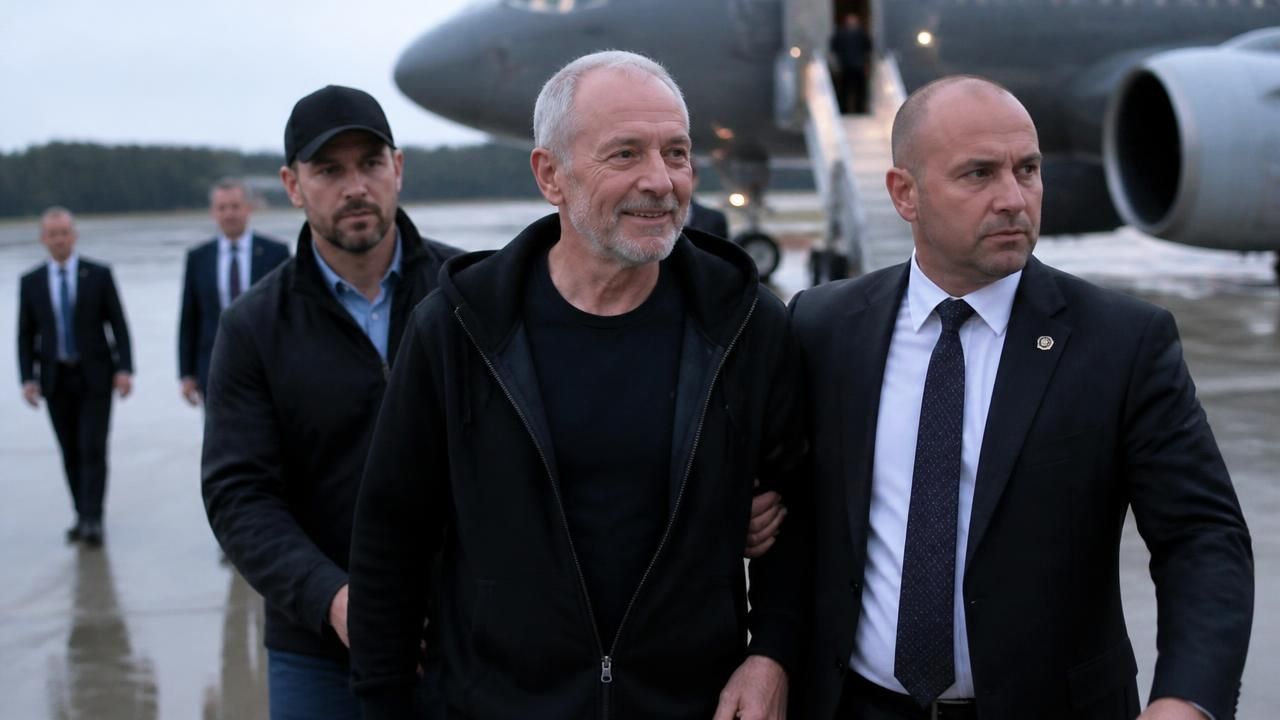
Russia has released American citizen Stephen Hubbard after more than four years in custody, a decision announced as President Vladimir Putin met with White House envoy Steve Witkoff in Saint Petersburg for talks aimed at ending the war in Ukraine. President Donald Trump confirmed the release, telling reporters that Hubbard was on his way home and stressing that the arrangement did not involve a prisoner exchange.
The timing placed the release squarely inside the most sensitive diplomatic channel between Washington and Moscow. NPR reported that the announcement came as talks got underway between Putin and Witkoff, focused on the latest U.S. efforts to broker an end to the conflict. The Boston Herald and other outlets framed the news simply: Russia released the detained American during a visit by a Trump administration envoy.
A release timed to diplomacy
The convergence of the two events — a high-stakes peace negotiation and a single American's freedom — was not lost on observers. Witkoff's trips to Russia have become the primary conduit for the Trump administration's direct engagement with the Kremlin, and the Hubbard case gave both sides a concrete, low-cost gesture at a moment when broader negotiations remain fragile.
"There was no swap," Trump said, according to multiple outlets, pushing back on characterizations that Hubbard had been traded for a Russian held in the United States.
The distinction matters. Washington and Moscow have in recent years relied on carefully constructed exchanges — most notably the swaps that brought home Brittney Griner and Trevor Reed — to free Americans held in Russia. A release without a reciprocal transfer is comparatively rare, and it raised questions about what, if anything, Moscow received in return.
Trump also suggested that the delay in imposing certain sanctions had played a role in securing Hubbard's freedom, according to reporting from Yahoo's Canadian edition. Yahoo separately reported the president's insistence that the release was not part of a swap. The White House has not detailed the specific mechanism of the arrangement.
Who is Stephen Hubbard?
Hubbard, a Michigan native, is a retired schoolteacher who served in the U.S. Air Force and the National Guard, according to profiles published by the Economic Times and other outlets. He is in his seventies and had been living in Ukraine before his detention.
Russian authorities detained Hubbard in 2022 in eastern Ukraine and accused him of serving as a paid mercenary for Ukrainian forces. He was convicted and sentenced to a lengthy prison term. Hubbard consistently maintained that he was not a combatant, and U.S. officials have described him as wrongfully detained — a designation that shifted his case from a consular matter into the realm of presidential-level diplomacy.
Unlike high-profile detainees such as Evan Gershkovich or Paul Whelan, Hubbard's case drew comparatively little sustained public attention. His release nonetheless became a test of whether the administration's direct-channel approach to Moscow could deliver results on a human level even as the larger war grinds on.
How the story was framed
Coverage varied sharply by outlet, revealing distinct editorial priorities:
- Diplomatic framing: NPR, the Boston Herald and the Baltimore Sun led with the Witkoff meeting, treating the release as a byproduct of peace negotiations.
- Transactional framing: Firstpost, The Yeshiva World and inkl emphasized the absence of a swap, headlining Trump's claim directly.
- Profile framing: Clarin, inkl and MSN focused on Hubbard himself — who he is, why he was imprisoned, and what his release means to his family.
- Process framing: The Economic Times examined the mechanics, asking how Trump and Witkoff secured the freedom of a retired teacher and former service member.
The multiplicity of angles reflects a familiar pattern in U.S.-Russia relations: the same event can be read as a humanitarian breakthrough, a diplomatic bargaining chip, or a domestic political win, depending on where you stand.
What it signals — and what it doesn't
The Hubbard release is a modest but genuine de-escalatory gesture at a moment when U.S.-Russia relations remain at their lowest point in decades. It follows a series of quiet contacts between Washington and Moscow and suggests the Kremlin sees value in offering visible concessions to an administration actively seeking a negotiated end to the Ukraine war.
Yet the limits are equally clear. A single detainee's release does not alter the underlying conflict, the sanctions architecture, or the deep mistrust between the two capitals. Nor does it resolve the question of other Americans still believed to be held in Russia.
For Hubbard's family and for the Michigan community where he taught, the significance is far more immediate. After more than four years in Russian custody, a retired schoolteacher is heading home — an outcome that, for all its geopolitical context, remains first and foremost a personal one.