KYIV — Ukrainian President Volodymyr Zelenskyy said this week that Ukraine again received no advance warning from its partners of a Russian ballistic missile barrage targeting Kyiv’s power infrastructure — only to announce shortly afterward that a U.S. early-warning channel for Russian missile attacks had resumed following a telephone call with Secretary of State Marco Rubio.
The sequence, reported across a dozen outlets in Europe and the United States, has exposed fresh fragility in the intelligence relationship between Washington and Kyiv at a delicate moment in the war, and produced sharply divergent framings: Kyiv describing a dangerous gap in warning, and Washington angrily rejecting any suggestion it deliberately withheld information.
What Zelenskyy said
Speaking after one of the most intense strikes on the capital’s energy system in recent months, Zelenskyy said Ukraine’s partners had failed to provide notice of incoming ballistic missiles. The Financial Times, The Guardian and HuffPost all led on the same point: Kyiv’s allies did not warn of the attack as Russian missiles came in.
“Ukraine again received no ballistic missile warning from partners,” Zelenskyy said, according to the Ukrainian outlet Hromadske, which also reported that Rubio subsequently attributed the lapse to an earlier software issue rather than any policy decision.
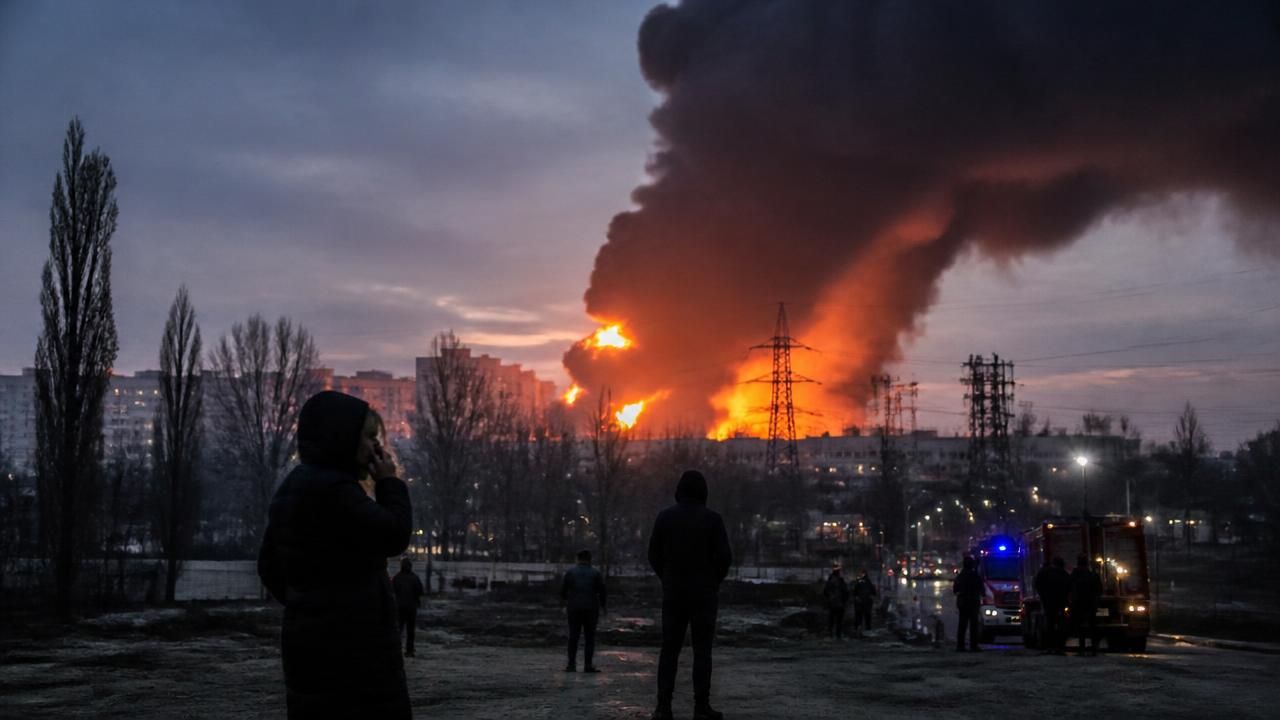
The strikes hit Kyiv power plants, part of a sustained Russian campaign against Ukraine’s generation and transmission capacity that has repeatedly left millions without heat and electricity. Business Standard reported that Ukrainian officials suspect Washington of restricting intelligence sharing on Russian attacks — an allegation the U.S. side has rejected.
The Rubio call and a system restored
Within hours, the picture shifted. Zelenskyy said the early-warning arrangement was functioning again after talks with American counterparts, including a phone call with Rubio. NPR, the Associated Press and MSN all reported the resumption, with Zelenskyy expressing gratitude to the United States.
“We are thankful to the United States that the system works now.”
LBC reported that Zelenskyy thanked Washington for restoring intelligence on missile strikes — while noting that U.S. officials simultaneously rejected as “scandalous” the claim that the flow had been paused at all.
Washington’s pushback
The competing accounts have produced two parallel storylines. In one, favored by U.S. officials and amplified by NBC News, the episode is a technical failure: a software problem in the pipeline that distributes warning data, corrected after the fact. In the other, reported by the FT, The Guardian, HuffPost, NBC and others, it is evidence that Ukraine cannot count on timely American intelligence.
NBC News reported that Zelenskyy met with Trump administration envoys as U.S. officials blasted what they called “scandalous” accusations about withdrawn support. MSN also carried reporting that the U.S. may have withheld warnings ahead of the deadly Kyiv strikes — a framing the administration denies.
The dispute matters because the substance is nearly unverifiable from outside. Early-warning intelligence is among the most sensitive categories of sharing, and neither side has published the technical details behind the alleged software fault.
Why warning time is decisive
For Ukraine, advance notice of ballistic missile launches is not a courtesy but a matter of survival. Ballistic missiles fly on high arcs at several times the speed of sound, leaving defenders only minutes — in some cases seconds — between detection and impact.
- Warning data allows air-defense crews to bring radars to readiness and prioritize which interceptors to fire at which targets.
- It triggers civilian alerts that push people into shelters and move workers away from critical infrastructure.
- It allows grid operators to pre-emptively shed load and island equipment, limiting cascading blackouts when plants are hit.
Ukraine’s air-defense architecture, built around Patriot and other Western-supplied systems, depends heavily on U.S. and allied sensor data. Any interruption — however brief — is felt immediately on the ground.
A relationship already under strain
The episode lands in a broader pattern. Since the change of administration in Washington, Kyiv has navigated repeated pauses, reviews and public disputes over military and intelligence support, each followed by reassurances that cooperation continues. For Ukrainian officials, each cycle carries a cost: uncertainty that Moscow can exploit, and a domestic audience increasingly sensitive to signs of abandonment.
Officials in Kyiv have been careful to praise Washington publicly even while describing the failure candidly — a balancing act evident in Zelenskyy’s remarks, which paired a blunt complaint about missing warnings with explicit thanks once the channel was restored.
Diplomacy moves north
The intelligence row is unfolding alongside intensified diplomacy. Newsmax reported that Zelenskyy was set to meet U.S. special envoy Steve Witkoff in Norway, and MSN reported that the Ukrainian president is seeking a U.S.–Russia–Ukraine summit and hailing the restored early-warning system.
A trilateral meeting would be a significant format shift, bringing Moscow and Kyiv to the same table with Washington as convener. Whether the Kremlin would accept such a framework remains unclear, and European capitals are watching closely for any sign that talks might proceed without them.
What to watch
Two questions will determine how this episode is remembered. First, whether the restored warning channel holds through the next major strike wave — the true test of whether the software explanation is complete. Second, whether the incident hardens or softens the Trump administration’s posture toward Kyiv as envoy-level talks continue in Scandinavia.
For now, both governments are telling a version of the same story with different emphases: one about a system that failed and was fixed, the other about allies who were left blind while missiles fell on their capital.