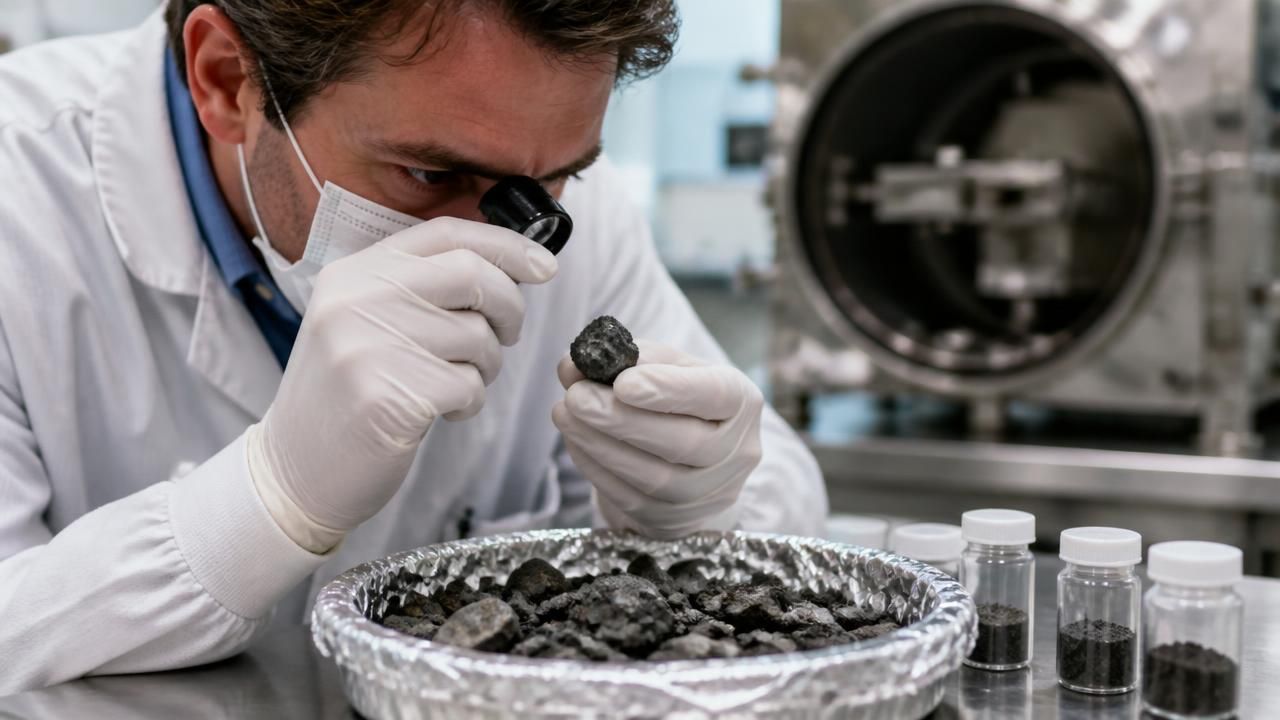
When NASA's OSIRIS-REx spacecraft dropped a parachute-slung capsule onto the Utah desert in September 2023, it delivered roughly 122 grams of rubble from a 4.5-billion-year-old asteroid — the largest pristine sample of extraterrestrial material ever brought home. Now, analysis of those grains has resolved a puzzle that has nagged planetary scientists since the spacecraft first arrived at Bennu in 2018: why a world carpeted in house-sized boulders sheds heat so quickly.
The answer, according to NASA-led research, lies not between the boulders but inside them. The rocks are riddled with hidden cracks.
The paradox of a boulder-covered world
Bennu is a "rubble-pile" asteroid — a loose agglomeration of debris roughly 500 meters across, held together by little more than gravity and weak van der Waals forces. Thermal measurements from OSIRIS-REx's infrared instruments showed that the surface heats up and cools down with surprising rapidity, a signature of low thermal inertia. That was odd: on Bennu, the fine dust and sand that typically insulate an asteroid's surface had largely been lost to space, leaving bare, massive boulders exposed. Solid rock, researchers reasoned, should retain heat far longer.
Remote sensing could only take the mystery so far. The returned samples provided the missing microscope.
What the rocks revealed
Under laboratory scrutiny, the Bennu fragments turned out to be far more fractured than their dense appearance suggested. Networks of microcracks pervade the material — voids and fissures created over eons of thermal cycling, impact shuffling and the slow, cumulative stress of being a small body in a hostile environment. Those cracks act as thermal bottlenecks, breaking up the continuous pathways along which heat would otherwise flow through solid mineral grains.
The result is a boulder that looks monolithic from orbit but behaves, thermally, more like a sponge.
The rocks returned from Bennu are not the solid, uniform blocks their appearance implies: their internal fracture networks fundamentally alter how the material stores and releases heat, reconciling decades of remote observations with the physical reality of the asteroid's surface.
The finding pulls together two threads that had resisted a common explanation: Bennu's anomalously rapid cooling, and the broader question of why so many asteroid surfaces appear rocky — or, more precisely, why so many appear only rocky, with the expected blankets of fine regolith conspicuously absent.
Formation, fracturing and the rocky-surface question
Several outlets framed the result in sweeping terms. Science Daily emphasized the thermal mystery and the hidden cracks; eurasianreview and nanowerk both ran the headline "Mystery surrounding the formation of asteroid Bennu solved"; Lake County News, syndicating space coverage, framed it around the question of why some asteroid surfaces are rocky at all. Those headlines reflect different emphases within a single body of work — the thermal-physics angle, the formation-history angle and the planetary-surface angle — rather than competing claims.
The formation context matters. Bennu is a fragment of a much larger parent body that was shattered by an ancient collision, then slowly re-assembled into a loosely bound pile of debris. Each stage — the original accretion, the catastrophic disruption, the gravitational re-accumulation, and billions of years of subsequent heating and cooling — would have left its own mechanical signature. A rock that has been fractured repeatedly and never re-annealed under pressure will carry that history internally, invisible to a telescope.
That has implications beyond Bennu. Thermal inertia measurements are among the primary tools used to infer the physical properties of asteroids from a distance, and they feed into models of how heat is transported across small bodies, how Yarkovsky drift nudges orbits over centuries, and — for a near-Earth object like Bennu — how its trajectory might evolve. If ordinary boulders are routinely webbed with fractures, remote estimates of density, strength and heat flow across the asteroid population may need recalibrating.
A mission built on a gamble
OSIRIS-REx launched in 2016, arrived at Bennu in 2018 and briefly touched the surface in October 2020, its sampling head punching into a surprisingly soft patch of regolith. The spacecraft then spent two years flying home, releasing its sample capsule on 24 September 2023 before veering off toward a new assignment: the extended OSIRIS-APEX mission to asteroid Apophis, which it will study after that object's close pass by Earth in April 2029.
The Bennu material itself remains under active investigation by a global consortium of laboratories. Small subsamples have already yielded evidence of carbon-rich organic compounds and abundant hydrated minerals — a chemical inventory consistent with the idea that carbonaceous asteroids delivered water and prebiotic chemistry to the early Earth. Each new analysis, like this one, demonstrates the value of returning physical material rather than relying on remote sensing alone.
Why it matters
- Planetary defense: Bennu is one of the most closely tracked near-Earth asteroids, with a small but nonzero chance of hitting Earth in the 2100s. Its internal structure affects how it would respond to any deflection attempt.
- Remote-sensing calibration: fractured boulders change how scientists interpret thermal and radar data from asteroids never visited by spacecraft.
- Origins science: crack networks reveal a history of mechanical stress that supplements the chemical story of how the early solar system assembled.
For planetary scientists, the takeaway is a familiar one, newly confirmed: asteroids are not inert lumps of rock but archives of violence and change, and their surfaces rarely look like what lies beneath. Bennu's boulders, it turns out, have been telling two different stories — one visible from orbit, one legible only under a laboratory microscope.