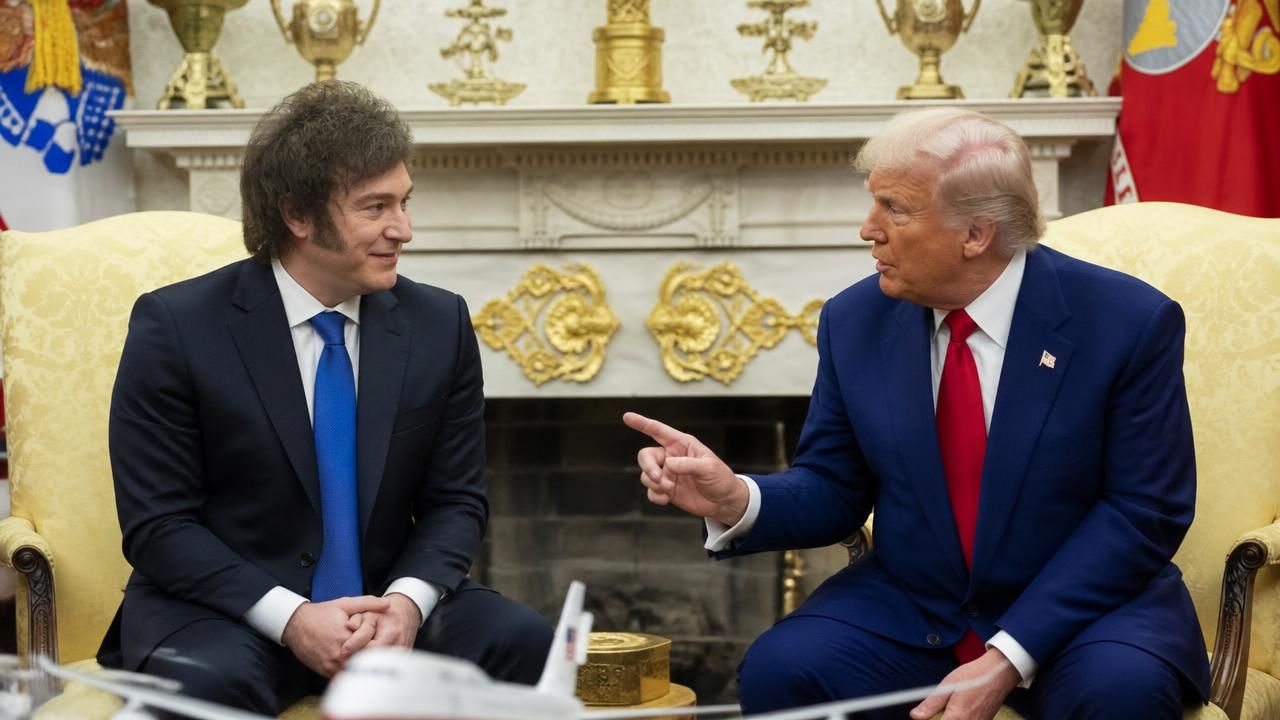
Latin America's rightward, market-friendly turn is quietly rewriting the region's financial relationship with Washington. According to Bloomberg Markets, governments aligned with Donald Trump are deepening ties with the multilateral lenders that were once cast as villains across the hemisphere — institutions long accused of imposing fiscal austerity on governments that could ill afford it. The shift, Bloomberg reports, is producing new flows of money and influence at a moment when the region's politics are converging on a single question: how closely to align with the United States.
The answer is increasingly being delivered at the ballot box. In Brazil, the presidential race has gone to a runoff after a campaign dominated by crime, corruption and Trump himself, CNN reported. In Argentina, President Javier Milei has gone further than any other regional leader, publicly endorsing Trump ahead of the U.S. midterms and framing the vote as a civilizational choice, MSN reported.
A hemispheric realignment
For decades, the International Monetary Fund, the World Bank and the Inter-American Development Bank occupied a fixed place in Latin American political mythology: the outside forces that arrived with loan conditions attached and left with sovereignty in hand. Debt crises in the 1980s and austerity programs in the 1990s and 2000s made the lenders reliable foil for populist leaders of both left and right.
Bloomberg's reporting suggests that dynamic is inverting. As market-friendly administrations take office from Buenos Aires to Brasília, the same institutions are being recast as partners rather than adversaries — sources of capital that can stabilize budgets and reassure investors without the stigma that once came attached. For Washington, that is a strategic windfall: lending capacity becomes an instrument of alignment, and alignment becomes leverage.
The timing is not accidental. The New York Times reported that a victory by Jair Bolsonaro would "nearly complete Trump's Latin America map" — a striking framing that casts the region's elections as pieces on a board rather than isolated national contests. Whether or not that map fills in, the metaphor captures how both capitals now view the stakes.
Brazil's runoff: crime, corruption and Trump
No contest illustrates the fusion of domestic grievance and foreign alignment more clearly than Brazil's. CNN reported that the campaign has been dominated by public safety, corruption allegations and the long shadow of Trump, whose tactics and rhetoric have been absorbed by parts of the Brazilian right and whose name functions as both endorsement and warning depending on the audience.
The runoff result means the country's deep polarization remains unresolved. For markets, the immediate question is fiscal credibility; for Washington, it is whether Brazil joins the arc of governments tilting toward the United States or remains a counterweight. Either outcome carries consequences for the lending flows Bloomberg describes, since multilateral money follows political confidence as much as it creates it.
Milei's endorsement and the midterm calculation
Argentina's president has made his preference unmistakable. According to MSN, Milei backed Trump for the U.S. midterms and described the vote as critical for the future of the West.
"The vote is crucial for the West," Milei said, according to MSN's account of his remarks.
The endorsement is unusual for its directness — foreign leaders typically avoid weighing in on American midterms — but it is consistent with Milei's broader project of binding Argentina tightly to Washington and to the multilateral institutions that underwrite its reform program. It also underscores how the hemisphere's ideological lines now run through U.S. domestic politics, not just through regional summits.
The coalition cracks
Not everyone in the emerging alliance is cheering. Politico reported on what it described as Trump's "cracking Latino coalition" — a reminder that the hemispheric story has a domestic American subplot. Gains among Latino voters, particularly men, have been central to Trump's electoral math, and the same swing-state dynamics that delivered those gains can reverse when economic anxiety or immigration rhetoric sharpens.
The tension is structural. A foreign policy built around ideological kinship with Latin American leaders does not automatically translate into support from Latino communities in the United States, whose priorities span wages, healthcare, housing and immigration status. Analysts have long cautioned that treating the diaspora as a monolithic bloc is a category error; the Politico framing suggests the bill for that assumption may be coming due.
Influence, money and the private channel
Beneath the diplomatic layer sits a more tangled commercial one. The New York Times reported on a Trump loyalist, a Turkish investor and a fight for wealth and influence — a story that illustrates how private capital, political access and foreign interests now intersect in the hemisphere's emerging markets. Such entanglements complicate the clean narrative of like-minded governments cooperating through public institutions, and they raise questions about who actually benefits when lending flows increase.
Critics of the multilateral lenders argue that the new enthusiasm is less about development than about discipline: money extended to governments that adopt market-friendly policies, withheld from those that do not. Supporters counter that the alternative — Chinese lending with fewer conditions, or no capital at all — leaves poorer countries worse off. Both arguments will be tested as disbursements scale up.
What to watch
- Brazil's runoff outcome and whether it accelerates or brakes the region's tilt toward Washington.
- Multilateral disbursements to Argentina, Ecuador and other aligned governments, and the conditions attached.
- Milei's campaign-season advocacy for Trump and whether other regional leaders follow.
- Latino voter sentiment in the U.S., where the coalition Politico describes appears to be under strain.
- Private deals and access of the kind the Times detailed, which may shape perceptions of the entire alignment project.
The throughline is a region re-sorting itself around Washington at the exact moment Washington is re-sorting itself around a narrower set of allies. That convergence has produced real money and real momentum — and, as the runoff in Brazil and the fractures at home suggest, no small amount of risk.