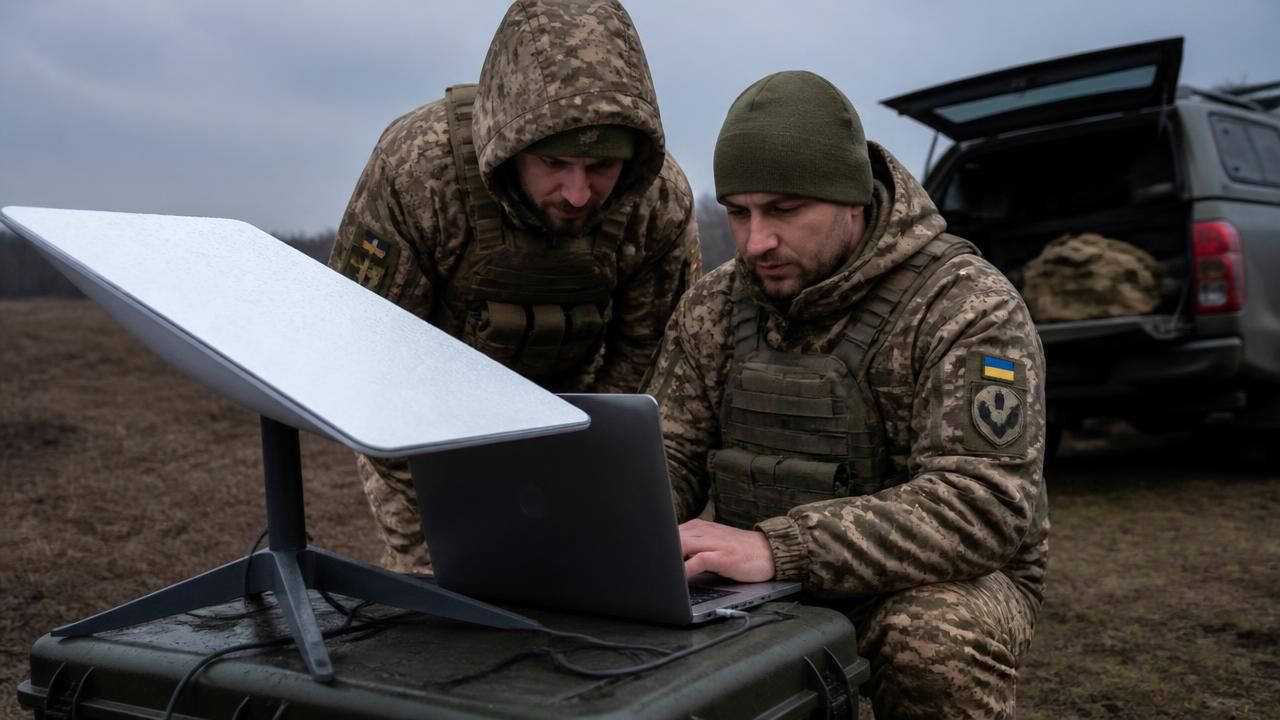
Ukraine's military is fighting a new battle on an unexpected front: the terms of service on a satellite network. According to reporting by Reuters and NPR, Ukrainian forces have lost normal access to Starshield — the military-grade, encrypted variant of SpaceX's Starlink constellation — and Kyiv believes the restriction was imposed from Washington rather than by the company itself.
The dispute burst into public view when Ukrainian President Volodymyr Zelenskyy said he believes the U.S. government is behind his military's loss of normal access to the satellite communications service its forces have relied on since the earliest days of Russia's full-scale invasion. Reuters, citing sources familiar with the matter, reported that the order to limit Starshield for Ukraine came from inside the White House — a claim that, if confirmed, would mark a striking turn in the technological partnership that has underpinned Ukrainian operations for more than three years.
What exactly is Starshield?
Starshield is SpaceX's government- and military-focused offshoot of Starlink. While consumer Starlink terminals beam broadband internet from low-Earth orbit to homes, ships and field units, Starshield is built around secured, encrypted communications, custom payloads and government contracts — including a classified agreement with the U.S. National Reconnaissance Office. For Ukraine, the practical distinction matters: Starshield terminals are the hardened, military-appropriate layer of the same orbital architecture, and are far harder to replace than off-the-shelf gear.
Starlink itself arrived in Ukraine in early 2022 as a battlefield lifeline, keeping command units, artillery teams and drone operators connected where cellular networks had been destroyed. Its importance has made it a recurring flashpoint in the war's politics, with Elon Musk's public statements and SpaceX's control over geofencing and coverage repeatedly drawing scrutiny from Kyiv and from Western lawmakers.
A speed cap, and drones that lose signal
The specific restriction at issue is a speed limit on the network. According to reporting highlighted by The Next Web, Zelenskyy said Ukrainian drones still lose their Starshield connection above roughly 161 km/h — about 100 miles per hour. That threshold effectively excludes the small, fast first-person-view attack drones and long-range one-way attack UAVs that have become central to Ukraine's arsenal, while leaving slower crewed vehicles and fixed positions connected.
Speed-based geofencing is a standard anti-abuse mechanism in satellite internet: it was designed to stop terminals being strapped to missiles or used on aircraft outside licensed parameters. In Ukraine's drone war, however, the same technical control functions as a capability limit.
"I believe the U.S. government is behind" the loss of normal access, Zelenskyy said, according to NPR — a charge that shifts the question from corporate policy to statecraft.
A presidential adviser in Kyiv confirmed that Ukraine is in talks to lift the speed limit on the military satellite network, framing the restriction as a negotiable technical parameter rather than a permanent cutoff. That characterization is notably more measured than the president's, and suggests Ukrainian officials see a path to restoring access through diplomacy.
Competing accounts of who pulled the lever
The story's central ambiguity is attribution. Reuters' sourcing points to the White House as the origin of the order to limit Starshield in Ukraine. Kyiv's public statements blame the U.S. government. SpaceX, for its part, has not been described in the reporting as the initiating party — a meaningful distinction for a company that has spent years defending itself against accusations of unilateral meddling in the war.
Neither the White House nor the Pentagon has offered a detailed public explanation in the accounts reviewed. The silence leaves open several possibilities that analysts will be watching: a deliberate policy pressure campaign tied to broader U.S.-Ukraine negotiations, a narrower compliance or escalation-management decision, or a contractual restriction enforced at Washington's request through SpaceX's government agreements.
Why it matters on the battlefield
- Command and control: Starshield terminals link Ukrainian headquarters to units along a front line roughly 1,000 kilometers long.
- Drone warfare: The 161 km/h ceiling directly affects fast UAVs used for strike and reconnaissance, a domain where Ukraine has pioneered tactics.
- Leverage: Control over a private satellite network gives Washington a tool — and a vulnerability — in shaping how the war is fought.
- Precedent: Commercial constellations are now dual-use infrastructure, raising unresolved questions about who may switch them off, and on whose authority.
The bigger picture
The Starshield episode crystallizes a dilemma that has shadowed Western support for Ukraine since 2022: critical military capability increasingly runs through private companies and foreign governments, neither of which is accountable to Kyiv's chain of command. Ukraine has spent years diversifying its communications — domestic encrypted systems, allied satellite capacity, fiber and radio — but no substitute matches Starlink's resilience and ubiquity at the front.
For the United States, the disclosure carries its own risks. If Washington did order the restriction, it must now justify limiting a partner's access to a network that partner depends on for survival; if it did not, it must explain who did. For SpaceX, the affair reinforces how thoroughly a commercial internet provider has become an instrument of national policy.
For now, the talks continue. Ukrainian officials are pushing to lift the speed limit, Zelenskyy is publicly pointing at Washington, and the terminals in the field keep dropping their signal above 161 km/h. The outcome will be decided not in orbit, but in negotiations — a reminder that in this war, even bandwidth is politics.