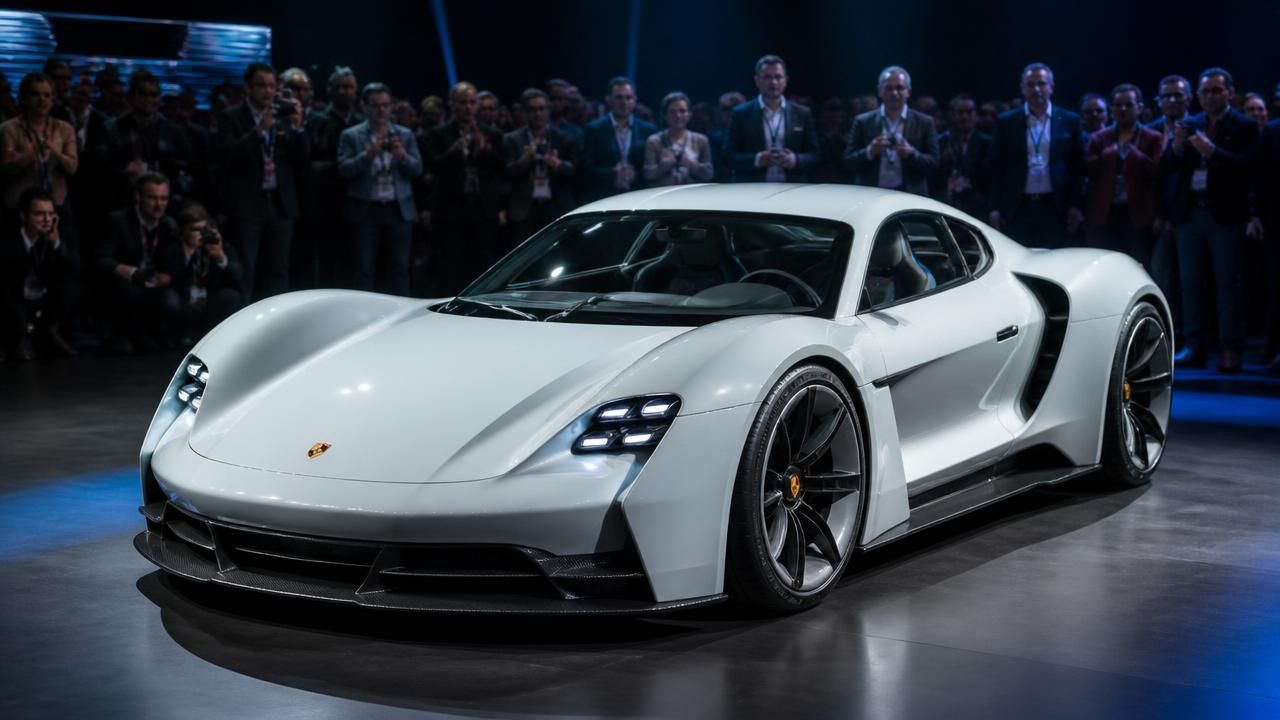
Porsche has confirmed what enthusiasts have speculated about for years: the German automaker is developing a mid-engined supercar that will sit above the 911 in its lineup. The wraps came off the Mission S concept in New York, and unlike the limited-run Carrera GT and 918 Spyder that preceded it, this car is destined for regular production rather than a numbered, sold-out allocation.
The reveal is the clearest signal yet of how Porsche intends to reinvent itself as a brand — and a business — over the next decade.
A permanent flagship, not a farewell special
The Mission S is a mid-engined, two-seat sports car positioned as a new halo model above the 911. That positioning matters: for decades, Porsche's ultimate performance cars have been occasional, celebratory machines — the 959, the Carrera GT, the 918 Spyder — built in tiny numbers and then retired. The Mission S breaks that pattern. Road & Track described it as heralding "a permanent supercar addition to the lineup," while Car and Driver was blunter: Porsche is officially developing a mid-engine supercar above the 911.
The concept also previews the brand's future design language, with coverage from MSN noting it takes direct aim at Ferrari — the historic rival Porsche has rarely challenged at the very top of the sports-car market with a series-production model.
The financial hole behind the halo car
The Mission S is not simply an engineering flex. It is a financial instrument. As Ars Technica reported, Porsche's profit margin — the envy of the industry at 18 percent just three years ago — collapsed to roughly 1 percent last year before recovering modestly. The company's board has responded with a strategy called "Sportwagenschmiede '35," which translates roughly to "sports-car forge '35," built around prioritizing "value over volume," deeper customer individualization, and the higher transaction prices that come with it.
"We are pursuing a clear plan with our strategy Sportwagenschmiede '35. The ultimate goal is to further strengthen our unique sports car brand — across all model lines and with new, highly desirable models in particularly high-margin segments."
— Michael Leiters, Chairman of Porsche
In other words, Porsche is not chasing more customers. It is chasing richer ones, and the Mission S is the tip of that strategy.
A flat-eight, an 8,000 rpm redline, and a roof scoop
Porsche has kept powertrain details deliberately vague, but the visual clues are loud. The concept wears quad exhausts, a configuration that has fueled widespread speculation of a flat-eight engine — an architecture Porsche has never put into series production. Yahoo coverage of the teaser highlighted an 8,000 rpm redline, a figure that signals a naturally aspirated or high-revving character rather than a hybridized turbo unit. Other outlets, including Paul Tan, noted a prominent roof scoop, a classic mid-engine air-intake signature that channels cooling air to the powerplant behind the cabin.
- Layout: mid-engined, two-seat, positioned above the 911
- Exhaust: quad pipes, hinting at a flat-eight
- Redline: teased at 8,000 rpm
- Bodywork: roof scoop feeding the mid-mounted engine
- Production intent: a regular series model, not a limited run
A cockpit with nothing to distract you
One of the more striking threads in the coverage concerned the interior philosophy. MSN's report on the concept described a driver-focused cabin deliberately free of distracting displays — a pointed counter-argument to the screen-saturated interiors that have become the industry norm. For a brand trying to justify a price above the 911, the pitch is experiential rather than digital: less software, more sensation.
Beyond the supercar: an electric 718 and new SUVs
The Mission S is only one piece of a broader product offensive. Reporting from PakWheels and Autocar India outlined a plan that includes an electric replacement for the 718 Boxster and Cayman, a new Macan-sized SUV offered with internal combustion power, and additional upmarket SUVs arriving around 2028. MSN's coverage framed the supercar as the top of a future range that stretches well beyond sports cars — a portfolio strategy designed to spread development costs across high-margin vehicles.
That mix reflects the awkward middle passage the industry is navigating: electrification is expensive, EV demand growth has cooled relative to forecasts, and brands are hedging by keeping combustion models alive longer than planned.
Five designs that never made it
Skepticism is warranted. As one MSN analysis pointedly noted, Porsche has already designed roughly five mid-engined supercars over the years and did nothing with them. Concept cars are cheap; production programs are not. The Mission S will have to survive board reviews, supply-chain realities, and the possibility that margins do not recover as forecast.
What comes next
Porsche has been drip-feeding information, with several outlets reporting teaser activity tied to a mid-October preview date before the full New York unveiling. Expect powertrain confirmation, a production timeline, and pricing — likely well above the 911 Turbo — in the months ahead.
What is already clear is the strategic logic. Porsche is not trying to sell more cars. It is trying to sell more expensive ones, and the Mission S is the most visible proof that the plan is real.