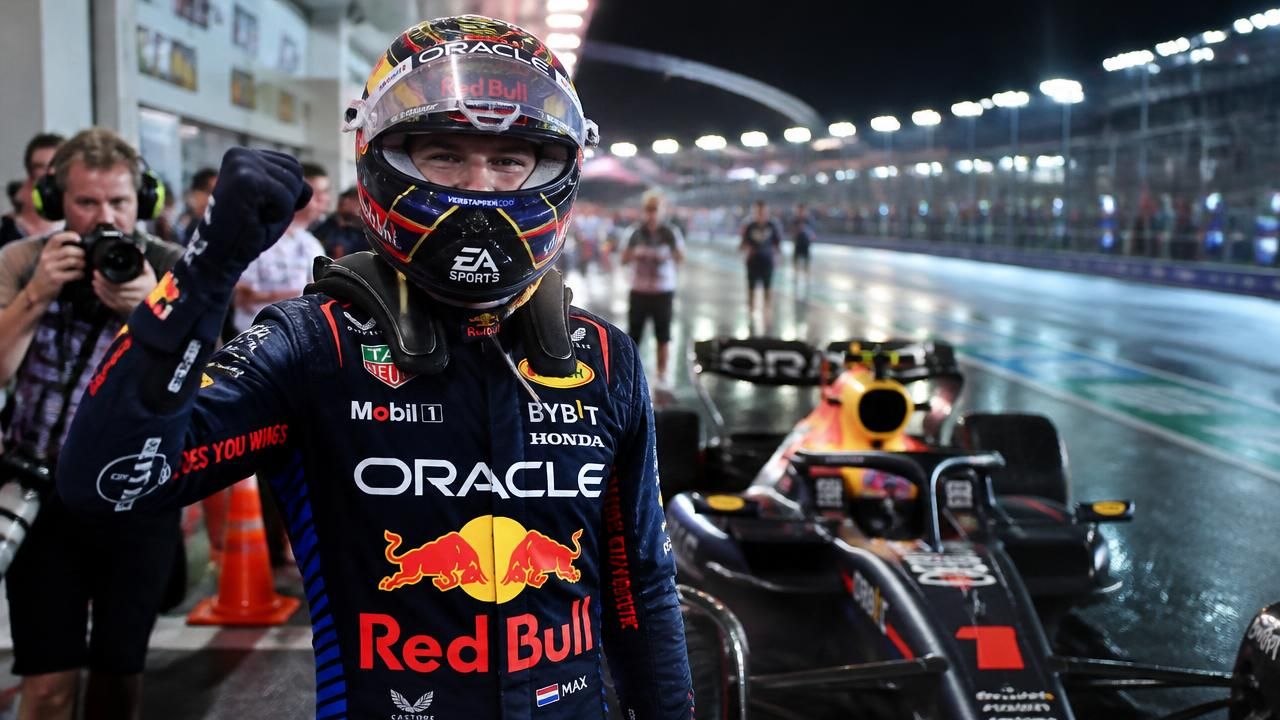
Max Verstappen will start Saturday's Formula 1 sprint from pole position in Singapore, a result Reuters reported as the 50th pole of the Red Bull driver's career — a milestone that reframes a season already entering its closing stretch. The session, held under the floodlights of the Marina Bay street circuit, was the headline act of a weekend that also saw Mercedes' George Russell make up ground on his teammate Kimi Antonelli, according to MSN's coverage of the grid order.
The three outlets covering the story emphasized markedly different things. Reuters led with the number: fifty poles, a figure that places Verstappen in rarefied statistical company. MSN led with the sprint grid and the intra-team battle at Mercedes, where Russell turned the tables on Antonelli. Ars Technica, meanwhile, barely mentioned the result at all, preferring to frame the weekend as a piece of theatre — and a referendum on Formula 1's controversial sprint format.
A Milestone Measured in Tenths
Pole positions are the cleanest currency in Formula 1, a pure measure of one-lap pace divorced from race strategy, tire management and pit-wall luck. Reaching 50 of them is a threshold only a handful of drivers have crossed, and it arrives for Verstappen during what Ars Technica described as a "lengthy" 2026 campaign now entering its final phase.
The nuance worth noting is that this particular pole was earned in sprint qualifying rather than in the traditional Saturday afternoon session that sets the grand prix grid. That distinction matters to purists, and it is one reason the coverage diverged so sharply: a milestone stat sheet reads very differently from a race weekend's competitive narrative.
For Mercedes, the more consequential story was internal. Russell outqualifying Antonelli is the kind of result that shapes team politics as much as championship arithmetic, particularly in a season's final stretch when contract leverage and internal hierarchy are quietly renegotiated with every lap.
Singapore as Spectacle — and as Argument
Ars Technica's dispatch captured why Singapore remains one of modern F1's greatest visual set pieces. From the air, the circuit reads as a bright ribbon threaded between overpasses and skyscrapers; at ground level, titanium skid blocks throw showers of sparks as drivers graze concrete barriers with millimetric precision.
"At ground level, the cars shower glittering sparks from their titanium skid blocks as the drivers flirt with how close they can get to the walls." — Ars Technica
The circuit is a world away from the abrasive tarmac and generous runoff of the season's previous round near the equator. Marina Bay's 90-degree corners and concrete-lined streets punish error absolutely, and the tropical heat and humidity are a constant. It is, in other words, precisely the kind of venue where the sprint format's risks are magnified.
The Sprint Problem
Saturday's sprint was delayed by 30 minutes after the skies opened shortly before the start, leaving standing water in places on the track. The interruption echoed the previous round, where a pre-race downpour disrupted proceedings — a rhyme that tropical weather makes almost inevitable.
The delay also amplified a long-running complaint. The sprint format replaces a practice session with a short additional race a day before the main event, and Ars Technica reported that it is unloved by drivers and teams alike. There is little prestige in winning on Saturday, and with grand prix qualifying following just hours later, the incentive structure discourages risk: a wrecked car in the sprint can ruin Sunday entirely.
- Sprint delay: 30 minutes, caused by standing water before the start.
- Grid: Verstappen on pole; Russell ahead of Mercedes teammate Antonelli.
- Context: The sixth and final sprint of the 2026 season.
The Red Bull Pole Tradition
There is a historical symmetry to a Red Bull driver reaching a pole milestone on a floodlit street circuit at the far end of a long season. In 2010, Sebastian Vettel won the Japanese Grand Prix at Suzuka for Red Bull — a victory that formed part of the run to his first world championship and the beginning of a four-title dynasty. Vettel's qualifying dominance in that era became the template Red Bull has since built upon, with Verstappen inheriting and extending the lineage.
The comparison is not merely decorative. Vettel's 2010 success demonstrated that a team's ability to convert single-lap pace into sustained championship output depends on operational discipline across a season's punishing final races — precisely the phase Verstappen now enters.
What the Divergent Coverage Reveals
Read together, the reports sketch a sport being pulled in two directions. Reuters supplies the record book: fifty poles, a driver cementing a statistical legacy. MSN supplies the soap opera: teammates fighting for position, hierarchies shifting beneath the surface. Ars Technica supplies the critique: a spectacular venue, a milestone grid, and a format that its own participants regard with ambivalence.
What happens next is straightforward. The sprint will run on a track that offers almost no margin for error, followed by full qualifying later in the day to set Sunday's grid. Whether Verstappen converts his milestone into silverware — and whether Russell's edge over Antonelli holds under race conditions — will determine how this Singapore weekend is remembered. For now, the night race has delivered what it reliably does: a spectacle, a statistic, and an argument that will not be settled until the lights go out.