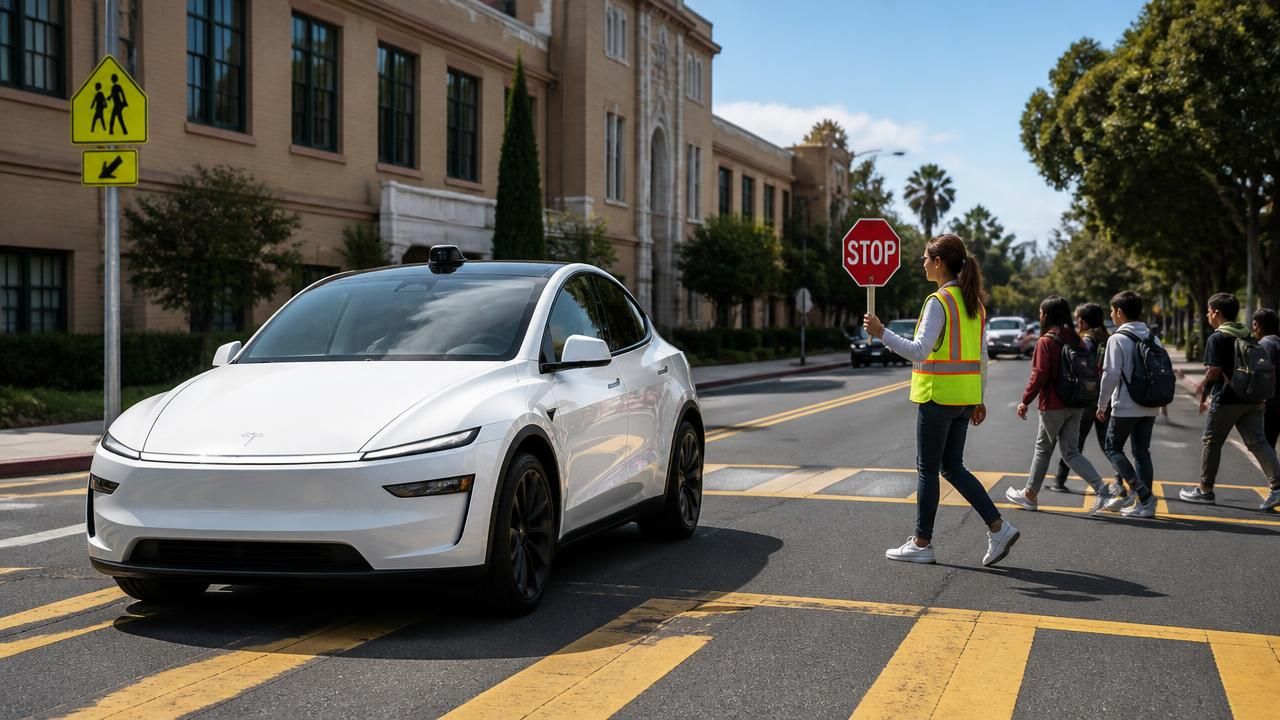
Federal auto safety regulators are examining allegations that Tesla's robotaxi fleet has been routinely exceeding posted speed limits in active school zones, a claim that could thrust the company's flagship autonomous driving program into a formal defect investigation just as it begins to scale.
The National Highway Traffic Safety Administration said it is evaluating the allegations, which arrived in the form of a defect petition filed with the agency's Office of Defects Investigation on September 23, 2026. The petition targets model year 2026 Tesla robotaxis — both the Model Y and the purpose-built Cybercab — when operating with Tesla's Automated Driving System engaged. Roughly 1,000 vehicles are covered by the complaint.
What the petition alleges
According to the agency's own summary of the filing, the petitioner claims the automated driving software exceeds posted speed limits specifically in school zones where those limits are in force.
"The Office of Defects Investigation (ODI) received a DP on September 23, 2026, requesting an investigation into model year (MY) 2026 Tesla Robotaxis (Model Y and Cybercab) with the Automated Driving System (ADS) engaged. The Petitioner alleges that the ADS exceeds posted speed limits in active school zones," NHTSA said.
The agency confirmed it is "evaluating" the request. That language matters: a defect petition is not the same as an open investigation. Under federal procedure, ODI reviews the petition, gathers preliminary information and then decides whether to grant it — escalating to a formal preliminary evaluation — or deny it and publish its reasoning in the Federal Register. The mere existence of a file, however, signals that regulators consider the claim credible enough to examine.
Why school zones are a stress test for self-driving software
School zones are among the most difficult environments a robotaxi can encounter. Speed limits drop sharply and often only during specific hours; beacons flash intermittently; signage varies by municipality; and children, crossing guards, cyclists and double-parked school buses create unpredictable motion that does not follow normal traffic logic.
For vision-based systems trained largely on ordinary road behavior, the mismatch between ambient traffic speed and a time-gated, low-speed zone is a classic failure mode. A car that is behaving "normally" by the standards of the surrounding traffic can still be illegal — and dangerous — if it fails to read the zone correctly.
Tesla is not alone in drawing regulators' attention
Tesla's rival Waymo has faced a string of similar inquiries, including scrutiny for illegally passing stopped school buses and, separately, an incident in which a child was struck near a California elementary school. Those episodes prompted a software recall and helped establish school-zone compliance as a benchmark issue for the entire autonomous vehicle industry.
That parallel shapes how the story is being framed. The Verge situates the Tesla petition within a broader pattern of robotaxi safety inquiries, treating it as the latest data point in an industrywide regulatory reckoning rather than an isolated Tesla problem. The New York Post's headline emphasizes the enforcement angle — "Tesla robotaxis face investigation" — casting the news as regulatory jeopardy for a high-profile company. Aggregators and wire-style outlets, meanwhile, lead with scale and mechanics: the roughly 1,000 vehicles named in the petition and the specific defect-petition process that could escalate or fade.
The stakes for Tesla
Tesla has bet heavily on autonomy, positioning robotaxis as the centerpiece of its long-term valuation story. Its Cybercab, unveiled as a two-seat vehicle with no steering wheel, is designed to be manufactured at volume for driverless service. A formal investigation that ends in a recall would force over-the-air or hardware remedies across the fleet and could slow expansion into new cities at precisely the moment the company is trying to demonstrate commercial viability.
- Who: Tesla; NHTSA's Office of Defects Investigation; an unnamed petitioner
- What: A defect petition alleging Tesla's Automated Driving System exceeds posted speed limits in active school zones
- When: Petition received September 23, 2026
- Scope: About 1,000 model year 2026 robotaxis — Model Y and Cybercab
- Status: Under evaluation; no formal investigation opened
What happens next
ODI's review will likely begin with data requests to Tesla covering speed-limit compliance logs, disengagement reports and any incidents in or near school zones. Tesla has historically cooperated with such requests while disputing characterizations of its software's performance, and it has argued that its vehicles are safer than human drivers on a per-mile basis — a claim that does not directly address whether the system breaks a specific traffic law.
Safety advocates argue that per-mile averages obscure exactly the kind of categorical violation described in the petition. "A robotaxi that speeds in a school zone is not a statistics problem, it is a compliance problem," is the logic behind the filing, and it is one regulators have increasingly embraced as automated miles accumulate.
For now, the practical consequence is uncertainty: for Tesla, for the cities weighing robotaxi permits, and for an industry that has spent years arguing it should be judged on outcomes rather than incidents. Whether the petition becomes a full investigation or is quietly denied, the school-zone question is now formally on the federal record.