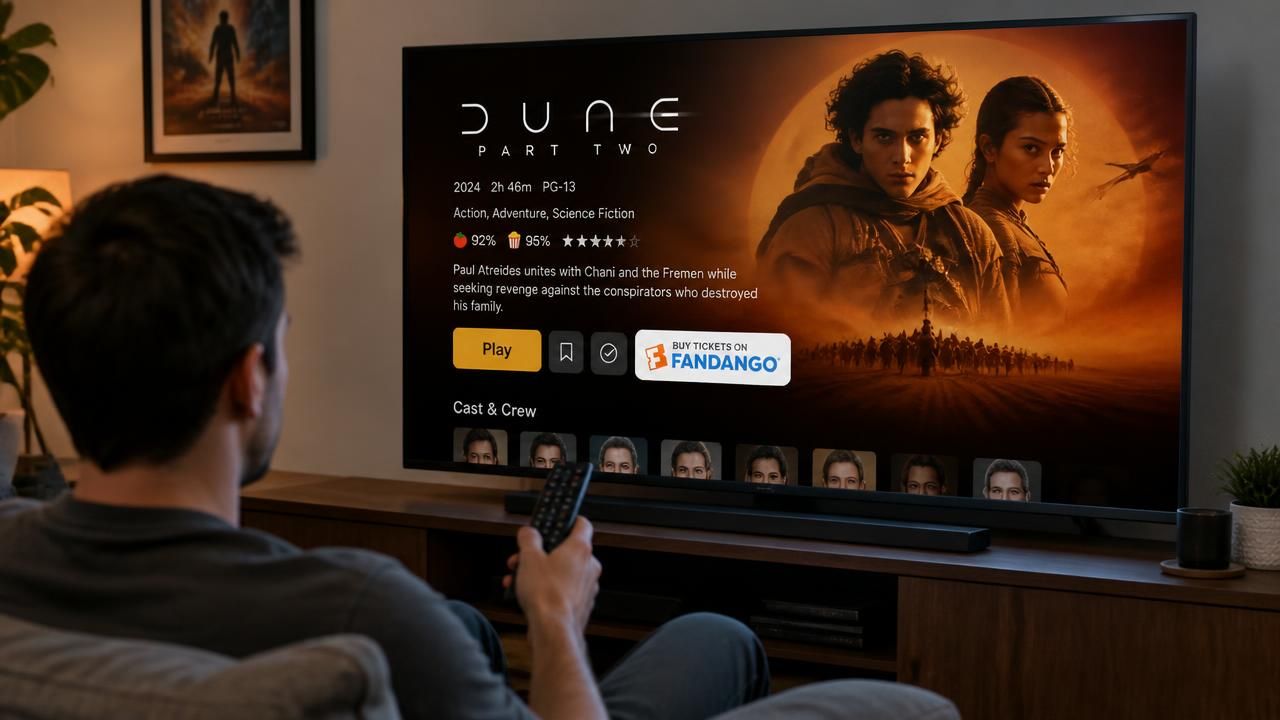
Plex, the company that built its reputation by letting users organize and stream media they already own, is now in the business of selling movie theater tickets. The Santa Clara-based firm announced a partnership with Fandango that places a ticketing option directly on title pages for films currently playing in theaters, turning the moment of discovery inside its app into a transaction.
The integration, which goes live for Plex users in the United States, adds a Fandango call-to-action on eligible movie pages. Clicking through takes users to Fandango to find showtimes and complete a purchase. It is a small interface change with outsized strategic weight: Plex is no longer just a place people decide what to watch — it is now a place where studios can convert that decision into revenue.
How the integration works
Under the arrangement, Plex surfaces a Fandango ticketing option on title pages for movies with an active theatrical run. Users who tap it are handed off to Fandango's platform, which has sold movie tickets online since 2000 and today serves roughly 31,000 theater screens across the United States.
The deal also includes attribution infrastructure built through Kochava, a mobile measurement firm. That piece matters more than it first appears. By tying campaign exposure and audience engagement to actual ticket purchases, Plex and Fandango can offer studios and advertisers something the theatrical marketing world has long struggled to deliver: a reasonably clear line from an ad impression to a seat sold.
Data at the center of the deal
Plex claims its users make more than 100 million streaming decisions every month. Fandango gains access to signals including ratings and cross-platform viewing behavior, which the companies describe as a way to generate "insight into audience intent." In practice, that means the partnership is as much a data play as a commerce one — a mechanism for identifying people who are actively interested in a title and intercepting them before they default to waiting for a streaming release.
Starting today, Plex users in the US will see a Fandango ticketing option on title pages for movies currently playing in theaters, allowing them to click through to Fandango to find showtimes and purchase tickets.
Why Plex is doing this
The move is a straightforward answer to a long-standing business question. Plex's core product — media server software that lets people catalog and stream their own libraries — is beloved by a niche audience but has never been a reliable engine of revenue on its own. In recent years the company has pushed into ad-supported streaming, FAST channels, and content discovery, positioning itself as a universal guide across services rather than merely a personal library tool.
Selling theater tickets is the logical next step. Discovery is the asset Plex owns; monetization has always been the harder half. By attaching commerce to the moment a user is browsing a movie's page, Plex converts attention into a transaction without having to license additional content or build a payments stack of its own — Fandango supplies both the inventory and the checkout.
For Fandango, the appeal is equally clear. The ticketing giant has spent years diversifying beyond pure transaction fees into content, reviews, and streaming through its Vudu business (now Fandango at Home). Partnerships that place its checkout inside third-party discovery surfaces extend its reach without requiring consumers to open the Fandango app or website unprompted.
A familiar pattern in streaming
The deal reflects a broader realignment across the entertainment industry. Streaming platforms have increasingly blurred the line between home viewing and theatrical exhibition as studios experiment with shorter windows and hybrid releases. Discovery surfaces — smart TV operating systems, streaming aggregators, and services like Plex — have become contested territory because they sit between audiences and the content they ultimately watch.
Amazon has used its Fire TV interface to promote theatrical and Prime Video titles. Roku has struck its own commerce and advertising arrangements. What distinguishes the Plex-Fandango tie-up is its explicitness: this is a ticketing product embedded in a discovery product, with measurement attached to prove it worked.
- Reach: Fandango sells tickets for approximately 31,000 US theater screens.
- Scale of intent signal: Plex says its users make over 100 million streaming decisions monthly.
- Measurement: Attribution runs through Kochava, linking campaigns and engagement to ticket purchases.
- Availability: The feature is live now for Plex users in the United States.
Coverage and framing
The story has been reported with notably different emphases. Ars Technica framed it primarily as a monetization story — a company famous for letting people share files they own now looking to cash in on its content-discovery capabilities and expand beyond media server software. That framing highlights the tension between Plex's community-driven roots and its commercial ambitions.
Cord Cutters News treated it as a cord-cutting-adjacent product story: a practical new feature for users navigating a fragmented landscape of streaming services and theatrical releases. Industry trade coverage from outlets like TMCnet and syndicated pickups on MSN emphasized the commercial mechanics — the Fandango partnership, the attribution layer, and the audience-intent data — treating it as a B2B arrangement between advertisers, studios, and platforms rather than a consumer feature.
All three framings are accurate; they simply answer different questions. For users, the question is whether a ticket button improves the experience or clutters it. For Plex, the question is whether discovery can finally pay for itself. For studios, the question is whether a click-through in a streaming app can measurably move box office.
What to watch next
The partnership's success will hinge on conversion rates that neither company has disclosed. Discovery-to-purchase funnels are notoriously leaky, and a handoff to an external site introduces friction that in-app checkout would avoid. If the Kochava attribution data shows meaningful lift, expect similar integrations to follow across other discovery platforms eager to prove they can drive theatrical revenue.
There is also a privacy dimension. Plex's pitch rests on combining ratings and cross-platform viewing behavior into audience-intent signals. How that data is shared, retained, and governed — and whether users are given meaningful notice — will likely draw scrutiny as the arrangement scales.
For now, the takeaway is simpler: a company built on letting people watch what they already have is betting it can make money from helping them decide what to watch next.