Florida's long role as America's gateway to space is converging this month on a single storyline: the International Space Station. NASA is preparing to connect an Orlando-area classroom directly with the orbiting laboratory, while a Central Florida high school prepares to honor one of its own and a Melbourne university pushes research aimed at the next giant leap — Mars.
NASA astronauts Jessica Watkins and Luke Delaney will answer prerecorded STEM questions from students while aboard the station on Friday, Oct. 16, at 12 p.m. EDT. The Earth-to-space call will stream live on the agency's Learn With NASA YouTube channel and is hosted by Sally Ride Elementary School in Orlando for students in grades K–12 as well as the broader community.
A classroom call, 250 miles up
The event is part of NASA's decades-old in-flight education program, which uses the station as a teaching platform to deepen understanding of space exploration and raise awareness of careers in science, technology, engineering and mathematics. Media wishing to cover the call must RSVP by 5 p.m. EDT on Thursday, Oct. 15, to Jenny Morgan at (407) 858-3100 or jenny.morgan@ocps.net.
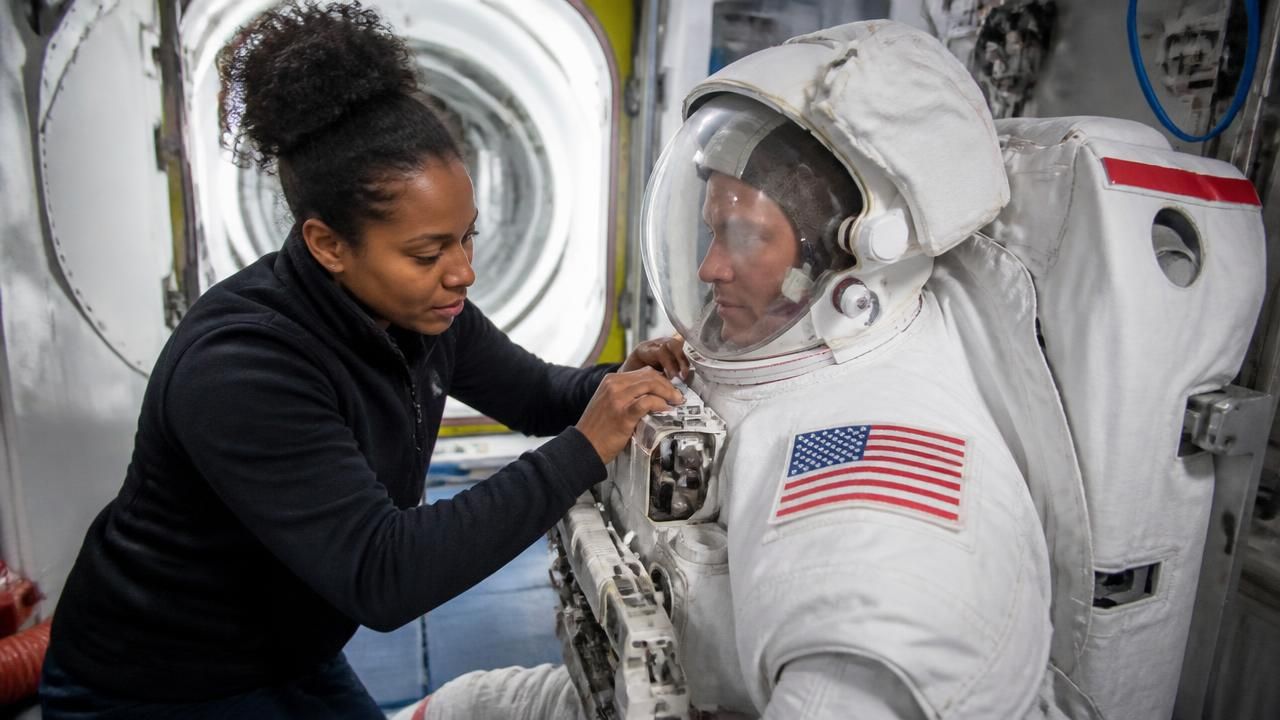
The two astronauts are hardly strangers to one another in the training pipeline. In a NASA image dated May 5, 2026, Watkins assists Delaney as he practices suiting up inside an International Space Station airlock simulator at the agency's Johnson Space Center Space Vehicle Mockup Facility in Houston — the kind of repetition that precedes every long-duration flight.
Watkins, a geologist by training, is a veteran of a long-duration station expedition and is widely noted as the first Black woman to serve as a full-time crew member aboard the outpost. Delaney, a Marine Corps aviator and test pilot selected in NASA's 2021 astronaut class, has been steadily building toward his first flight — a milestone that has not gone unnoticed in the Florida county where he grew up.
Deltona High to honor a former student
Local coverage highlighted by MSN reports that Deltona High School plans to honor a former student who is now a NASA astronaut heading to the station, a homecoming moment that turns a Volusia County campus into a front-row seat for human spaceflight. It is a familiar pattern in Florida, where the aerospace workforce and the Space Coast launch cadence give students an unusually short line of sight from the classroom to orbit.
That same proximity is central to the school events NASA promotes. The agency frames each in-flight call as more than a novelty: a way to show students that the engineers, flight controllers, scientists and astronauts who make missions possible come from ordinary towns.
Florida Tech's experiment targets Mars
Meanwhile, researchers at the Florida Institute of Technology in Melbourne have sent an experiment to the station that is designed to help protect future Mars astronauts, according to Sportsbookwire. Long-duration crews face hazards that Earth's atmosphere and magnetic field largely shield people from — radiation exposure, bone and muscle deterioration, vision changes and immune system shifts among them. A round trip to Mars could expose astronauts to years of cumulative risk, and station experiments are among the few ways to study countermeasures in a real microgravity environment.
The research adds Florida Tech to a broad roster of universities and commercial partners using the orbiting lab as a proving ground, a role NASA increasingly emphasizes as it expands commercial opportunities in low Earth orbit.
A launch that left educators 'moved to tears'
On the Space Coast, Florida Today reported that the Crew-13 launch — carrying a Florida-born NASA astronaut — inspired local educators, with some describing themselves as "moved to tears" as the rocket climbed off the pad. For teachers in Brevard County and beyond, the flight is a tangible reminder that the launches they watch from school parking lots now carry people they may have taught, mentored or simply cheered on.
"For more than 25 years, people have lived and worked continuously aboard the International Space Station, advancing scientific knowledge and making research breakthroughs not possible on Earth," NASA said in announcing the student call.
Why it matters
The different outlets covering this moment each frame it through their own lens. NASA emphasizes education and the pipeline to Artemis and Mars. Local outlets in Volusia and Brevard counties emphasize hometown pride and the emotional pull of a launch. Science-focused coverage emphasizes the research payloads riding along with the crew.
Taken together, they describe the same ecosystem: a station that has been continuously crewed for more than a quarter century, a state that launches the rockets, and schools that now treat spaceflight as a career path rather than a spectacle.
That framing matters as NASA works to build the foundation for long-duration missions to the Moon under Artemis and eventually to Mars. The agency has repeatedly said the station is where it learns to overcome the challenges of human spaceflight — lessons that Florida students, soon to be asking questions of Watkins and Delaney from 250 miles below, may one day apply themselves.
How to watch
- What: Earth-to-space call with NASA astronauts Jessica Watkins and Luke Delaney
- When: Friday, Oct. 16, 12 p.m. EDT
- Where: Streamed live on NASA's Learn With NASA YouTube channel
- Host: Sally Ride Elementary School, Orlando, Florida (grades K–12 and community)
- Media: RSVP required by 5 p.m. EDT Thursday, Oct. 15, to Jenny Morgan at (407) 858-3100 or jenny.morgan@ocps.net
- More: NASA in-flight call information is available on the agency's education site