Anyone who has tried to start a car on a subzero morning knows that batteries hate the cold. On the Moon, that problem is orders of magnitude worse. At the lunar south pole — the region NASA has targeted for its Artemis campaign — nighttime temperatures plunge to minus 328 degrees Fahrenheit (minus 200 Celsius), cold enough to cripple the lithium-ion chemistry that powers everything from phones to rovers on Earth.
That is why a team of researchers at NASA is developing a new class of solid-state battery designed to survive, and operate, in some of the most hostile thermal conditions in the solar system.
The cold, hard problem
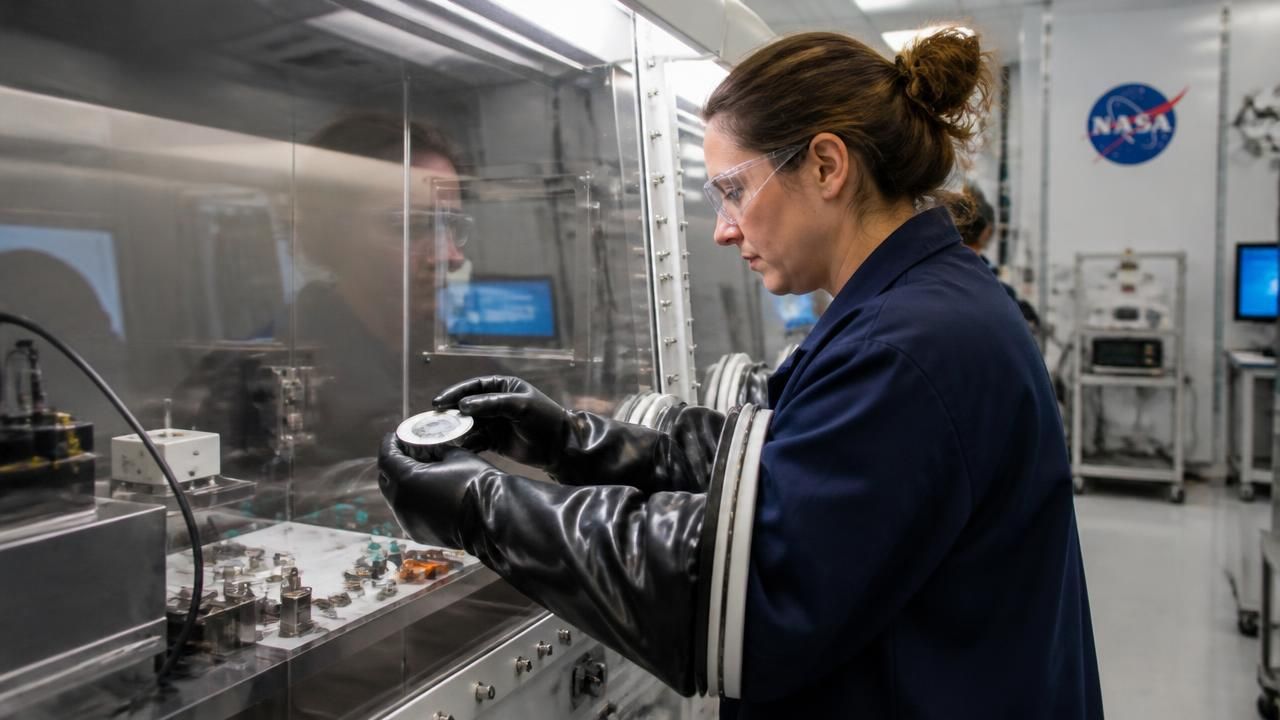
The project is called SPEARS — Solid Power for Extreme Environment Adaptability and Resilience in Space — and it is led out of NASA's Glenn Research Center in Cleveland, with testing and research work carried out at NASA's Langley Research Center in Virginia. Researchers there have been running small coin-cell batteries through thermal vacuum testing, subjecting them to the combined vacuum and temperature extremes they would face on the lunar surface.
For future lunar operations, the requirements are unforgiving. A battery must work immediately when warmed up, power everything from an astronaut's emergency kit to a rover exploring the Moon's permanently shadowed craters, and do so without posing a fire hazard.
Batteries have become an important part of our lives here on Earth, which enable our laptops, cell phones, power tools, and even our vehicles. We will need the same kind of capability on the Moon.
That assessment comes from Donald Dornbusch, principal investigator for SPEARS at Glenn, where the project is managed. His point is simple: a sustained human presence on the lunar surface is, at bottom, an energy storage problem.
Why solid state
Conventional lithium-ion cells use a liquid electrolyte that can freeze, degrade or, in the worst case, ignite. Solid-state designs replace that liquid with a solid electrolyte, which is inherently less flammable and can be engineered to tolerate a far wider temperature range. For NASA, the appeal is twofold: safety and operability.
- Survive thermal vacuum conditions comparable to the lunar night.
- Deliver power immediately upon warm-up, without lengthy conditioning.
- Support high-drain applications such as rovers and emergency life-support kits.
- Eliminate the fire risk that liquid electrolytes pose in a sealed habitat.
If SPEARS succeeds, it would give NASA a foundational tool for the Artemis architecture — the multi-mission effort to return astronauts to the Moon and, eventually, establish a long-term foothold there.
A portfolio, not a single bet
Batteries, however, are only one piece of a much larger power strategy, and that is where coverage of the story begins to diverge. Some outlets have framed the news around NASA's decision to pursue fuel cells rather than batteries for bulk energy storage on the Moon. Regenerative fuel cells work by using solar power during the two-week lunar day to electrolyze water — including water ice harvested at the poles — into hydrogen and oxygen, then recombining those gases to generate electricity through the equally long lunar night. The technology has deep heritage, dating back to the Gemini and Apollo programs.
The trade-off is not binary. Fuel cells excel at storing large amounts of energy for long durations; batteries excel at delivering rapid bursts of power and cold starts. A credible lunar base would almost certainly use both, alongside nuclear options.
Other reports emphasize the breadth of NASA's investment. The agency has selected dozens of space technologies for future Moon and Mars exploration — one accounting puts the figure at 41 — and has tapped on the order of 37 companies to develop tools for a lunar base, spanning nuclear batteries, laser power beaming and other infrastructure concepts. Radioisotope power systems, which convert the heat of decaying plutonium into electricity, have powered deep-space probes for decades and could keep instruments alive through the lunar night. Fission surface power and laser beaming from a lander or solar array to a shadowed crater are also under study.
Hunting for caves
Meanwhile, NASA is searching for hidden caves and lava tubes on the Moon, which could serve as natural shelter for a first lunar base. Subsurface voids offer thermal stability, shielding from radiation and protection from micrometeorites — conditions that would dramatically reduce the energy burden on any surface habitat and, by extension, the storage demands on its batteries.
How the story is being framed
NASA's own communications frame SPEARS as a materials-science breakthrough and a direct enabler of Artemis — a story about American engineering solving a physics problem. Syndicated versions of the release, carried verbatim by aggregators, extend that framing without alteration. By contrast, aggregator headlines that lead with fuel cells versus batteries, or with the roster of companies selected to build base tools, frame the same underlying effort as an industrial competition and a power-architecture debate. Science-focused outlets emphasize the broader selection of exploration technologies and the search for caves, positioning batteries as one component of a sprawling research portfolio.
Taken together, the coverage reveals a program that is deliberately hedging: no single technology is expected to carry a lunar base through the night.
What it means back on Earth
The implications extend well beyond the Moon. Cold-tolerant, fire-resistant solid-state cells are precisely what the terrestrial market wants for electric vehicles in northern climates, for grid-scale storage, and for aviation and defense applications where thermal runaway is unacceptable. As with memory foam, freeze-dried food and cordless tools before it, the extreme requirements of spaceflight may once again produce technology that quietly reshapes daily life — this time by making the batteries in our cars and homes safer, longer-lasting and less afraid of winter.