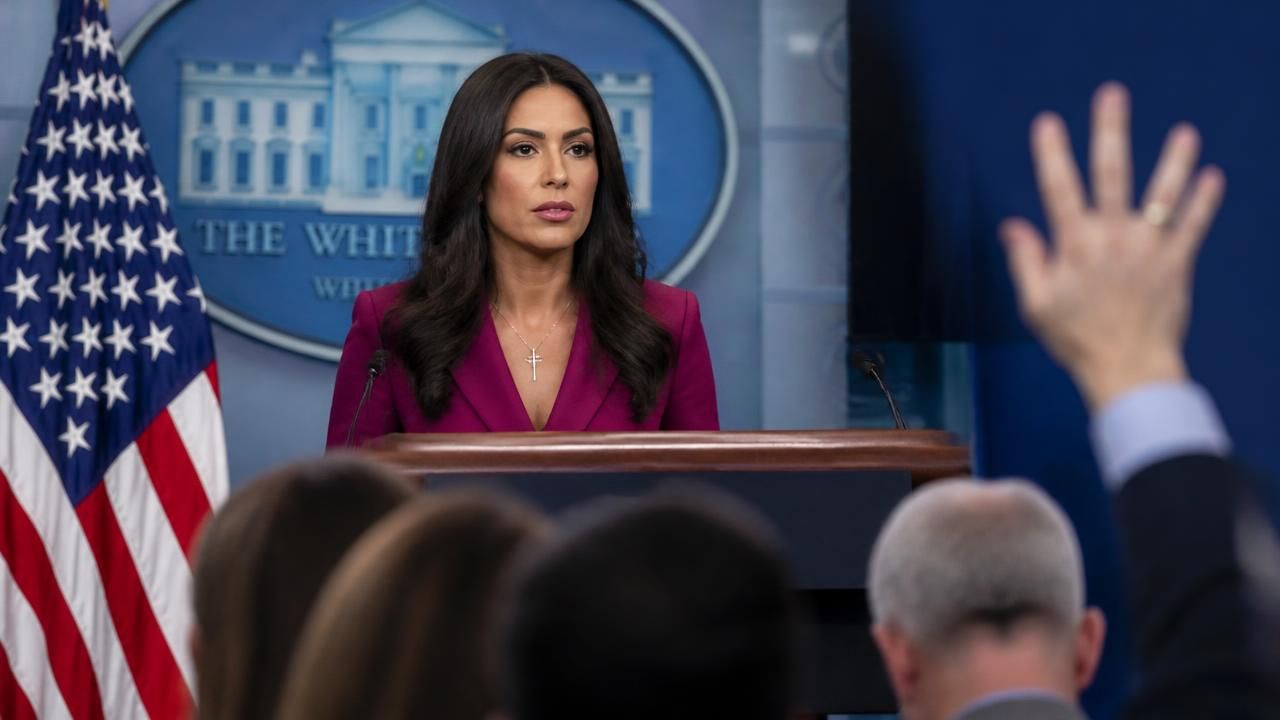
Katie Zacharia had barely finished her first turn at the White House briefing room podium before the questions shifted from policy to her résumé. Within 24 hours of her debut as President Trump's press secretary, Zacharia was facing a torrent of scrutiny over her claim to be a lawyer — scrutiny that escalated sharply when she told reporters she had passed the bar exam in China.
The exchange, first reported by outlets aggregated on MSN and amplified across cable and social media, turned what was supposed to be a routine introductory briefing into a credibility crisis for an administration already known for its combative relationship with the press corps. By her second day, the story had metastasized into a full-blown controversy, with headlines asking bluntly: did Trump's new press secretary lie about being a lawyer?
Who Is Katie Zacharia?
Zacharia's path to the briefing room was unconventional. According to NPR Politics, she previously worked for one of Trump's companies and raised her public profile through appearances on conservative-leaning talk shows. In that period, she also amplified right-wing conspiracy theories — a record that critics say sits uneasily with the traditional expectation that a White House press secretary serve as a credible, non-partisan conduit between the president and the public.
Her supporters argue that her business background and media savvy make her well suited to a role that has become as much about communicating to the president's base as it is about answering reporters' questions. Her detractors counter that the job demands a degree of factual discipline that her history does not obviously demonstrate.
The Bar Exam Question
The flashpoint came when a reporter asked Zacharia where she had passed the bar — a standard credential check for anyone presenting themselves as an attorney. Her answer, that she had qualified in China, raised more questions than it answered.
"I passed the bar in China," Zacharia said, according to accounts of the briefing, an answer that left reporters pressing for specifics on when, where and whether the credential entitles her to practice law anywhere in the United States.
The claim is not inherently implausible. China administers its own national judicial examination — historically among the world's most demanding professional tests — and a small number of foreign lawyers have pursued qualification there, typically in connection with cross-border commercial work. But the Chinese bar does not confer the right to practice law in any U.S. jurisdiction, and passing it would not normally be described simply as "passing the bar" in an American context.
That gap in framing is what turned a biographical detail into a political story. As one MSN headline put it, Trump's "new mouthpiece" was "cornered on mysterious legal credentials." Another framed the episode as simply "controversy over new White House press secretary Katie Zacharia's legal credentials."
A Brutal Second Day
If the first briefing was rocky, coverage of the second was unforgiving. MSN described it as the new press secretary's "brutal second day on the job," a characterization that captured how quickly the Washington press corps had moved from introducing Zacharia to interrogating her.
The dynamic is familiar. Press secretaries from Sean Spicer to Kayleigh McEnany to Jen Psaki have all endured early-period credibility tests, and the briefing room has long been a venue where a spokesperson's personal biography becomes fair game. But the speed and severity of this particular cycle — driven by a fragmented media ecosystem in which a single exchange can generate a dozen competing headlines within hours — reflects how much the information environment has changed.
Different outlets framed the story in markedly different registers. NPR and its affiliate network, including WVXU, emphasized the institutional stakes: a new chief spokesperson arriving with a background in partisan media rather than traditional communications or government service. The MSN aggregation cluster — drawing on tabloid and opinion-driven sources — leaned into the personal and the sensational, with headlines trading on words like "mysterious," "cornered" and "lie."
Why It Matters
The press secretary occupies a peculiar position in American government: a political appointee whose credibility is nonetheless a public asset. When that credibility is questioned, the damage radiates beyond the individual. Reporters become more adversarial, the public grows more skeptical of official statements, and the administration loses one of its few remaining channels for shaping a story on its own terms.
- The credential question: Whether Zacharia's Chinese bar qualification is accurately described, and whether the White House will release documentation.
- The vetting question: How a nominee with a non-traditional legal and professional record reached one of the most visible jobs in government.
- The credibility question: Whether the episode hardens perceptions that this White House treats facts as negotiable.
- The media question: Whether the press corps is scrutinizing Zacharia's résumé more aggressively than it would a conventional appointee.
What Comes Next
The White House has so far offered no detailed clarification of Zacharia's legal credentials, and it remains unclear whether she will address the matter directly at a future briefing. For now, the new press secretary finds herself in a position few of her predecessors escaped: defined, early, by a question she did not choose.
How she handles the next round may determine whether this becomes a footnote in her tenure or the frame through which her entire tenure is read. In Washington, the second briefing is often more consequential than the first — and for Katie Zacharia, the clock is already running.