For a few minutes on the evening of Oct. 6, the largest planet in the solar system disappeared behind a thin crescent of the Moon. A week later, a photographer in suburban New York turned the aftermath of that alignment into a portrait of five worlds at once — one of the most striking astronomical images of the autumn.
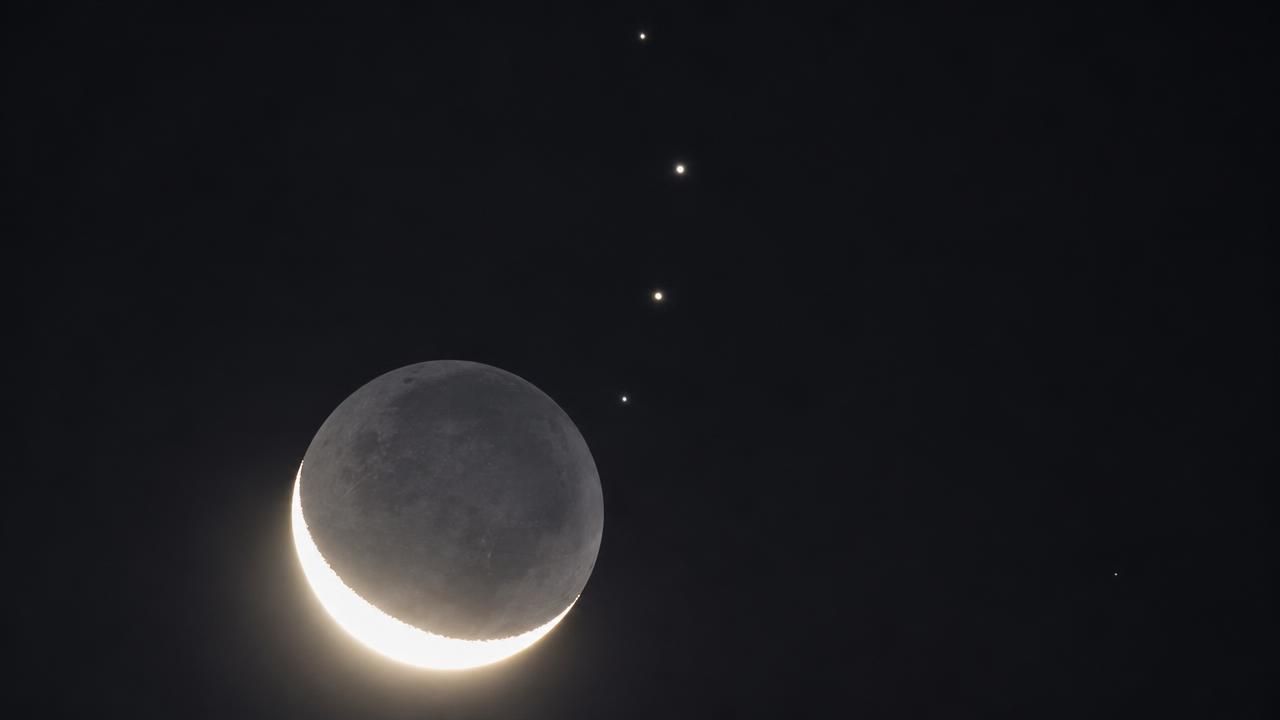
NASA's Astronomy Picture of the Day for Oct. 12, 2026, features an image by Chirag Upreti of Westchester, New York, assembled from a series of exposures taken near the moment of alignment. Earth's Moon appears at lower left as an overexposed sunlit crescent, while its night side floats faintly above, lit by earthshine — sunlight bounced off our own planet. Lined up almost vertically above it are Jupiter's four Galilean satellites: Ganymede, Io, Callisto and Europa, in that order from bottom to top.
"How many moons can you see? The best answer is five: four orbiting Jupiter and Luna orbiting Earth," the APOD editors wrote in their accompanying explanation.
Anatomy of a Five-Moon Frame
The image is a study in scale as much as composition. Three of the Jovian moons in the frame are genuinely larger than our own: Ganymede is the biggest moon in the solar system, wider than the planet Mercury; Callisto is nearly as large; and Io, though volcanic and sulfur-scarred, still edges past the Moon in diameter. Europa is the outlier, slightly smaller than Luna but arguably the most intriguing — a world of fractured ice shell over a probable subsurface ocean.
- Ganymede — largest moon in the solar system, larger than Mercury
- Callisto — heavily cratered, ancient, and larger than Earth's Moon
- Io — the most volcanically active body known, larger than Earth's Moon
- Europa — slightly smaller than the Moon, and a prime target in the search for habitable environments
Because Jupiter sat so far behind the Moon, the geometry that produced the picture was fleeting. Jupiter's disk spans only about 40 arcseconds from Earth, while the Moon covers roughly 30 arcminutes — some 45 times wider — so the planet slips behind the lunar limb in seconds and can stay hidden for an hour or more.
The Occultation of Oct. 6
The event itself, previewed across major outlets in the days beforehand, was a lunar occultation rather than a true eclipse. Sky-watching guides framed it as a headline attraction of October's calendar, with coverage on MSN and Forbes highlighting the Moon's passage in front of Jupiter alongside the month's other draw: the Hunter's Moon, the full moon that follows September's Harvest Moon and traditionally marks the close of the harvest season.
The framing difference between outlets is instructive. Preview coverage treated the occultation as an accessible spectacle — a naked-eye event visible across much of North America, requiring no equipment beyond patience and a clear horizon. NASA's APOD, by contrast, treated it as raw material for a retrospective image, published six days later, that asks viewers to look beyond the event itself and consider the architecture of the solar system. Both are correct; they simply sit at opposite ends of the same experience.
Occultations of Jupiter are not rare in isolation, but they arrive in clusters. The Moon's orbit is tilted about five degrees to the plane of Earth's orbit, so the geometry only lines up during so-called occultation seasons — runs of events spanning roughly a year or two, followed by gaps of several years. During a season, the Moon can hide Jupiter repeatedly for observers in different parts of the world.
Juno at Jupiter
As Upreti's camera looked outward, a spacecraft was already there. NASA's robotic probe Juno is currently orbiting Jupiter and has made close passes near three of the moons in the frame — Ganymede, Europa and Io — during its extended mission. Those flybys have reshaped scientists' understanding of the Jovian system, from Ganymede's magnetic field and auroral glow to Europa's ice surface and Io's towering volcanic plumes.
The juxtaposition is one of the quiet pleasures of the APOD entry: a backyard telescope rig in Westchester and a nuclear-powered spacecraft half a billion miles away, both studying the same four points of light. The Galilean moons, discovered by Galileo Galilei in 1610, were the first objects proven to orbit a body other than Earth — evidence that helped dislodge the geocentric model of the cosmos. Four centuries later, they remain among the most scrutinized objects in the sky.
What to Watch Next
For amateur observers, the October 2026 alignment is a reminder that the best astronomy often requires no equipment. A modest pair of binoculars will resolve the Galilean moons on most clear nights when Jupiter is above the horizon; a small telescope reveals their shifting positions from hour to hour and night to night, a motion Galileo himself recorded in sketches.
The months ahead offer further reasons to keep looking up. Jupiter remains a bright evening object through the autumn, the Hunter's Moon dominates the mid-October sky, and additional lunar-planetary conjunctions will punctuate the calendar. For Upreti, the reward was a single frame that compressed two worlds, five moons and one very narrow window of geometry into an image that will circulate far beyond the night it was taken.