GAZA CITY — The cease-fire reached last October was supposed to end the war that began after the Hamas-led attacks of Oct. 7, 2023. But a year later, Israeli strikes — though less frequent — have not stopped, and Gaza’s landscape remains a tableau of ruin and improvisation. From the rubble, Palestinians are pulling out both tragedy and a fragile kind of hope: roads rebuilt with crushed concrete, a lone FM radio station crackling back to life, and, in the accounts of local writers, children flying paper kites over shattered neighborhoods.
A Cease-Fire That Never Fully Holds
The New York Times framed the moment as a story of “wringing hope from the rubble” — a phrase that captures the strange limbo of Gaza after the October cease-fire. The agreement ostensibly brought an end to full-scale war. Yet the Times reported that Israeli strikes, while less frequent, have continued, leaving residents to navigate a landscape where the line between war and aftermath is still dangerously blurred. The cease-fire has not delivered the clean break that many hoped for, nor has it ended the sporadic violence that keeps families on edge.
Rubble as Resource — and as Evidence
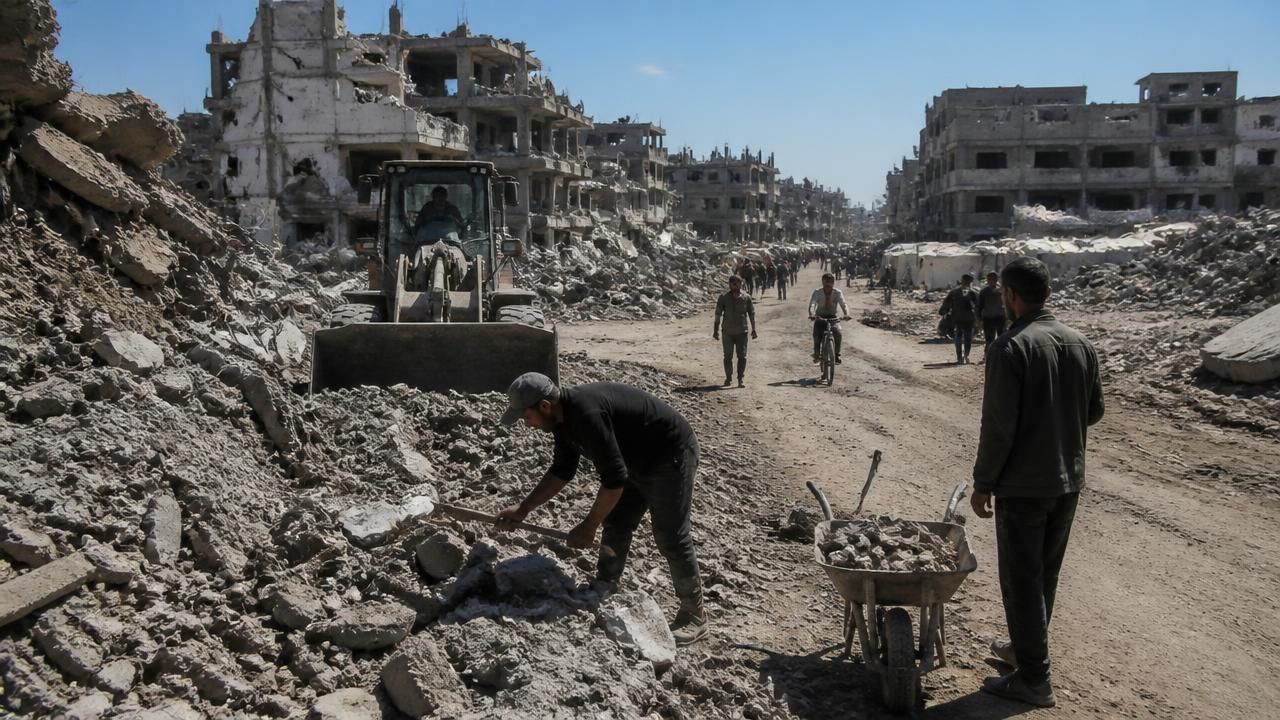
As reconstruction falters, Palestinians have begun using the rubble itself. Reuters reported that residents are crushing and repurposing debris to restore streets, a grassroots response to the stalling of a U.S.-backed rebuilding plan. The effort is practical: with roads impassable and international funding slow to materialize, rubble becomes raw material for a kind of makeshift recovery. But the same debris is also a crime scene. A United Nations expert warned that Israeli rubble-clearing operations in Gaza could erase evidence of “atrocity crimes,” potentially destroying forensic material that might be used in future war-crimes prosecutions. The warning highlights a painful tension: the rubble that residents want to clear for daily life may also hold the only proof of what happened there.
Death Amid Reconstruction
The dangers of the debris were underscored by a building collapse in Gaza that left at least 21 people dead, according to reports. The incident added to the toll of a conflict that has already killed and displaced vast numbers of Palestinians, and it illustrated how unstable the physical environment remains. Even as some neighborhoods see small signs of revival, unstable structures, unexploded ordnance, and the sheer scale of destruction continue to claim lives.
Voices from the Rubble
Amid the destruction, Zaman FM has become an unlikely symbol of resilience. The station re-opened its damaged building in Gaza, with broadcaster Rami Al-Sharafi working from a laptop inside the ruins. Before the war, 23 local radio stations operated in Gaza; all were destroyed and ceased broadcasting. Today, Zaman FM is the only FM station broadcasting from within Gaza.
“Today, we are the only radio station broadcasting on FM from within Gaza after this widespread destruction,” Al-Sharafi told UN News. “We hope that other local radio stations will resume broadcasting, thus allowing competition in providing media services to the people of the Gaza Strip.”
The re-opening comes ahead of World Radio Day, observed on 13 February, and as local and international voices call for support of journalism as part of Gaza’s broader recovery. For a population cut off from reliable information, the return of a familiar voice on the dial is more than nostalgia; it is a lifeline.
Framing Hope and Horror
Different outlets have approached the same landscape through different lenses. The New York Times emphasized perseverance and the unfinished business of the cease-fire. Reuters focused on the material reality of reconstruction — and its political bottlenecks. UN News and Global Issues highlighted the media’s role in recovery, while MSN reported the deadly collapse that reminded readers of the ongoing physical dangers. An OpEd in Eurasia Review titled “From Rubble To Hope: Tala And Farah In Gaza” and a dispatch from IMEMC titled “In Gaza: When a Paper Kite Rises From the Rubble” point to another framing: intimate stories of children, families, and small acts of normalcy that resist the narrative of total devastation. While the full texts of those pieces were not immediately available, their titles signal a genre of Gaza correspondence that seeks to humanize the statistics.
Why It Matters
The competing claims on Gaza’s rubble — as a resource for rebuilding, as a grave, as evidence — reflect the larger impasse. The U.S. rebuilding plan has stalled, leaving Palestinians to improvise. International justice efforts depend on preserving forensic evidence, yet daily survival often requires clearing it away. And the cease-fire, however fragile, has not ended the strikes that make recovery precarious.
For now, hope in Gaza is being wrung from the ruins one street, one broadcast, one kite at a time. But the same ruins also hold the record of loss. How the world handles them — whether it paves over the past or preserves it for accountability — will shape not only Gaza’s reconstruction but the possibility of justice and a durable peace.