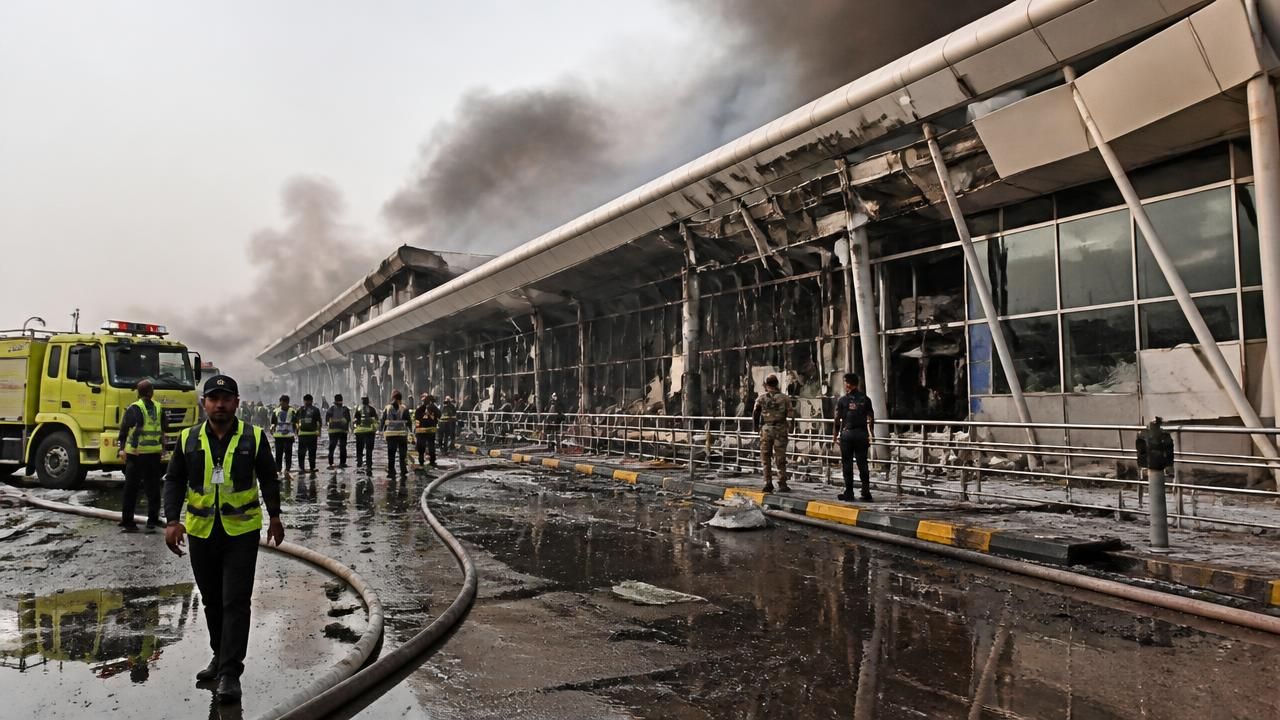
RIYADH — A missile slammed into the passenger terminal at King Khalid International Airport in Saudi Arabia's capital on Saturday, killing at least 12 people and wounding more than 300, according to Saudi authorities, in an attack attributed to Yemen's Houthi movement that immediately escalated tensions across the region and drew a sharp response from the White House.
Saudi officials said the dead included four Saudi citizens as well as two Bangladeshi nationals and one citizen each from the United States, Egypt, Jordan, Syria, Sudan and the Palestinian territories — a casualty roll that underscored the international character of the airport, a major hub for Gulf carriers and connecting flights. Authorities said some of the wounded remained in critical condition, and CNN reported the injury toll had climbed to 309.
The attack halted flights at the airport, according to multiple reports, and eyewitnesses described scenes of panic as passengers and staff fled the terminal.
"People lying injured on the ground" — that was how eyewitnesses described the immediate aftermath of the blast, in accounts carried by several outlets as emergency crews converged on the scene.
Attribution and the Battle Over Framing
The strike was the latest of several in the past week targeting King Khalid International Airport, a pattern that Saudi authorities said was intensifying pressure on the kingdom's allies — above all the United States — to provide expanded military support.
How news organizations framed the attack varied markedly. American outlets, including NPR, CBS News, MSN and USA Today, led with Saudi authorities' casualty figures and described the event neutrally as an "attack on Riyadh airport." International publications — The Jakarta Post, LBC, Philstar, The Statesman and others — placed responsibility directly in their headlines, calling it a "Houthi attack" or "Houthi strike." Indian outlets, including Livemint and The Indian Express, foregrounded President Trump's reaction, framing the story as much about Washington's response as about the attack itself.
That divergence reflects a broader information battle: Saudi officials have consistently avoided naming the perpetrator in their initial statements, while the Houthis' involvement has been widely reported by regional and international media.
Trump: Strikes 'Not Acceptable'
President Trump said the strikes were "not acceptable" and indicated the United States may join military operations against the Houthis, according to Livemint and The Indian Express. The comments signaled a potential shift toward direct American involvement in a conflict that has largely been fought by Saudi-led coalition forces with U.S. logistical, intelligence and arms support.
The attack is expected to increase Saudi pressure on Washington for deeper military backing — a request that has animated U.S.-Saudi relations for years and has repeatedly run into congressional resistance over civilian casualties in Yemen and the scope of American entanglement in the war.
What We Know
- Death toll: At least 12 killed, per Saudi authorities.
- Injuries: More than 300 wounded, with some in critical condition; CNN reported 309.
- Nationalities of the dead: Four Saudis, two Bangladeshis, one American, one Egyptian, one Jordanian, one Palestinian, one Syrian and one Sudanese.
- Location: The passenger terminal at King Khalid International Airport, Riyadh.
- Operational impact: Flights halted; eyewitnesses reported chaos and casualties inside the terminal.
- Pattern: The latest of several attacks on the airport in the past week.
A War That Keeps Reaching Farther
The strike on Riyadh's primary international gateway marks a significant escalation in a conflict that has for years been confined largely to Yemen's borders and to Saudi Arabia's southern provinces. Riyadh, a city of more than seven million people and the seat of the kingdom's government, has rarely been the site of mass-casualty attacks of this magnitude.
Analysts have long warned that the Houthis' expanding missile and drone capabilities — demonstrated in strikes on Saudi oil infrastructure in 2019 that briefly halved the kingdom's crude output — represent a strategic threat that conventional air defense systems have struggled to fully counter. The targeting of a civilian airport, if confirmed, would raise difficult questions about the adequacy of Saudi air defenses and about the risk to international aviation in the Gulf.
The conflict traces back to 2014, when the Houthis seized Yemen's capital, Sanaa, prompting a Saudi-led coalition intervention the following year. What was expected to be a short campaign has become a protracted war that has produced what the United Nations has called the world's worst humanitarian crisis, killed hundreds of thousands, and left the Houthis controlling large swaths of northern Yemen while firing continuously at their neighbors.
What Comes Next
Attention now turns to Washington. A direct U.S. military role against the Houthis would deepen American involvement in a region the Trump administration has at times sought to disengage from, and would likely draw scrutiny from lawmakers who have questioned the scope of presidential war powers.
For Saudi Arabia, the attack sharpens a dilemma: the kingdom's security depends on American support, but each escalation pulls it further into a war with no clear exit. For the thousands of travelers who pass through King Khalid International Airport each day, the strike was a reminder that the conflict is no longer distant — it arrived, for one afternoon, at the departures hall.
Casualty figures remain provisional and have shifted as authorities update their tallies.