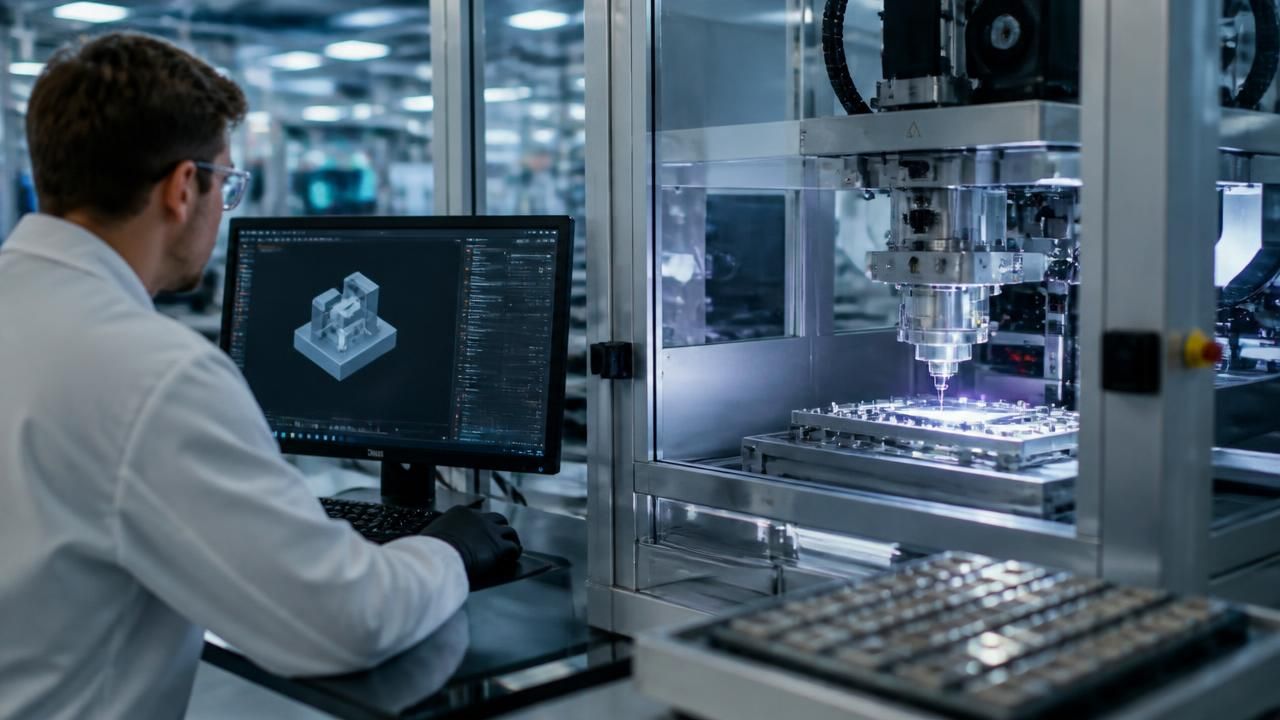
Atomic Machines, a startup developing a new class of manufacturing technology, has emerged from stealth with $250 million to launch its Matter Compiler, an AI-native system that the company says can build micro-machines directly from digital code. The disclosure, reported across Bloomberg, Yahoo Finance, MSN and The Next Web, places the company at the intersection of artificial intelligence, advanced manufacturing and the long-running quest to make physical production as programmable as software.
At the center of the story is CEO Jeffrey Holden, who appeared on Bloomberg Markets' "The Close" with Romaine Bostick to explain the concept. Holden described a new kind of factory that takes digital code and produces "micro-machines"—tiny mechanical and electromechanical devices that can sense, move, switch or actuate at scales often measured in microns. He said the technology is being developed to support a broader range of micro-machines, suggesting the initial platform is not limited to a single component or market.
What the Matter Compiler actually promises
The phrase "matter compiler" is a deliberate metaphor. In computing, a compiler translates human-readable source code into machine instructions. Atomic Machines is promising something analogous for the physical world: a software-driven production system that takes a design expressed in code and outputs a working micro-machine. The company calls the system AI-native, meaning artificial intelligence is not bolted on after the fact but is embedded in how designs are generated, optimized and manufactured.
That is a significant ambition. Micro-machines—often built using MEMS, or micro-electromechanical systems—already sit inside smartphones, cars, medical devices and industrial equipment. Accelerometers, gyroscopes, pressure sensors, inkjet nozzles and RF switches are all examples of micro-scale devices that must be fabricated with extreme precision. Today, producing them typically requires specialized fabs, long lead times and deep expertise. Atomic Machines is betting that a compiler-like abstraction layer can lower those barriers and widen the field of possible devices.
If it works, the implications could be far-reaching: faster prototyping, more customized micro-devices, and a shift toward software-defined manufacturing. The $250 million in funding—a substantial sum for a company emerging from stealth—signals that investors see a large potential market. It is intended to launch the Matter Compiler, not merely to research it.
How different outlets frame the story
The coverage reveals distinct angles on the same announcement. Bloomberg, which interviewed Holden on "The Close," frames the story around the CEO and the vision of a new factory. Its audience is markets-focused, so the emphasis is on what the technology does and who is leading it. Yahoo Finance, carrying the company's own release language, leads with the $250 million and the Matter Compiler as an "AI-native manufacturing system that builds micro-machines from code." That framing positions Atomic Machines as a category-defining startup and highlights the funding event.
MSN takes a more accessible approach, with a headline that translates the concept for a general audience: "This startup's 'matter compiler' turns code into tiny machines." The Next Web, meanwhile, is concise and ecosystem-oriented, noting simply that Atomic Machines has emerged with $250 million to build micro-machines from code. Together, the outlets show a story moving from specialized business media into mainstream tech coverage—a sign that the company's pitch has broad intrigue.
Holden has described the effort as building a new kind of factory—one that takes digital code and produces micro-machines, with the platform being developed to support a broader range of such devices.
Why it matters—and what remains unproven
The manufacturing world has spent decades chasing the dream of "bits to atoms." 3D printing brought that idea to macro-scale objects, but micro-scale production remains stubbornly difficult. The physics are unforgiving: at micron scales, surface forces dominate, materials behave differently, and tiny defects can ruin a device. A compiler that claims to handle this complexity must solve problems in materials science, process control, metrology and automation simultaneously.
There are also open questions. The sources do not disclose Atomic Machines' investors, valuation, customers or technical specifications. It is not yet clear which materials the Matter Compiler can use, how fast it can produce devices, what yield it achieves, or whether it can produce micro-machines that meet the reliability standards of industries such as automotive, aerospace or medical devices. Those details will determine whether the company is a niche toolmaker or a true platform shift.
Still, the timing is notable. AI is increasingly being applied to design and optimization, while supply-chain pressures have pushed manufacturers to seek more flexible, localized production. A system that compiles code into micro-machines could fit that trend, allowing engineers to iterate on tiny devices with software-like speed. It could also democratize access to micro-fabrication, letting smaller teams create sensors, actuators and other micro-devices without building a fab from scratch.
The road ahead
Atomic Machines now faces the classic challenge for any deep-tech startup: turning a compelling demo and a large funding round into repeatable, scalable production. The $250 million gives it room to build out the Matter Compiler, hire across engineering and manufacturing, and prove the system with early customers. The company's success will depend less on the elegance of the compiler metaphor than on whether it can reliably output micro-machines that work in the real world.
For now, the emergence from stealth has done what it needed to do: put Atomic Machines and its "matter compiler" on the map. If Holden and his team can deliver, the phrase "compiling matter" may shift from metaphor to manufacturing reality—and the factory of the future may look less like a fab and more like a code editor.