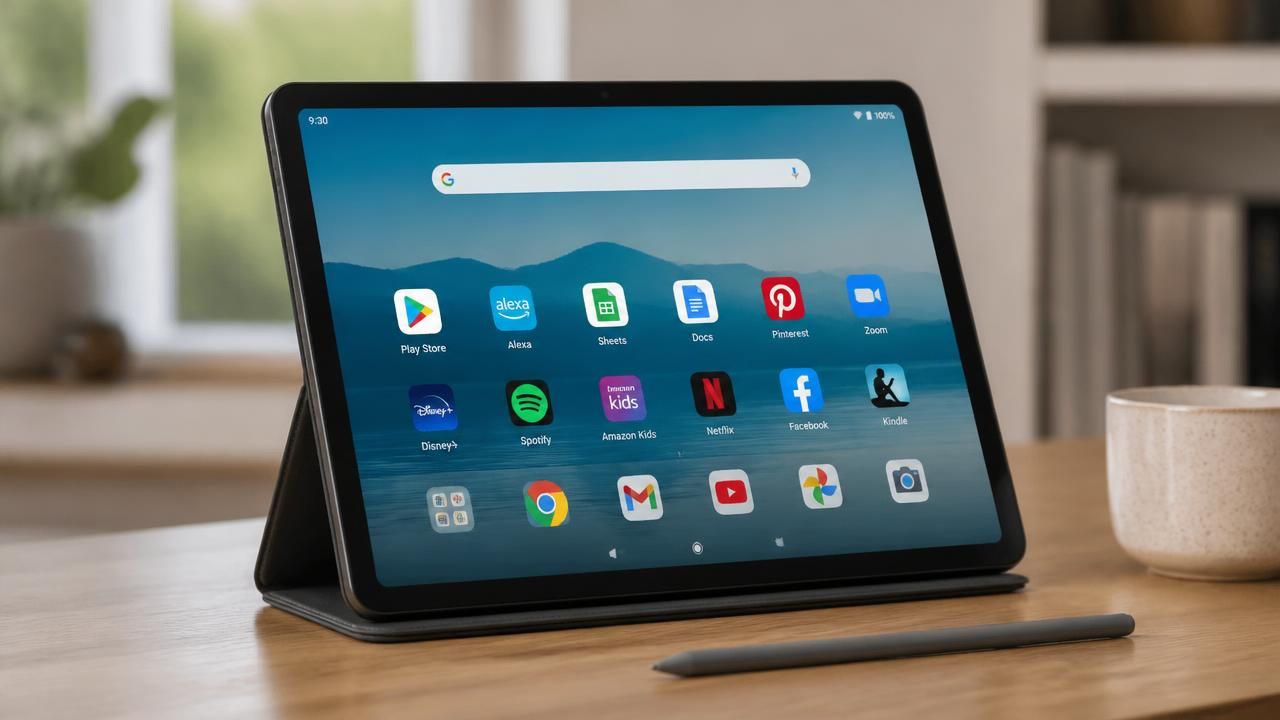
Amazon is retiring one of the most recognizable names in budget consumer hardware. After roughly 15 years of Fire tablets, the company is replacing the line with a new family of Alexa Tablets — and, in the most consequential shift in the product's history, they run full, Google-certified Android with the Play Store installed out of the box.
The move marks a clean break from the strategy Amazon pursued for more than a decade. Fire tablets ran Fire OS, a heavily modified Android fork that pointed users toward Amazon's own Appstore and kept Google's services at arm's length. Amazon consistently downplayed the Android lineage of those devices, treating the operating system as plumbing rather than a selling point.
From Fire OS to full-fat Android
The reversal is partly a consequence of Amazon's own retreat from app distribution. The company shut down its app store last year, removing the very ecosystem that gave Fire OS its reason to exist. Without a first-party storefront to funnel users into, maintaining an Android fork with no Google integration became a liability rather than an advantage.
The new tablets therefore ship with the Play Store and the standard suite of Google apps — a configuration that would have been unthinkable on a Fire tablet. It also puts Amazon's tablets in direct, spec-for-spec competition with Samsung, Lenovo, and Google's own Pixel Tablet, rather than in a walled garden of Amazon's design.
Notably, the strategy does not extend across Amazon's hardware portfolio. Fire TV streaming sticks have moved in the opposite direction, abandoning Android altogether for Vega OS, a custom Linux-based platform Amazon controls end to end. The split suggests Amazon is now segmenting its devices by business model: streaming hardware as a controlled vehicle for content and advertising, tablets as commodity Android devices competing on price and Alexa integration.
Three devices, aluminum bodies, and a Pro model aimed at work
Amazon is launching three Alexa Tablets, all redesigned with unibody aluminum housings — a meaningful material upgrade over the plasticky Fire HD line. Known pricing and positioning:
- Alexa Tablet 8 — starts at $230, the entry point to the family.
- Alexa Tablet 11 — jumps to $330, with the larger panel and more headroom for multitasking.
- Alexa Tablet 12 Pro — the flagship, pitched explicitly at productivity and work use rather than pure media consumption.
Both the 8 and the 11 run on MediaTek's 8189 processor — a budget-oriented chip, but still a step up from the silicon in the outgoing Fire tablets. Both use 16:10 display ratios, which suit widescreen video better than the squarer panels common to the category. Amazon says the flagship deviates from its siblings, though the company has been selective about exactly how.
The Pro model is the clearest signal of Amazon's ambition. By positioning a 12-inch tablet for work, Amazon is chasing a segment — keyboard-equipped, stylus-friendly productivity tablets — that has historically been Apple's and Samsung's territory, and more recently Google's. Whether Amazon can credibly sell into that market at a premium is an open question; its brand has long been associated with value pricing rather than professional-grade hardware.
The price problem
The most immediate friction point for existing customers is cost. Fire tablets built their following on aggressive pricing, with the 10-inch model frequently discounted well below its list price during Amazon's own promotional events. The Alexa Tablets arrive at higher price points, and the value proposition now has to be argued on hardware quality, Android app compatibility, and Alexa intelligence rather than sheer cheapness.
For years, the pitch was simple: a competent tablet for less than almost anything else. The new pitch is different — a real Android tablet, with real Google apps, that happens to be made by Amazon.
That reframing puts the Alexa Tablet 12 Pro in an awkward spot in particular. Buyers weighing it against a comparably priced iPad or Galaxy Tab will be comparing build quality, chip performance, and long-term software support — areas where Amazon has historically trailed. Against a base-model Fire HD 10, however, the upgrade is substantial: better materials, a current-standards processor, an appreciably better display ratio, and access to the entire Google Play catalog instead of a shrinking Amazon-run store.
Alexa as the differentiator
The branding itself is the giveaway. Amazon is not selling these as Android tablets that happen to have a voice assistant; it is selling them as Alexa devices. With Amazon pouring resources into generative AI upgrades for Alexa and the assistant increasingly positioned as a conversational agent rather than a command-and-response utility, hardware carrying the Alexa name becomes a distribution channel for that subscription-and-services strategy.
The irony is that this is the same playbook Amazon ran with Fire OS — use cheap hardware to pull users into Amazon's ecosystem — executed with the opposite technical approach. Instead of locking users in with a proprietary fork, Amazon is meeting them where they already are: the Play Store, Google's apps, and the Android habits they already have.
What it means
For consumers, the shift is mostly good. Amazon's tablets become genuinely useful general-purpose devices rather than appliances optimized for Amazon shopping and Prime Video. For Amazon, the bet is that Alexa — and the services layered on top of it — can carry the lock-in that Fire OS used to provide, even as the software underneath becomes thoroughly Google's.
The open questions are price and differentiation. Amazon has raised its entry point, surrendered much of its software control, and entered a tablet market where it will now be judged on the same terms as everyone else. The Alexa name may get shoppers to look. Whether it gets them to pay is the harder test.