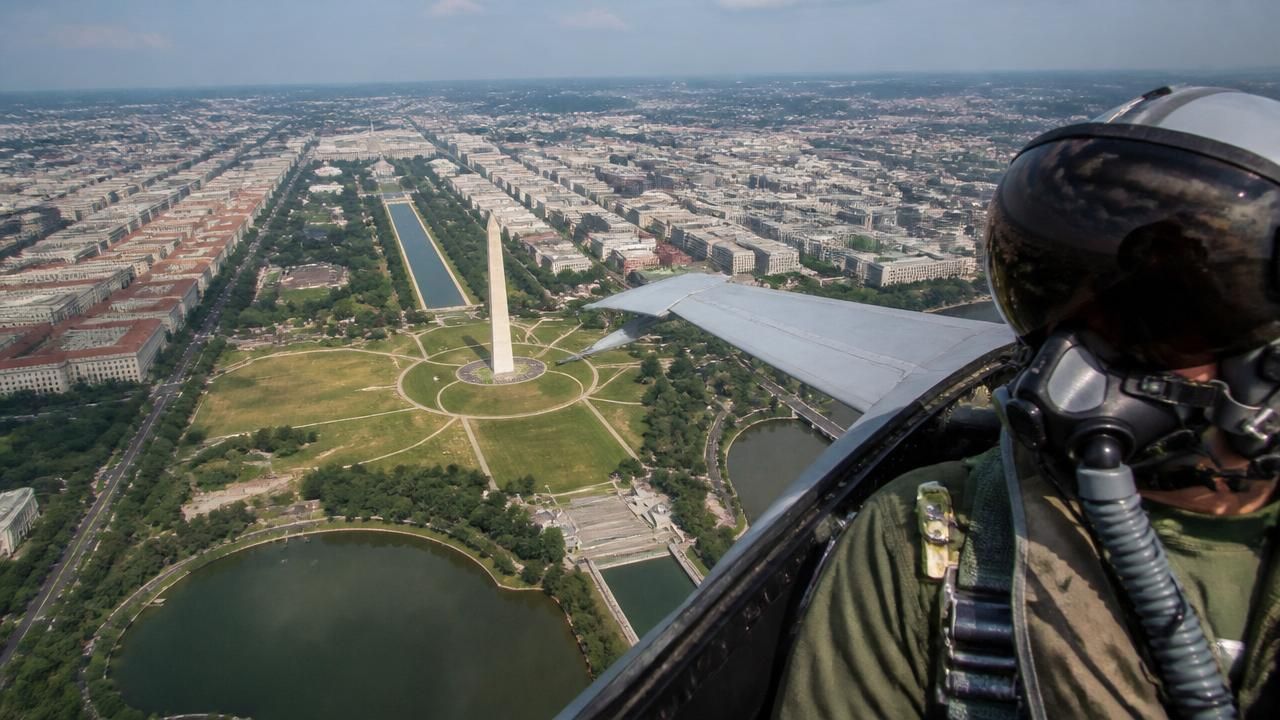
On July 4, 2026, as the United States celebrated its 250th birthday, NASA photographer Jim Ross soared above the National Mall in an F-18 aircraft, capturing a once-in-a-lifetime perspective of the nation's capital. The flyover, part of a larger celebration, featured multiple NASA aircraft and provided a rare bird's-eye view of the Washington Monument and surrounding landmarks. Ross, a veteran photographer from NASA's Armstrong Flight Research Center in Edwards, California, has spent nearly 37 years documenting the agency's most iconic moments, from early SR-71 flights to the delivery of Space Shuttle Endeavour.
“I grew up in Bozeman, Montana, when it was still considered a small town, so if someone told that little kid that he would be flying in an F-18 over the National Mall, he would have never believed it,” Ross said in a NASA release. “I love documenting history, and having the opportunity to capture flights and launches has kept me doing it for almost 37 years.”
A Legacy of Aerial Photography
Ross's work is part of a broader tradition at NASA, where flight photographers capture missions from perspectives few ever experience. Their images not only document research but also inspire public engagement with science and exploration. The July 4 flyover was no exception, as Ross's photos will serve as a lasting record of the nation's semiquincentennial.
The flyover included aircraft from NASA's fleet, such as the F-18, which is often used for research and photography missions. Ross's images join a rich archive of NASA aerial photography, including shots of the X-59 quiet supersonic research aircraft and the Space Shuttle Endeavour's final flight over Los Angeles in 2012.
Beyond the Flyover: A Week of Space Imagery
The same week, other NASA and space-related imagery captured public attention. On July 3, the astrophotographer behind the stunning shot of comet 3I/ATLAS passing by a galaxy was featured by NBC News. The image, taken from Earth, shows the comet's tail streaking across the sky near a distant spiral galaxy, highlighting the beauty of celestial mechanics.
Meanwhile, NASA's Jet Propulsion Laboratory released a series of Mars images, including Curiosity's first 360-degree view of boxwork patterns—a geological formation that may hold clues about ancient water activity. Although some JPL pages were temporarily inaccessible due to server issues, the images underscore the ongoing exploration of the Red Planet.
Mars in Focus
Curiosity's boxwork images, captured in Gale Crater, show a network of ridges that likely formed from mineral deposits in fractures. The rover also sent back views of the Yardang Unit, a wind-sculpted rock formation. Additionally, the HiRISE camera on the Mars Reconnaissance Orbiter captured Perseverance during its descent to Mars in 2021, a remarkable feat of interplanetary photography.
Other Mars-related stories included the formation of high-altitude clouds shimmering over the planet, as reported by PetaPixel. These rare clouds, captured by the Curiosity rover, provide insights into Martian atmospheric dynamics.
Venus and the Moon Dazzle
Back on Earth, skywatchers were treated to a spectacular post-sunset show featuring Venus and a crescent moon. Space.com featured photos of the conjunction, which occurred on July 3, 2026. The images, taken by astrophotographers around the world, show the two brightest objects in the night sky appearing close together, a sight that often draws public interest in astronomy.
Other Notable Space Events
NASA's Lunar Reconnaissance Orbiter spotted Japan's Moon lander, SLIM, on the lunar surface, as reported by EurekAlert. The image, taken from orbit, shows the lander's shadow and highlights the precision of Japan's lunar mission.
On Saturn, the Cassini spacecraft, though long retired, left behind images of the moon Helene, nicknamed “Ice Queen.” The image, released in 2017 but still circulating, shows Helene's icy surface in stunning detail.
Closer to the Sun, a study published in July 2026 confirmed that Mercury is tectonically active, with thrust faults indicating ongoing geological activity. The finding, reported by BBC Sky at Night Magazine, challenges previous assumptions that the planet's interior had cooled and ceased activity.
Context and Implications
The diversity of space imagery in early July 2026—from a NASA flyover to Martian clouds to lunar landers—reflects the breadth of modern space exploration. Each image tells a story of human ingenuity and our quest to understand the cosmos. For photographer Jim Ross, the F-18 flyover was a personal milestone, but it also symbolizes NASA's enduring mission to share the wonder of flight and space with the public.
As Ross noted, “Documenting history is a privilege.” His images, along with those from other missions, will continue to inspire future generations to look up and explore.